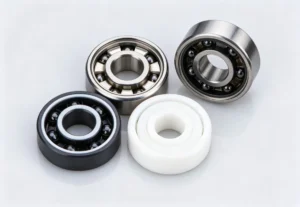
Your special application needs a special bearing, but ceramic options are confusing. You see huge price differences between white and black ones, leaving you unsure which to choose.
White (Zirconia) bearings are ideal for high-corrosion, low-to-moderate speed environments. Black (Silicon Nitride) bearings excel in high-speed, high-temperature, and extreme-precision applications. Your specific operating conditions and budget will determine the best choice for reliability and cost-effectiveness.
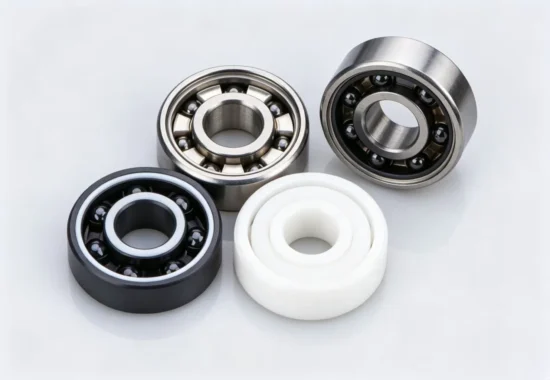
I've been in the bearing business since 1992, and one question comes up all the time. A purchasing manager calls, confused. They got quotes for the same size ceramic bearing, but one is a few hundred dollars and the other is a few thousand. When the samples arrive, one is white, the other is black. This confusion is exactly why we need to talk about the two main players in the ceramic bearing world: white Zirconia1 (ZrO2) and black Silicon Nitride2 (Si3N4). Let's break down the real-world differences so you can put your money where it counts.
Quick Decision Guide: Which Ceramic Bearing Do You Need?
Feeling overwhelmed by technical data sheets? You just need a quick, reliable answer for your machine. We get it. Let's make this simple.
For heavy corrosion and moderate speeds, choose white Zirconia. For extreme speed, high temperatures, or critical precision, black Silicon Nitride is your only real choice. This quick guide will help you pick the right one fast.
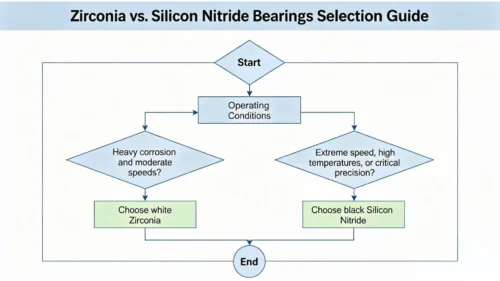
In our workshops, we have a simple saying that has saved our clients a lot of time and money: "Low-speed corrosion, choose white ceramic. High-speed high-temp, go for black ceramic." This isn't just a catchy phrase; it's based on the core properties of these materials. To make it even clearer, I've put together a simple table based on common applications we see every day. Think of this as your cheat sheet. Before you dive into the deeper technical details, see if your application fits into one of these common scenarios.
| Application Scenario | Key Challenge(s) | Our Recommendation | Why It Works Best |
|---|---|---|---|
| Chemical Pumps | Aggressive corrosion, low/mid RPM | Zirconia (White) | Excellent chemical resistance at a lower cost. High speed is not a factor. |
| Machine Tool Spindles | Extreme speed (RPM), high precision | Silicon Nitride (Black) | Low density reduces centrifugal force, ensuring cool operation and precision. |
| Vacuum Environments | No outgassing, non-magnetic | Either (Budget-Dependent) | Both are clean and non-magnetic. Choose based on speed/temp needs. |
| Medical MRI Equipment | Completely non-magnetic, clean | Zirconia (White) | Provides the necessary non-magnetic properties cost-effectively. |
Zirconia vs Silicon Nitride — What Key Differences Impact Your Purchase?
That white or black color isn't just for looks. It points to deep material differences that directly affect your machine's performance, lifespan, and final cost.
The key differences are density, hardness, and thermal expansion. Zirconia is denser and tougher, with thermal expansion similar to steel. Silicon Nitride is much lighter, harder, and extremely stable in changing temperatures, making it superior for high-speed use.
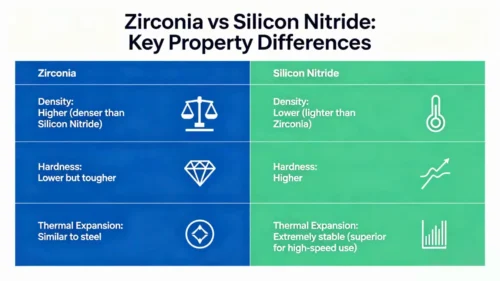
When you hold them in your hand, the first thing you notice is the weight. The white Zirconia1 ball feels heavy, substantial, like a little stone. We call it the "heavy infantry." The black Silicon Nitride2 ball feels surprisingly light for its size, almost like a high-tech plastic. It's our "light cavalry." This simple physical difference is the starting point for understanding why they perform so differently under pressure. Let's break down the three properties that matter most for you as a buyer.
Density and Speed: The Lighter, The Faster
- Zirconia (ZrO2): Has a density of about 6.0 g/cm³. This is quite heavy, close to the density of steel.
- Silicon Nitride (Si3N4): Has a density of only 3.2 g/cm³. That's less than half the weight of steel or Zirconia.
When a bearing spins, the balls are pushed outward by centrifugal force. The heavier the ball, the greater the force. This force creates friction and heat, which are the enemies of high-speed performance. Because Silicon Nitride2 balls are so light, they generate very little centrifugal force, allowing them to spin at incredible speeds without overheating. This makes them the absolute best choice for applications like CNC machine spindles and electric vehicle motors.
Hardness vs. Toughness: Resisting Wear vs. Resisting Impact
- Zirconia (ZrO2): In the world of ceramics, Zirconia is known for its high fracture toughness. Simply put, it's "less brittle" than other ceramics. It can handle minor shocks and vibrations without cracking.
- Silicon Nitride (Si3N4): This material is extremely hard, much harder than Zirconia on the Rockwell scale. This hardness makes it incredibly resistant to wear and helps it maintain its precise shape for a long time.
Think of it like this: if your machine has some light vibration when it starts up, the toughness of Zirconia1 is a benefit. But if your main goal is to maintain perfect dimensional stability3 and resist abrasive wear4 over millions of cycles, the superior hardness5 of Silicon Nitride2 is what you need.
Thermal Expansion: Staying Stable When Things Heat Up
- Zirconia (ZrO2): Its thermal expansion coefficient is about 10.5 x 10⁻⁶/°C. This is very close to steel. This is a huge advantage when fitting a ceramic bearing onto a steel shaft, as they will expand and contract together, preventing the bearing from becoming loose or seizing up. Its temperature limit is around 400°C.
- Silicon Nitride (Si3N4): It has a very low thermal expansion coefficient of about 3.2 x 10⁻⁶/°C. It barely changes size, even with dramatic temperature swings. This dimensional stability is critical in precision applications. It can also withstand temperatures over 800°C.
Which Material Is Right for Your Application?
Theory is great, but how does this apply to the machines on your factory floor? Let's walk through some common industrial scenarios I've seen over the years.
For chemical pumps, Zirconia is a cost-effective corrosion fighter. For high-precision machine spindles, Silicon Nitride is non-negotiable. For clean, non-magnetic needs like in semiconductor manufacturing, your budget might be the deciding factor between the two.
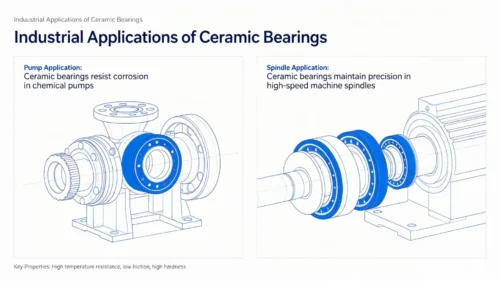
Choosing the right material is about matching the properties to the problem you're trying to solve. You wouldn't use a race car to haul gravel, and you wouldn't use a dump truck to win a race. The same logic applies here. Picking the right ceramic bearing means you get the performance you need without paying for features you'll never use. Let’s look at three distinct situations.
Scenario 1: The Corrosion Fighter (Chemical Pumps, Plating Lines)
In these environments, the number one enemy is corrosion from harsh chemicals. The bearings are often fully submerged and run at relatively low to medium speeds. Here, a full Zirconia (ZrO2) bearing is the perfect hero. It offers fantastic resistance to acids and alkalis, and its higher toughness handles the operational vibrations of a pump well. Speed is not a concern, so the higher density6 of Zirconia1 is irrelevant. Using a more expensive Silicon Nitride2 bearing here would be a waste of money, as its high-speed capabilities would never be used.
Scenario 2: The Speed Demon (Machine Tool Spindles, EV Motors)
Here, the game is all about speed and precision. A machine tool spindle can spin at tens of thousands of RPM. At these speeds, even tiny amounts of heat or wear can ruin a workpiece or cause catastrophic failure. This is where a Silicon Nitride (Si3N4) hybrid bearing (ceramic balls with steel rings) is the only choice. Its lightweight balls minimize heat-generating centrifugal force. Its extreme hardness5 prevents wear, maintaining precision for longer. The dimensional stability3 ensures performance doesn't change as the spindle warms up. Using Zirconia1 here would lead to rapid overheating and failure.
Scenario 3: The Specialist (Vacuum, MRI, Semiconductor)
In these applications, the key requirements are often non-magnetic properties and cleanliness (no lubrication or outgassing). Both Zirconia and Silicon Nitride2 excel here. So how do you choose? It comes down to the other operating conditions. If the application is low-speed and room temperature, a Zirconia bearing does the job perfectly and saves you money. If there are also high-speed or high-temperature requirements within that clean environment, you'll need to step up to Silicon Nitride to ensure reliability.
Cost vs Performance — Is Silicon Nitride Worth the Extra Price?
You see the high price tag on black ceramic bearings7 and hesitate. Is the performance boost really worth that much more than the white ones?
Silicon Nitride's higher price is due to complex manufacturing. It is absolutely worth it when standard or Zirconia bearings fail prematurely due to speed or heat, causing expensive downtime. The investment pays for itself through reliability and longer machine life.
Nobody wants to spend more than they have to. The initial cost of a Silicon Nitride bearing can be many times that of a Zirconia bearing. This price difference comes from more expensive raw materials and a much more difficult, energy-intensive manufacturing process called sintering. But focusing only on the purchase price is a big mistake. You have to think about the Total Cost of Ownership8 (TCO). Imagine a critical machine spindle that costs $5,000 per hour in downtime. A cheaper bearing that fails every three months will cost you far more in lost production and labor than a premium bearing that runs flawlessly for two years. In high-performance applications, the higher initial cost of Silicon Nitride is not an expense; it's an investment in uptime.
| Factor | Zirconia (ZrO2) | Silicon Nitride (Si3N4) |
|---|---|---|
| Initial Cost | Lower | Significantly Higher |
| Lifespan (High Speed) | Short | Very Long |
| Downtime Risk | Higher | Much Lower |
| TCO in Demanding Apps | Can become very high | Often the lowest option |
What Are the Common Mistakes Buyers Make?
Choosing the wrong ceramic bearing can be a very costly mistake. Over my 30 years in this industry, I've seen buyers fall into the same few traps over and over again.
The most common mistakes are choosing based on price alone, over-specifying for a simple job (paying for performance you don't need), and under-specifying for a demanding one (causing quick failure). Another is ignoring the cage material.
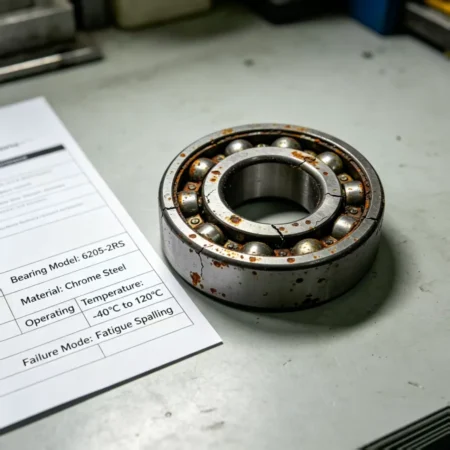
A little knowledge can prevent a lot of headaches down the road. By being aware of these common errors, you can ensure you make a smart, cost-effective decision for your company. Let's look at the top three mistakes I see buyers make.
Mistake 1: The "Cheapest is Best" Fallacy
This is the most common trap. A buyer sees two bearings that fit, and one is 80% cheaper. They choose the cheaper one without considering the application. Putting a Zirconia bearing in a high-speed spindle because it was cheaper is a recipe for disaster. It will fail, and the cost of the downtime and repair will dwarf the initial "savings." Always match the material to the demand, not the price tag.
Mistake 2: Paying for a Supercar to Go Grocery Shopping
The opposite mistake is also common. A buyer might hear that black ceramic bearings are "the best" and decide to use them everywhere. Using a high-performance Silicon Nitride bearing in a slow-moving, corrosive chemical pump is complete overkill. A Zirconia bearing would perform perfectly for years in that environment at a fraction of the cost. Don't pay for performance capabilities your machine will never use.
Mistake 3: Forgetting About the Cage
The balls get all the attention, but the cage that holds them is just as important. The cage material must be compatible with the application's temperature and chemical environment. A standard steel cage will corrode in a chemical pump. A nylon cage will melt at high temperatures. Always discuss the cage material9 (e.g., PEEK, PTFE, or Stainless Steel) with your supplier to ensure the entire bearing assembly is right for the job.
How Do You Choose a Reliable Ceramic Bearing Supplier?
The right material is only half the battle. Your supplier's expertise and manufacturing capability are crucial for getting the performance and reliability you paid for.
A reliable supplier is a partner, not just a seller. Look for manufacturers with in-house production, deep material knowledge, OEM/ODM capabilities, and a commitment to understanding your application before recommending a solution.
When you buy a specialized component like a ceramic bearing, you're not just buying a part; you're buying a solution to a problem. A box-shifter who just sells from a catalog can't help you solve that problem. You need a partner with deep engineering knowledge and control over their product quality. At Yuanguang Bearing, we've built our business on this principle since 1992. Here’s what you should look for in any supplier.
Look for True Manufacturing Capability
Many suppliers are just trading companies. They don't make anything. This means they have no control over quality. We have our own casting foundry, processing workshops, and bearing assembly plants. This vertical integration means we control every step of the process, from raw material to the final finished bearing. This is how we guarantee quality and can offer custom OEM/ODM solutions.
Prioritize Technical Support and Partnership
A good supplier will ask you more questions than you ask them. They should want to know about your RPM, loads, temperatures, and operating environment. Their goal should be to help you find the most effective solution, not just sell you the most expensive product. They should be able to explain why one material is better than another for your specific needs.
Check for OEM/ODM Experience
The ability to provide custom-made (OEM/ODM) solutions is a clear sign of a supplier's technical expertise and manufacturing flexibility. It shows they can move beyond standard catalog items and engineer a bearing specifically for a customer's unique challenge. This level of service indicates a deep understanding of bearing technology and a commitment to solving customer problems.
FAQ
Zirconia vs Silicon Nitride cost difference?
Silicon Nitride (black) is significantly more expensive than Zirconia (white). This is due to higher raw material costs and a much more complex and energy-intensive manufacturing process required to achieve its superior properties.
Which ceramic bearing lasts longer?
It completely depends on the application. In high-speed, high-temperature, or high-wear applications, Silicon Nitride will last dramatically longer. In low-speed, highly corrosive environments, a Zirconia bearing is designed to last a very long time.
Are black ceramic bearings always better?
No. They are only "better" in applications that demand their specific properties, like extreme speed or heat resistance. For many common industrial applications involving corrosion or moderate speeds, white Zirconia is the more appropriate and cost-effective choice.
Can Zirconia be used in high-speed applications?
It is not recommended. Its high density creates strong centrifugal forces at high RPMs, which leads to excessive friction, heat buildup, and premature failure. Zirconia is best suited for low-to-moderate speed applications.
Ready to Find the Perfect Ceramic Bearing?
Stop guessing and start getting results. Let our 30 years of manufacturing experience work for you. Tell us about your application, and we'll help you find the most reliable and cost-effective bearing solution.
Send Your Application Details → Get a Free Material Recommendation in 12 Hours
Conclusion
Remember our simple rule: "Low-speed corrosion, choose white Zirconia; high-speed high-temp, go for black Silicon Nitride." Matching the right material to your job is the key to performance and saving money.
Explore the advantages of Zirconia bearings for corrosion resistance and cost-effectiveness. ↩
Learn why Silicon Nitride is preferred for high-speed and high-temperature applications. ↩
Learn why dimensional stability is critical for precision applications. ↩
Discover how ceramic bearings maintain their shape and performance over time. ↩
Discover why hardness is crucial for wear resistance in bearings. ↩
Explore how the density of materials influences bearing performance and longevity. ↩
Discover the various types of ceramic bearings and their specific applications. ↩
Understand how TCO impacts the long-term value of bearing investments. ↩
Learn about the significance of cage material in ensuring bearing reliability. ↩