Your bearing is rated for 250°C. So why did it fail at 180°C? High Temperature Bearings live or die by more than a catalog number. The problem is not just “heat.” It is how heat multiplies the effects of load, speed, clearance, lubrication, cage design, and sealing. I will show you how to choose and verify the right solution.
High Temperature Bearings are engineered to run continuously above 120°C using heat‑stabilized materials, proper internal clearance (C3–C5), high‑temp lubricants or solid films, and seals that survive heat and contamination. Selection hinges on temperature class, speed/load, environment, and housings. Verify the continuous operating temperature, not just the maximum rating.
The short answer hides a lot of nuance. Below, I answer what makes a bearing truly “high temperature,” how heat actually causes failure, and how maximum temperature differs from continuous operating temperature. I also include materials and lubrication matrices, application parameters, and a fault diagnosis table you can use on the shop floor.
1. What Makes a Bearing Suitable for High-Temperature Applications?
You expect a hot zone bearing to “just survive.” But survival requires design choices that anticipate heat expansion, lubricant life, and cage stability. Without those, High Temperature Bearings lose clearance, run dry, and fail early.
The essentials are: heat‑stabilized rings, extra internal clearance, cages that do not embrittle, lubricants that do not carbonize, and seals that keep heat and dust in check. Dimensional stability and re‑lube strategy complete the picture.
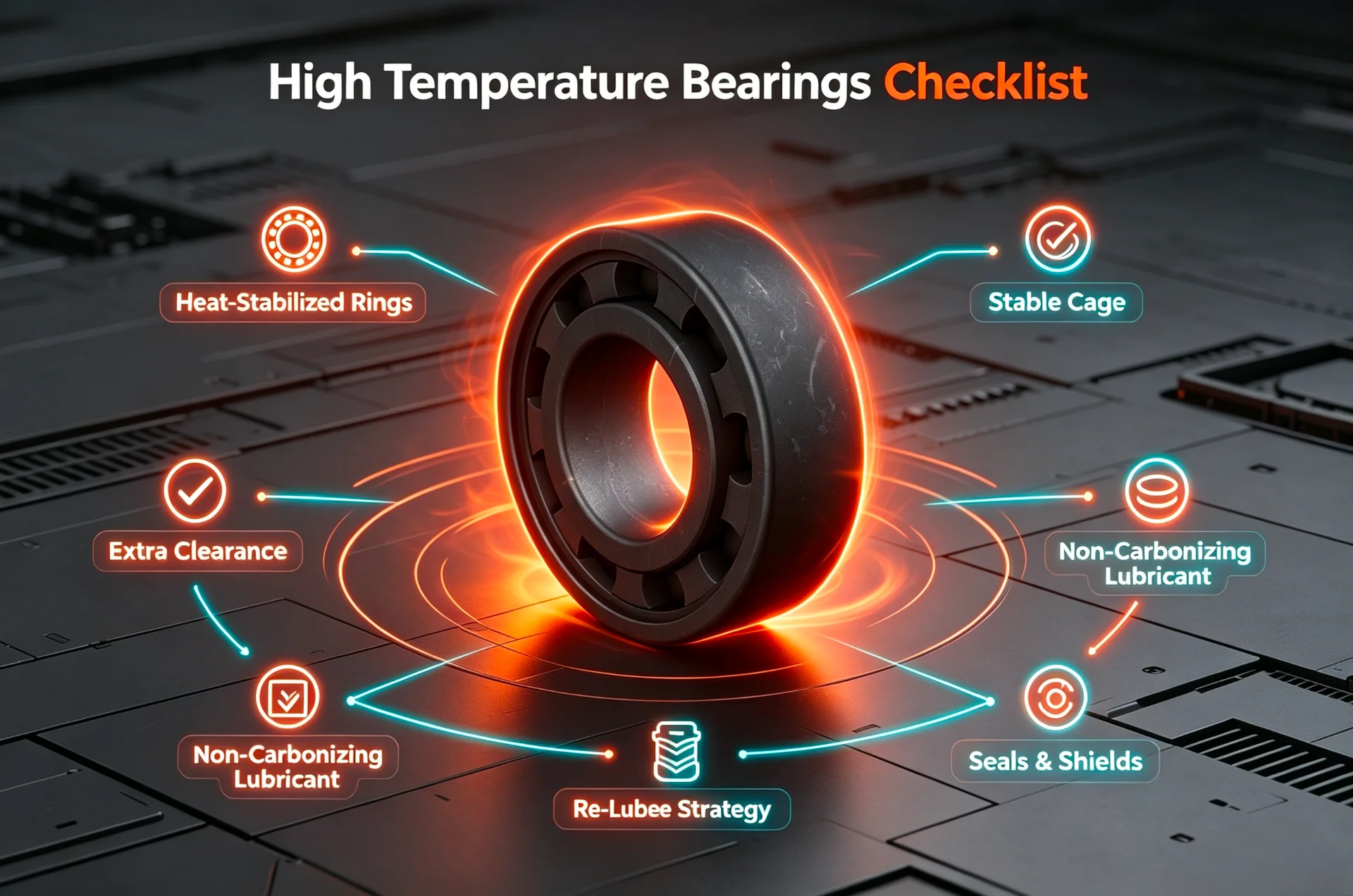
The must-have features
- Heat-stabilized rings: Rings that retain hardness and size at temperature. Common levels: S0 (~150°C), S1 (~200°C), S2 (~250°C), S3 (~300°C+).1 Always verify the class with your supplier’s certificate.
- Internal clearance: Larger clearance offsets thermal expansion. Typical recommendations:
- ≤100°C: CN/C2
- 100–150°C: C3
- 150–250°C: C4
-
250°C: C5 or custom
- Cages: Choose brass (machined), steel (machined), or PEEK for mid‑range heat. Avoid light-gauge steel cages in severe cycling; consider full complement when speed is low and load is high.
- Lubrication: Polyurea or PFPE greases for 180–260°C, ester/PAO synthetics for mid ranges, and solid lubricants (graphite/MoS2) or solid-impregnated bushings above 300–350°C where grease fails.
- Seals and shields: Metal shields or labyrinth seals are preferred above 180°C. Elastomeric seals must be FKM/FFKM at minimum; verify thermal class. In dusty kilns, use multi‑stage labyrinths.
- Surface treatments: Nitriding, carbo‑nitriding, or coatings (e.g., DLC) can raise scuffing resistance and reduce adhesive wear when lubrication thins out.
- Housings: For pillow block bearings, use heat‑dissipating or insulated housings with labyrinth end caps; plan expansion joints and thermal isolation spacers.
A quick suitability checklist
- Dimensional stability certificate (S1–S3) available?
- Clearance set for peak temperature?
- Cage material rated above your peak soak?
- Lubricant useful temperature exceeds continuous operating temperature by 20–40°C margin?
- Seals compatible with heat and environment (dust, steam, chemicals)?
- Speed derating applied (n·dm limit reduced at temperature2)?
I learned this the hard way in a glass line audit: a “250°C max” bearing survived only 6 weeks because clearance was CN, grease was lithium (drop point high, life low), and the stamped cage embrittled. The replacement with S2 rings, C4, PFPE grease, and a brass cage ran the entire season.
2. How Does High Temperature Cause Bearing Failure?
It is not just heat. High temperature changes material behavior, lubricant chemistry, and internal geometry at the same time. That is why High Temperature Bearings fail below their “max rating.”
Heat drives clearance to zero, softens rings, carbonizes grease, collapses film thickness, and accelerates oxidation and creep. Once dry friction starts, micro‑welding and spalling follow fast, often misdiagnosed as “overload.”
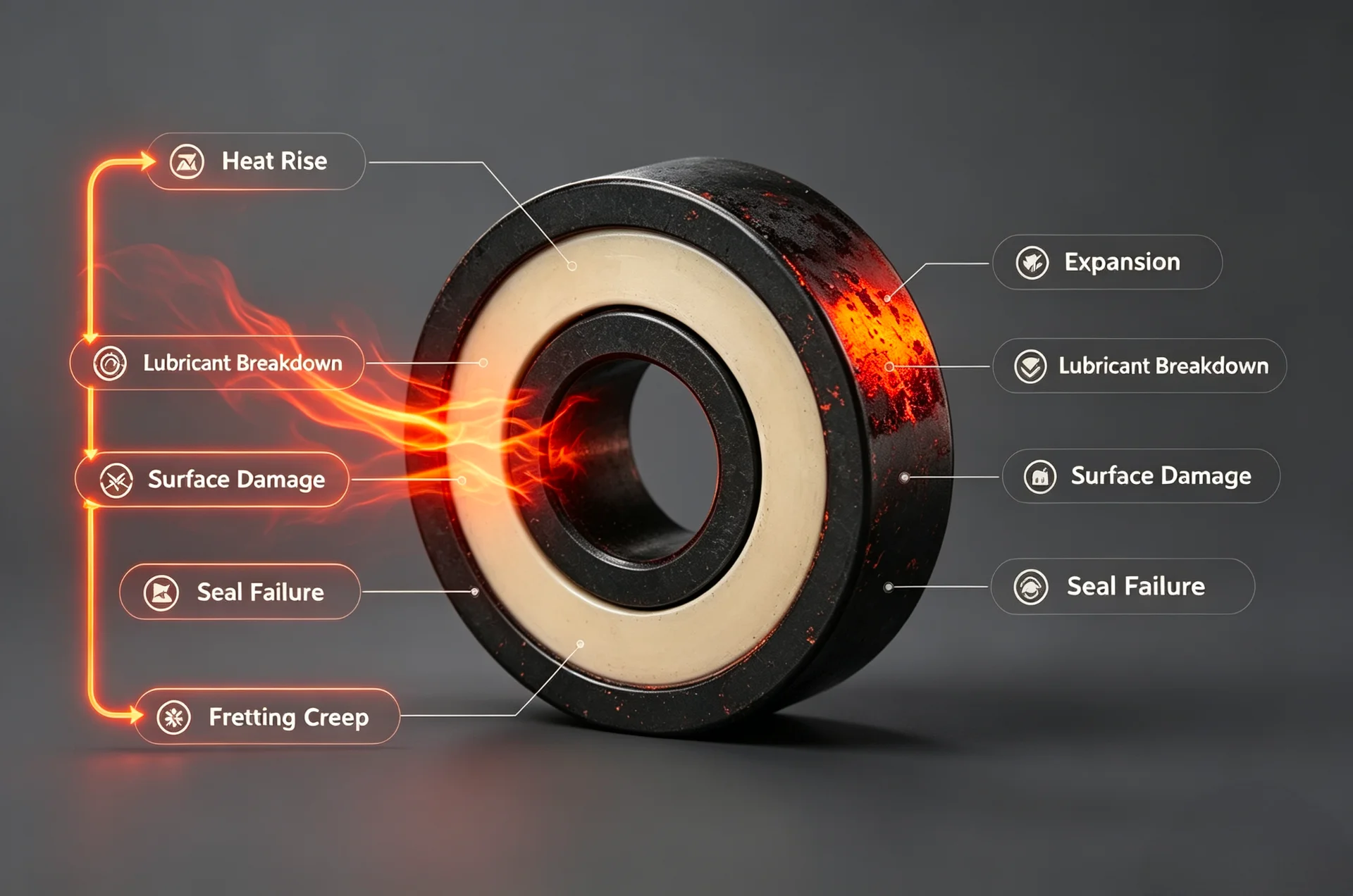
Primary failure mechanisms
- Thermal expansion mismatch:
- Inner ring on a hot shaft expands more than the outer ring in a cooler housing.
- Result: clearance collapse, boundary contact, rapid temperature rise, seizure.
- Lubricant oxidation and carbonization:
- Standard lithium greases oxidize above ~120°C and carbonize above ~150°C.
- PFPE and select polyurea greases last longer, but still age by Arrhenius kinetics (life halves every ~10°C rise).
- Softening/tempering of steel:
- Cage degradation:
- Light-gauge steel loses strength; polymer cages (non-PEEK) creep; brass and machined steel resist better. At very high temperature, go full complement.
- Surface distress:
- Seal failure:
- NBR hardens, cracks; grease leaks or burns off; contamination ingresses.
- Creep and fretting:
- Loose fits expand further with heat; micro‑slip at seats creates red/brown fretting and noise.
Telltale symptoms and likely causes
- Blue/purple discoloration: overheating, zero clearance, dry running.
- Dry, coked residue: grease carbonization; wrong thickener/base oil.
- Cage fracture: embrittlement or seized rolling elements.
- Spalling with shallow pits: poor film, hardness loss.
- Polished tracks with dark smears: boundary friction, scuffing.
- Red/brown powder at fits: fretting due to loose fit + thermal cycles.
A real case: a glass conveyor pillow block at ~190°C housing temperature failed in 2 months. Autopsy showed dry, carbonized grease, cracked cage, and spalled raceways. Root causes: CN clearance, standard lithium grease, light-gauge cage. Fixes: C4 clearance, S2‑stabilized rings, PFPE grease, brass cage, and a labyrinth. Uptime increased 5×.
3. Maximum Temperature vs. Operating Temperature: What’s the Difference?
A catalog can state “max temperature 300°C.” But High Temperature Bearings rarely survive long at that temperature continuously. Maximum means short‑term survivability; continuous operating temperature means the range where you can expect a predictable life.
Always size for continuous operating temperature, derate for speed/load, and leave margin for excursions. Verify both the bearing and grease continuous ratings.
Key concept
Maximum Temperature ≠ Continuous Operating Temperature. Real life depends on:
- Temperature, speed, load
- Lubrication type and film thickness
- Internal clearance
- Cage material
- Ring material and heat stabilization
- Sealing and environment (dust, steam, corrosives)
How hot can they really go?
Use this as a starting point and verify with your supplier’s data and test certificates.
| Bearing class/configuration | Typical continuous operating temperature | Short-term maximum | Notes |
|---|---|---|---|
| Standard 52100 (GCr15) + lithium grease | ≤100°C | 120–150°C | Beyond 120°C, grease life collapses. |
| 52100 stabilized S1/S2 + polyurea/PFPE | 150–230°C | 250–270°C | Needs C3–C4 clearance; brass/PEEK cage recommended. |
| High-temp alloy (e.g., M50) + PFPE | 230–315°C | 330–350°C | Aerospace roots; verify hardness retention. |
| Stainless 440C/9Cr18Mo (stabilized) + PFPE | 180–250°C | 270–300°C | Gains corrosion resistance, modest heat. |
| Hybrid ceramic (Si3N4 balls + steel rings) + PFPE | 200–350°C | 380°C | Lower thermal growth, better EHL; steel ring stability still limits. |
| Full ceramic (Si3N4) + solid lubricant | 500–800°C | 900°C | Low load/speed preferred; no grease. |
| Specialty ceramics/graphite or composite bearings | 800–1200°C+ | 1200°C+ | Niche designs; often low speed, harsh environments. |
Important: grease life halves for every 10–15°C increase (Arrhenius rule)5. A bearing “rated” for 260°C with PFPE may need frequent relubrication or solid lubrication at ≥240°C.
Speed derating with temperature
As temperature rises, permissible speed falls because:
- Viscosity drops, film thins (λ ratio falls).
- Grease churn heat accelerates. Rule of thumb: for each 50°C above baseline, reduce catalog speed limit by 20–30% (×0.7–0.8)6. Always compute n·dm and confirm with supplier.
4. High-Temperature Bearing Materials: Steel, Stainless Steel and Ceramic
Material makes or breaks High Temperature Bearings. The wrong steel softens; the wrong stainless smears; the wrong ceramic chips. You need hardness at temperature and compatible thermal expansion.
Pick steels for load and cost, stainless for corrosion at moderate heat, and ceramics for extreme temperatures or high-speed hybrids.
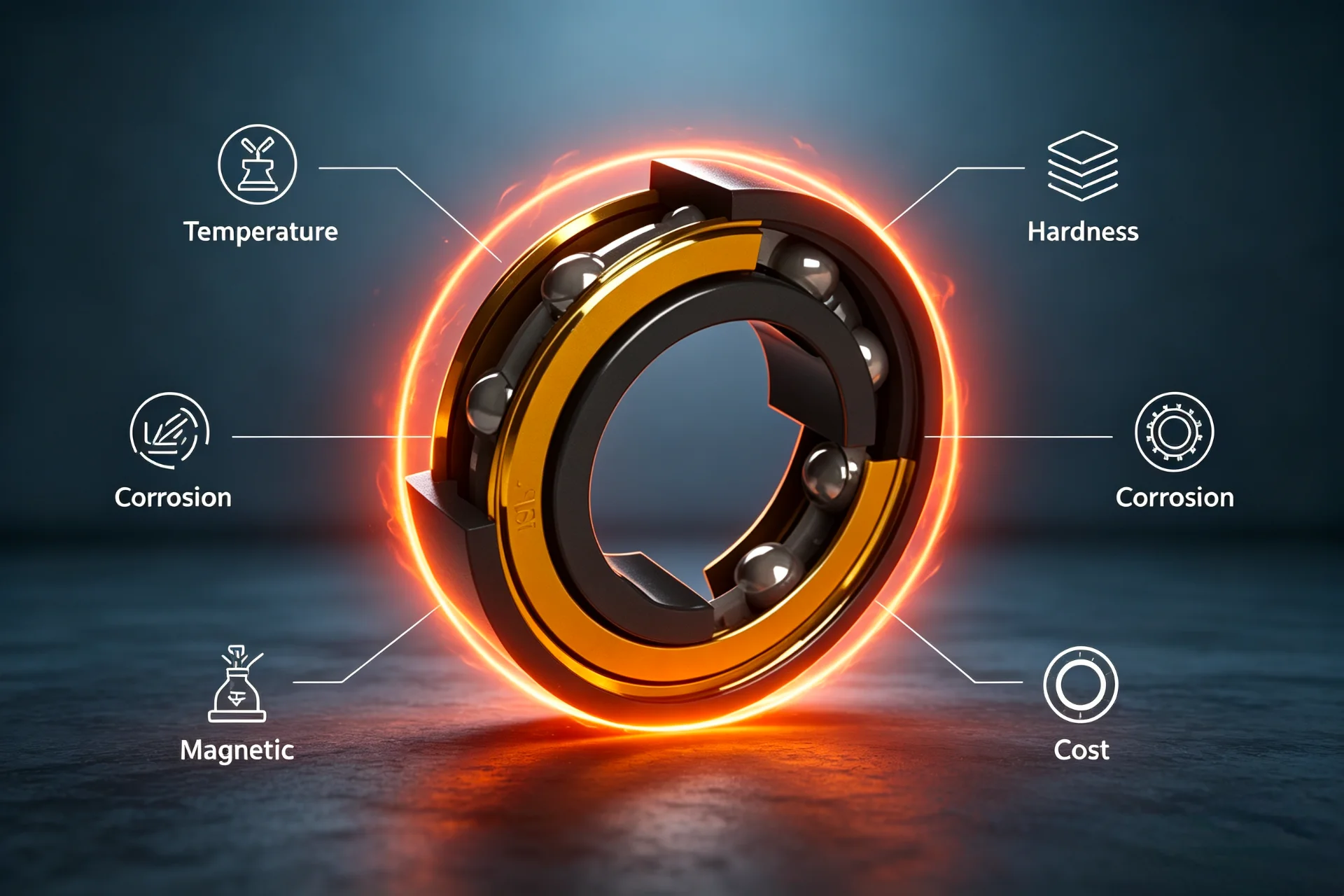
Materials selection matrix
| Material | Typical continuous temp | Hardness retention at temp | Corrosion | Magnetic | Cost | Notes |
|---|---|---|---|---|---|---|
| 52100/GCr15 (stabilized) | 150–230°C | Moderate (drops above 200°C) | Low | Yes | $ | Most economical; needs S1–S2 stabilization. |
| GCr15SiMn (stabilized) | 180–250°C | Better than 52100 | Low | Yes | $$ | Improved dimensional stability. |
| M50 (AISI M50)7 | 230–315°C | High (aerospace grade) | Low | Yes | $$$ | Excellent hot hardness, fatigue. |
| 440C/9Cr18Mo (stabilized) | 180–250°C | Moderate | Good | Yes | $$ | For combined heat + corrosion. |
| Austenitic SS (304/316) | ≤150°C | Low (soft) | Excellent | Non | $$ | Used for specialty, low-load bearings. |
| Si3N4 ceramic (full or balls) | 500–800°C (full) | Excellent | Excellent | Non | $$$$ | Full ceramic for extreme heat; hybrid reduces mass and thermal growth. |
| ZrO2 ceramic | 300–500°C | Good | Excellent | Non | $$$$ | Better toughness, lower temp ceiling than Si3N4. |
Temperature “tiers” you can plan with
- 150–300°C (foundation tier):
- Materials: stabilized bearing steel (GCr15), sometimes 440C.
- Use C3–C4 clearance, polyurea or PFPE grease, brass/PEEK cage.
- Typical: baking ovens, paint curing lines, textile dryers.
- 300–500°C (advanced tier):
- Materials: high-temp alloy steels (M50), stabilized stainless in corrosive zones.
- Full complement rollers for load; graphite/MoS2 solid lubrication for ≥350°C.
- Typical: steel continuous casting, kiln car wheels, petrochemical cracking.
- 500–800°C (premium tier):
- Materials: special alloy rings with nitriding, hybrids or full ceramics where load allows.
- Double labyrinth seals; no grease; solid films or impregnated carriers.
- Typical: glass melting forehearth drives, some turbine auxiliaries.
- 800–1200°C+ (extreme tier):
- Materials: full ceramic (Si3N4), specialty composites.
- Applications: rocket turbomachinery (short duty), SOFC stacks, fusion experiment fixtures.
Pro tip: hybrid ceramic bearings (Si3N4 balls + steel rings) excel in mid‑high temperature with high speed. The balls run cooler, need less lubrication, and reduce thermal growth. But ring stability still caps the temperature.
5. High-Temperature Bearing Lubrication: Grease, Oil and Solid Lubricants
Most “high-temp” failures are lubrication failures. This is where High Temperature Bearings succeed or fail. Dropping point is not service life. Choose grease by base oil volatility and oxidation resistance, thickener chemistry, and additive system. Above ~260–300°C, think solid lubrication.
Grease life halves with every 10–15°C increase. If you cannot re-lube, you need either PFPE or a solid lubricant system with conservative speeds.
Grease choices at a glance
| Grease type | Useful continuous temp | Notes and typical use |
|---|---|---|
| Lithium soap (mineral) | ≤100–120°C | General purpose; not for high temp. |
| Complex lithium | ≤140–160°C | Light high-temp duty; frequent re-lube. |
| Polyurea (PAO/ester) | 150–180°C | Motors, ovens; better oxidation life. |
| Ester synthetic (diester/polyol ester) | 160–200°C | Good film at temp; watch hydrolysis. |
| PFPE (perfluoropolyether) + PTFE | 220–260°C | Premium; inert; food-grade H1 options exist; costly. |
| Silicone grease | 150–200°C | Stable viscosity; low load capacity. |
| Solid lubricants (MoS2, graphite) | 300–800°C | For grease-free operation; needs compatible surfaces. |
Notes:
- Dropping point ≠ service temperature. Many greases drop at 250–300°C but lose life far earlier.
- PFPE stands out for oxidative stability and low volatility at high temp. Pair with PTFE thickener for inert systems.
- Food contact (H1) ovens: use H1 polyurea or H1 PFPE where required.
Oil vs grease vs solid
- Oil circulation:
- Pros: heat removal, filtration, stable viscosity (with synthetics).
- Cons: plumbing complexity; leaks at high temp; contamination risk in food lines.
- Grease:
- Pros: simple, sealed, lower maintenance.
- Cons: finite life; churning heat at speed; requires re-lube access.
- Solid lubrication:
- Pros: survives where oils/greases burn; clean; can work in vacuum.
- Cons: lower speed/load envelope; startup friction higher; requires surface prep.
Film thickness and speed
As temperature rises, base oil viscosity falls, reducing EHL film. Aim for λ (film thickness / composite roughness) ≥1.0 for mixed/≥3.0 for full film8. If λ drops, consider:
- Higher viscosity base oil (synthetic esters or PFPE grades).
- Reduced speed (n·dm).
- Hybrid ceramic rolling elements to reduce heat generation.
- Surface polishing and coatings to cope with mixed lubrication.
Relubrication guidance
- Arrhenius rule: grease life halves with each 10–15°C increase.
- Practical tip: if a grease is rated L10 life of 2,000 h at 150°C, expect ~1,000 h at ~165°C and ~500 h at ~180°C, all else equal.
- For pillow block bearings in ovens at 200°C with PFPE: start with 1–2 week intervals, confirm by condition checks, and extend cautiously.
6. Types of High Temperature Bearings and When to Use Them
Not all designs behave the same in heat. The best High Temperature Bearings for you depend on load, speed, misalignment, and contamination. Full complement rollers thrive in slow, hot, heavy loads. Deep groove balls run faster with lower load.
Use a type that tolerates your thermal movement and sealing scheme.
Common types and selection hints
| Type | Strengths | Watch-outs | Heat-friendly options |
|---|---|---|---|
| Deep groove ball | Simple, low friction, moderate speed | Limited misalignment and heavy load | Hybrid ceramic balls; brass cage; C3–C4; PFPE |
| Angular contact ball | High speed, axial load capacity | Preload changes with heat | Duplex with controlled preload; hybrids |
| Self-aligning ball | Handles misalignment | Lower load | Heat-stabilized rings; brass cage |
| Cylindrical roller | High radial load, separable | Axial capacity limited (NJ/NUP types vary) | Full complement for slow/hot; steel/brass cage |
| Spherical roller | Heavy load, misalignment | More heat from sliding | Brass cage; C4–C5; solid lubrication options |
| Needle roller | Compact, high load | Sensitive to lubrication | Full complement; solid lube at slow speed |
| Full ceramic (ball) | Extreme heat/corrosion | Lower toughness; cost | Solid lubricant; moderate load/speed |
| Hybrid ceramic | High speed, cooler running | Ring stability still limits temp | PFPE; brass cage; precision preload |
| Pillow block (plummer) | Easy mounting, sealing options | Housing heat soak | Labyrinth caps; insulated spacers; high-temp inserts |
Pillow block bearings (our specialty)
For hot conveyors, kilns, and ovens:
- Use high-temperature inserts with:
- Heat-stabilized rings (S1–S3)
- C4 or C5 clearance
- Brass cage
- PFPE grease or solid-lube insert
- Housings:
- Cast iron or ductile iron with heat-dissipating fins
- Multi-stage labyrinth end caps
- Thermal isolation shims to protect the housing and grease
- Mounting:
- Use expansion (EX) and fixed (FX) positions to manage thermal growth
- Set screw vs eccentric: choose based on vibration and direction; tapered adapter for heavy load
I often recommend split plummer blocks with labyrinths for steel mill rollers. They give you inspection access and better sealing while tolerating expansion.
7. How to Choose the Right High Temperature Bearing for Your Application?
Selection is not a single number. It is temperature plus speed plus load, wrapped in lubrication and sealing choices. The right High Temperature Bearings balance clearance, material, cage, and lubricant life.
Start with your real continuous operating temperature, not the “max.” Then derate speed, choose clearance, and validate lubricant life.
High Temperature Bearings Selection Workflow
Choosing a high-temperature bearing requires more than checking the temperature rating. Follow these 9 key steps to build the right bearing solution.
🌡️ 01 — Define Temperature
Shaft → Housing → Ambient → Worst-Case Soak
Use the continuous operating temperature as the design basis.
⚙️ 02 — Set Internal Clearance
Higher temperature → Greater thermal expansion → Larger clearance
At around 190°C housing temperature with a hotter shaft, C4 is a common starting point.
🔧 03 — Choose Bearing Materials
| Temperature | Recommended Starting Point |
|---|---|
| ≤230°C | Stabilized 52100 / 440C |
| 230–315°C | M50 / Hybrid Ceramic |
| >350°C | Hybrid / Full Ceramic* |
*Subject to load and application conditions.
🛡️ 04 — Select Cage & Seals
Cage: Brass / Machined Steel / PEEK
Sealing: Metal Shields / Labyrinth / FKM / FFKM
Above 180°C, avoid conventional NBR seals.
🛢️ 05 — Select Lubrication
| Temperature | Lubrication |
|---|---|
| ≤200°C | Polyurea / Ester Synthetics |
| 200–260°C | PFPE |
| >300°C | Solid Lubrication Systems |
For food applications, confirm food-grade requirements.
🚀 06 — Derate Speed
Calculate the bearing n·dm value and account for temperature-related speed reduction.
Higher temperature + higher speed = greater heat generation
As a preliminary guideline, consider a 0.7–0.8 speed factor for each +50°C above the baseline.
📊 07 — Check Load & L10h Life
Verify:
Dynamic Load Capacity → Hardness Retention → Load → L10h Life
High temperature and lubricant degradation can significantly reduce actual bearing life.
🏭 08 — Check Housing & Mounting
Consider:
- Fixed / expansion arrangements
- Thermal expansion relief
- Isolation spacers
- Heat shields
- Housing heat dissipation
For pillow block bearings, housing design can strongly affect operating temperature.
✅ 09 — Validate Before Production
Material Certificate + Stabilization Certificate + Lubricant Datasheet + Pilot Test
Monitor:
Temperature → Vibration → Noise → Lubrication → Bearing Condition
The Selection Logic
Temperature → Clearance → Material → Cage & Seals → Lubrication → Speed → Load & Life → Housing → Validation
The right high-temperature bearing is not determined by temperature alone. The complete operating system must be evaluated.
Worked example: automotive glass conveyor
- Conditions:
- Ambient ~30°C (summer), glass ~590°C, cast plate ~350°C, bearing housing ~190°C
- Load: medium; Speed: low to moderate; Environment: hot dust
- Failures observed: grease carbonization, cage cracking, raceway spalling within 2 months
- Root causes: CN clearance, lithium grease, light-gauge cage, inadequate seals
- Solution:
- Bearing: heat-stabilized S2 rings, C4 clearance, brass cage
- Lubrication: PFPE grease (H1 optional), conservative re-lube interval
- Sealing: double labyrinth end caps
- Housing: pillow block with thermal isolation shim; expansion/fixed pairing
- Speed: verified n·dm below derated limit
- Outcome: multi-month reliability (5× improvement observed in similar lines). Always validate on-site.
Quick parameter heuristics
- If T ≥ 200°C and speed moderate: PFPE + brass cage + C4.
- If T ≥ 300°C and speed low: full complement rollers + solid lube + C5.
- If heavy dust: prioritize labyrinth and purgeable seals over contact seals.
8. High Temperature Bearing Applications, Failure Diagnosis and FAQs
Applications vary wildly—from clean bakery ovens to abrasive steel mills. The best High Temperature Bearings align with your specific temperature, load, and environment profile. Diagnosis tools close the loop when things go wrong.
Use the profiles below as starting points and verify on your line.
Application profiles
-
Steel mill (continuous casting)
- Temperature: 200–400°C
- Load: heavy
- Environment: dusty, wet scale
- Main challenge: heat + contamination
- Guidance: spherical/cylindrical rollers, full complement in slow zones, brass cage, solid lube ≥300°C, split plummer blocks with multi‑stage labyrinths.
-
Bakery oven conveyor
- Temperature: 150–250°C
- Load: light to medium
- Environment: clean, food contact constraints
- Main challenge: continuous heat + long grease life
- Guidance: deep groove ball in pillow blocks with S1/S2 stabilization, C3–C4 clearance, H1 polyurea or H1 PFPE grease, metal shields.
-
Kiln car / ceramics
- Temperature: 300°C+
- Load: medium to heavy
- Environment: heat + dust, limited re-lube access
- Main challenge: lubrication difficulty
- Guidance: full complement cylindrical/spherical rollers, solid lubricants (graphite/MoS2), C5 clearance, thick labyrinth seals, expansion provision.
-
Glass manufacturing conveyors
- Temperature: up to ~190°C at housing (higher near product)
- Load: medium
- Environment: fine dust + radiant heat
- Guidance: S2 rings, C4 clearance, brass cage, PFPE grease, labyrinths, thermal shims in pillow blocks.
-
Petrochemical cracking units
- Temperature: 300–500°C zones
- Load: medium
- Environment: corrosive vapors
- Guidance: stabilized stainless or M50 with solid lube; non-elastomeric seals; consider hybrid ceramics where speed is moderate.
Fault diagnosis table
| Symptom | Likely cause(s) | Corrective action |
|---|---|---|
| Blue/purple rings, seized | Clearance collapse; excessive preload; speed too high for temp | Increase clearance (C4/C5); add expansion joint; derate speed; improve cooling. |
| Dry, black/coked residue | Grease carbonization; wrong thickener/base oil | Switch to PFPE or solid lube; shorten re-lube interval; add labyrinths. |
| Cage cracked or missing pieces | Embrittlement; heat-induced stress; seizure | Use brass/machined cage; ensure proper clearance; reduce speed; verify alignment. |
| Shallow spalling, pitting | Reduced hardness at temp; poor film | Heat-stabilized rings; higher viscosity/premium grease; hybrids; polish raceways. |
| Red/brown dust at fits | Fretting due to loose fit + thermal cycles | Tighten fits; use adhesives/sleeves; provide axial location; consider tapered adapter. |
| Grease leaking, seals brittle | Elastomer breakdown | Metal shields/labyrinths; FKM/FFKM if elastomers required. |
| Excess noise at start-up | Solid lube break-in; mixed lubrication | Pre‑run at low load; improve surface finish; consider hybrid balls for smoother rolling. |
I keep this table on my phone when I walk a hot line. It speeds up root cause conversations and points maintenance to the quickest wins.
9.Frequently Asked Questions
How hot can High Temperature Bearings run continuously?
Most High Temperature Bearings run continuously from 150–315°C depending on material, stabilization, and lubricant. Stabilized 52100 with PFPE typically covers 150–230°C; M50 can reach ~315°C; full ceramic with solid lubricants can exceed 500°C. Always verify continuous ratings and plan speed derating.
What clearance should I use at high temperature?
As a rule: ≤100°C use CN/C2; 100–150°C use C3; 150–250°C use C4; >250°C use C5 or custom. Clearance offsets thermal expansion and avoids preload. Confirm shaft/housing fits, actual temperature gradients, and speed before finalizing.
Is PFPE grease worth the cost?
Yes when temperature is ≥200°C or relubrication is difficult. PFPE resists oxidation and has low volatility, delivering longer life. In many ovens, the extended re-lube interval offsets PFPE’s price. For ≥300°C, consider solid lubrication instead of any grease.
When should I choose hybrid or full ceramic bearings?
Choose hybrids for high speed and moderate-to-high temperature where steel ring stability still suits your load. Choose full ceramic when temperatures exceed ~500°C, loads are modest, speeds are moderate, and lubrication must be grease-free or solid-lube only.
How do I derate speed with temperature?
Reduce catalog speed limits by about 20–30% for each 50°C above baseline, because viscosity drops and heat generation rises. Compute n·dm and check the lubricant’s allowable speed and temperature limits to avoid thermal runaway.
10.Conclusion
Selecting High Temperature Bearings is about matching continuous operating temperature with the right material, clearance, cage, lubrication, sealing, and speed derating. Use heat‑stabilized rings, C3–C5 clearance, PFPE or solid lubricants, and robust labyrinths. If you want a practical, tested spec for your oven, kiln, or steel line, contact us. We manufacture high‑temperature pillow block bearings and, with 30+ years of quality control and a complete supply chain, we can source one‑stop bearing solutions and help you validate them on your actual line.
"Dimensional Stability in Through-Hardening Bearing Steels", https://www.asminternational.org/results/-/journal_content/56/10192/37628621/NEWS/. Heat-stabilized bearing ring classifications (S0 through S3) correspond to dimensional stability at progressively higher operating temperatures, as defined in international bearing standards for high-temperature applications. Evidence role: definition; source type: institution. Supports: The classification system and temperature ratings for heat-stabilized bearing rings (S0–S3 designations). Scope note: The exact temperature thresholds may vary slightly between manufacturers and standards bodies ↩
"DN factor", https://en.wikipedia.org/wiki/DN_factor. Bearing speed ratings, commonly expressed as the n·dm value (rotational speed × mean diameter), must be reduced at elevated temperatures due to decreased lubricant viscosity, reduced film thickness, and increased risk of thermal runaway, with typical derating factors applied according to manufacturer engineering guidelines. Evidence role: general_support; source type: institution. Supports: The reduction in permissible bearing speed at elevated operating temperatures. Scope note: Specific derating factors vary by bearing type, lubrication method, and temperature level ↩
"Effects of Heat Treatments on Steels for Bearing Applications", https://digitalcommons.lmu.edu/cgi/viewcontent.cgi?referer. Through-hardened 52100 bearing steel experiences microstructural changes and hardness reduction when exposed to temperatures above approximately 150–180°C without prior heat stabilization treatment, due to tempering of the martensitic structure. Evidence role: mechanism; source type: research. Supports: The temperature at which non-stabilized 52100 bearing steel undergoes metallurgical changes affecting hardness. Scope note: Exact tempering onset temperature depends on prior heat treatment, time at temperature, and acceptable hardness loss threshold ↩
"ELASTOHYDRODYNAMIC FILM THICKNESS ...", https://ntrs.nasa.gov/api/citations/19720004771/downloads/19720004771.pdf. As operating temperature increases, lubricant viscosity decreases exponentially, reducing elastohydrodynamic film thickness and lambda ratio; when film thickness becomes insufficient, the lubrication regime transitions from full-film to mixed and boundary conditions, enabling asperity contact that can lead to scuffing, adhesive wear, and eventual spalling. Evidence role: mechanism; source type: research. Supports: The relationship between lubricant film thickness, temperature, and progressive bearing surface damage. ↩
"Measuring and Modeling Grease Degradation", https://repository.lsu.edu/cgi/viewcontent.cgi?article. Lubricant oxidation and degradation follow Arrhenius-type kinetics, with service life typically decreasing by approximately half for each 10–15°C increase in operating temperature, though exact rates vary by base oil chemistry and additive package. Evidence role: mechanism; source type: research. Supports: The temperature-dependent degradation rate of bearing lubricants. Scope note: The doubling rate is an approximation and varies with specific grease formulations and operating conditions ↩
"Operating temperature and speed", https://www.skf.com/us/products/super-precision-bearings/principles/bearing-selection-process/operating-temperature-and-speed. Bearing manufacturers recommend progressive speed derating as operating temperature increases, with typical reduction factors in the range of 20–30% per 50°C increment above standard conditions, though exact values depend on bearing type, lubrication method, and thermal management. Evidence role: general_support; source type: institution. Supports: The magnitude of speed derating required for bearings operating at elevated temperatures. Scope note: Derating factors are approximations; specific applications require consultation of manufacturer engineering data ↩
"Steel M-50", https://www.techsteel.net/alloy/steel/m-50/. M50 is a high-speed tool steel (nominal composition Fe-4Cr-4Mo-1V-0.8C) developed for aerospace bearing applications, offering superior hardness retention at elevated temperatures compared to conventional 52100 bearing steel through its stable carbide structure. Evidence role: general_support; source type: education. Supports: The composition and high-temperature properties of M50 bearing steel. ↩
"Experimental and Numerical Study of the Mixed Lubrication ...", https://pmc.ncbi.nlm.nih.gov/articles/PMC9919675/. The lambda (λ) ratio, defined as minimum film thickness divided by composite surface roughness, is used to characterize lubrication regimes: λ < 1 indicates boundary lubrication, 1 ≤ λ < 3 indicates mixed lubrication, and λ ≥ 3 indicates full elastohydrodynamic film separation with minimal asperity contact. Evidence role: definition; source type: education. Supports: The lambda ratio thresholds that define different lubrication regimes in rolling element bearings. ↩