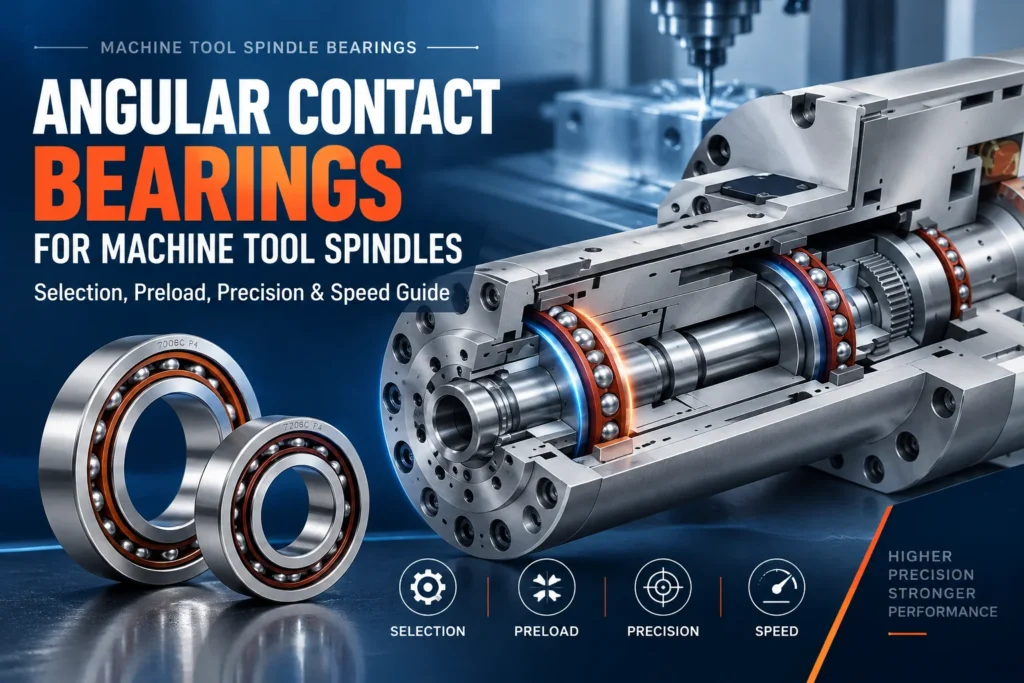


Struggling to select the right bearing for a high-speed machine tool spindle? You're not alone. Choosing the wrong component can cripple your machine's precision and lead to premature failure1, turning a valuable asset into a source of costly downtime. The complexity of balancing load, speed, and rigidity makes this a daunting task. This guide simplifies the entire selection process for angular contact bearings for machine tool spindles, transforming a challenging decision into a clear, step-by-step path to optimal performance.
The selection of angular contact bearings for machine tool spindles hinges on a systematic evaluation of seven key factors: bearing series (e.g., 719, 70, 72), contact angle (typically 15° or 25°), precision grade (P4 or P2), ball material (steel or hybrid ceramic), bearing arrangement (DB, DF, or DT), preload (light, medium, or heavy), and the lubrication method. Each choice represents a trade-off between speed, rigidity, and load capacity, and must be matched to the specific demands of the machining application, whether it's high-speed milling or heavy-duty cutting.
This article is structured to walk you through the complete engineering selection process. We will move from the foundational "why" to the practical "how," breaking down each technical decision into a manageable step. By the end, you will not only understand the theory but will also be equipped to configure and specify the right bearing for your application.
Why Are Angular Contact Bearings Used in Machine Tool Spindles?
Ever wondered why a standard deep groove ball bearing isn't up to the task in a CNC spindle? The answer lies in the unique combination of forces and precision demands inherent to machining. A spindle must deliver exceptional rotational accuracy while simultaneously resisting cutting forces from multiple directions.
Angular contact ball bearings are specifically engineered to meet these challenges2. Unlike standard radial bearings, which primarily handle forces perpendicular to the shaft, angular contact bearings have a contact angle that allows them to support both radial (sideways) and axial (thrust) loads at the same time. This capability is critical for maintaining stiffness and positional accuracy when a tool is pushed into a workpiece.
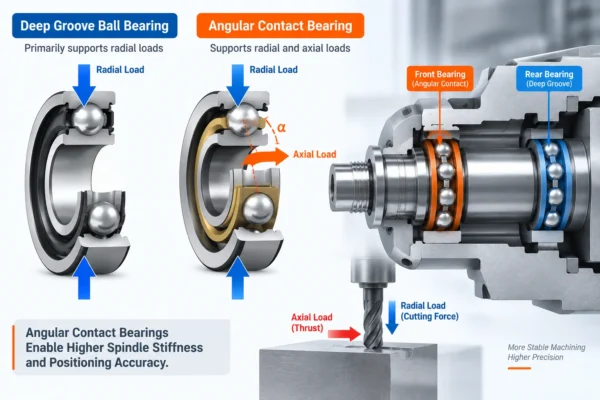
Let's dive deeper into the core advantages that make these components the default choice for high-performance spindles. The primary reason is their ability to be preloaded. Preload is an internal force applied during installation that eliminates clearance3, or "play," between the rolling elements and raceways. This creates a highly rigid system that minimizes deflection under load, which is essential for achieving tight machining tolerances.
Here's a direct comparison of why angular contact bearings are preferred over standard deep groove ball bearings for this application:
| Requirement | Deep Groove Ball Bearing | Angular Contact Ball Bearing |
|---|---|---|
| Combined Load Support | Limited axial capacity | Excellent |
| System Rigidity | Moderate | High (when preloaded) |
| Axial Positioning | Moderate | Excellent |
| High-Speed Capability | Good | Excellent |
| Suitability for Preload | Limited | Designed for it |
While some heavy-duty spindles may use cylindrical roller bearings for maximum radial stiffness, angular contact ball bearings provide the best all-around balance of high-speed capability, bi-directional load support (when used in pairs), and extreme running accuracy required for most modern CNC applications.
What Types of Angular Contact Bearings Are Used in Machine Tool Spindles?
Once you've decided on angular contact bearings, the next step is to identify the right physical series. For machine tool spindles, you will primarily encounter four main dimension series: 718, 719, 70, and 72. The core difference between them is the bearing's cross-section size for a given bore diameter.
This choice creates a fundamental trade-off: a larger cross-section provides higher load capacity and rigidity but generally has a lower speed limit due to the larger rolling elements and raceways. As a bearing manufacturer, I've seen customers improve spindle speed by simply switching to a series with a smaller cross-section.
Here’s how to approach this decision:
| Series | Cross-Section | Speed Potential | Rigidity & Load Capacity | Typical Spindle Application |
|---|---|---|---|---|
| 718 | Extra-Thin | Highest | Lower | Extremely high-speed, compact designs |
| 719 | Thin | Very High | Moderate | High-speed milling and grinding spindles |
| 70 | Light | High | High | General-purpose CNC machining centers |
| 72 | Medium | Lower | Very High | Heavy-duty cutting, lathes, and low-speed, high-rigidity spindles |
Beyond the series, you must also understand the bearing's nomenclature, which encodes its key features. For example, a bearing marked 7010C/P4ADBA tells a detailed story:
- 7010: Indicates the 70 series with a 50 mm bore (10 x 5).
- C: Denotes a 15° contact angle (this suffix can vary by brand).
- P4: Specifies the precision class (P4 is "Super Precision").
- A: Indicates a specific internal design or cage type.
- DBA: Refers to a duplex set arranged back-to-back (DB) with a specific preload.
A critical point to remember is that these bearings are almost always used in matched sets of two, three, or four (duplex, triplex, or quadruplex) to handle axial loads in both directions and provide the required system rigidity.
15° vs 25° Contact Angle: Which Is Better for Your Spindle?
Choosing the contact angle is one of the most critical decisions in spindle bearing selection. The contact angle is the angle between the bearing's radial plane and the line of action connecting the ball-to-raceway contact points. The most common options for machine tools are 15° (C suffix) and 25° (AC suffix).
This choice is a direct trade-off between speed and axial load capacity. A smaller contact angle reduces friction and allows for higher rotational speeds4, while a larger angle provides greater axial stiffness and the ability to handle heavier thrust loads.
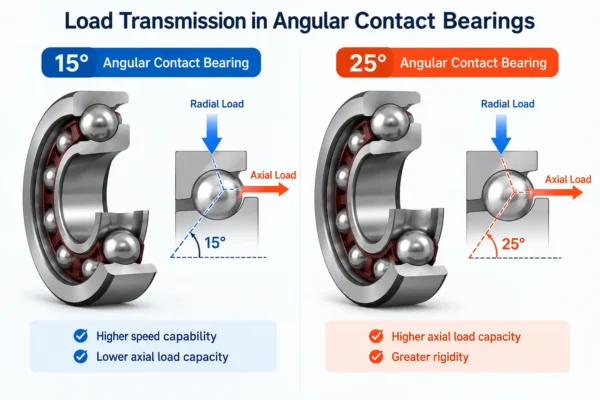
From my experience, swapping between these two is not an option; they are engineered for different jobs and are not interchangeable. Using a 15° bearing in an application designed for 25° will likely lead to excessive deflection and potential failure under heavy axial cuts. Conversely, using a 25° bearing in an ultra-high-speed spindle could lead to overheating and reduced bearing life.
Use this table as a starting point for your decision:
| Spindle Requirement | Recommended Contact Angle | Why? |
|---|---|---|
| Ultra-High-Speed Machining (>20,000 RPM) | 15° | Minimizes friction and heat generation, maximizing speed capability. |
| General-Purpose Milling/Routing | 15° or 25° | Balanced choice. 25° is common for general CNC routers. |
| High-Precision Grinding | 15° | Often favored for high speeds and achieving fine surface finishes. |
| Heavy Axial Cutting Force (e.g., drilling) | 25° | Provides higher axial rigidity to resist tool deflection. |
| CNC Lathe / Heavy Machining | 25° or higher | The higher angle supports the significant thrust loads common in these applications. |
It's crucial to understand that the contact angle is just one variable. The final speed limit of a spindle is a system property determined by the bearing size, preload, ball material, lubrication, and cooling systems working in concert. A larger contact angle increases axial load capacity, but it also generates more friction, which can limit the maximum speed if not managed properly.
P4 vs P2 and Steel vs Hybrid Ceramic: How Much Precision Does a Spindle Need?
After settling on the bearing series and contact angle, the next decision point involves precision and material. These choices directly impact the spindle's rotational accuracy, speed capability, thermal stability, and, of course, cost.
Precision Grade: P4 or P2?
Bearing precision is defined by ISO tolerance classes, with lower numbers indicating higher precision. For machine tools, the relevant grades are P5 (High Precision), P4 (Super Precision), and P2 (Ultra Precision). These grades dictate the manufacturing tolerances for the bearing's dimensions and runout (rotational accuracy). For any serious CNC spindle, P4 is considered the industry standard starting point.
So, does every spindle need the highest P2 precision? Not necessarily. The choice depends on the required machining accuracy and speed.
| Application | Typical Precision | Rationale |
|---|---|---|
| General Machine Tools | P5 / P4 | P4 is common for most CNC machining centers where good accuracy is required. |
| High-Speed Machining Centers | P4 / P2 | Higher grades ensure stability and low vibration at high RPMs. |
| Precision Grinding / Metrology | P2 | Essential for applications demanding minimal runout and the highest surface finish quality. |
Ball Material: Steel or Hybrid Ceramic?
The choice of ball material—traditional bearing steel or hybrid ceramic (typically Silicon Nitride, Si₃N₄)—is a critical decision for high-speed applications. While more expensive, hybrid ceramic bearings offer significant performance advantages.
The primary benefit comes from the lower mass of ceramic balls, which are about 40-60% lighter than steel balls of the same size. At high speeds, this drastically reduces centrifugal force, leading to less friction, lower heat generation, and higher potential RPMs. In our experience, high-speed spindles using hybrid bearings can run significantly cooler, which improves thermal stability and prolongs lubricant life.
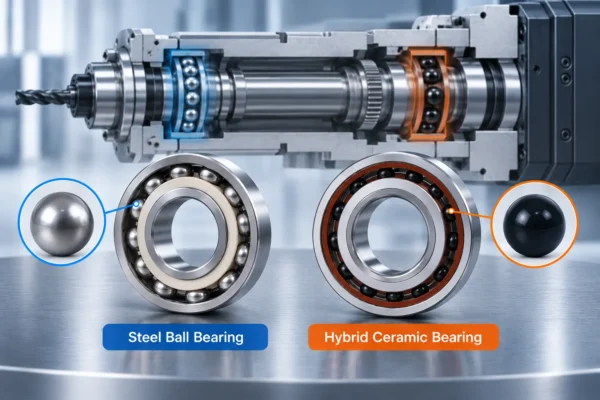
Here's a breakdown of the trade-offs:
| Factor | All-Steel Bearings | Hybrid Ceramic Bearings (Si₃N₄ Balls) |
|---|---|---|
| Cost | Lower | Higher |
| Speed Potential | Good | Excellent |
| Stiffness | High | Higher (15-20% increase) |
| Heat Generation | Higher | Lower at high speeds |
| Lifespan | Standard | Potentially longer in high-speed or poor lubrication conditions |
| Electrical Insulation | No | Yes (balls are non-conductive) |
| Corrosion Resistance | Prone to rust | Balls are corrosion-immune |
The decision logic is straightforward: for standard-speed spindles where cost is a primary driver, steel bearings are sufficient. For high-speed (>15,000 RPM), high-precision, or thermally sensitive applications, the performance gains from hybrid ceramic bearings often justify the additional investment.
DB, DF or DT? Bearing Arrangement and Preload Explained
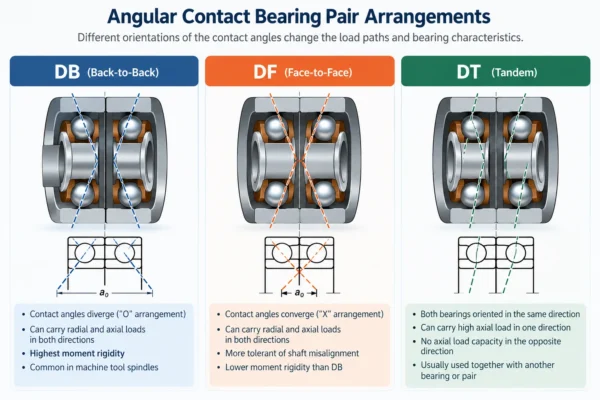
Single angular contact bearings can only support axial load in one direction, so they must be used in pairs or sets within a spindle. The way these bearings are arranged—known as DB, DF, or DT—profoundly affects the spindle's rigidity and ability to handle loads.
- DB (Back-to-Back): The contact angles diverge, creating a wide support base. This "O" arrangement provides the highest moment rigidity, making it excellent at resisting tilting forces. It is the most common arrangement for machine tool spindles.
- DF (Face-to-Face): The contact angles converge, forming an "X" arrangement. This configuration is less rigid against moments but is more tolerant of shaft misalignment.
- DT (Tandem): Both bearings are oriented in the same direction. This arrangement doubles the axial load capacity in one direction but offers no support in the opposite direction. It must be used in conjunction with another bearing or pair.
Preload: The Key to Rigidity
Once the arrangement is chosen, the next critical parameter is preload. Preload is a constant internal axial force applied to the bearing set to eliminate all internal play. This is what gives a spindle its stiffness. Preload is typically categorized as Light, Medium, or Heavy.
However, preload is a delicate balance. The relationship is clear: As Preload Increases:
- Rigidity and accuracy increase.
- Heat generation and friction increase.
- High-speed capability decreases.
Too little preload and the spindle will chatter and deflect, resulting in poor surface finish. Too much preload, and the bearing will overheat5, leading to thermal expansion, a further increase in preload, and rapid failure. This is why selecting the correct preload is not just a suggestion; it's a fundamental requirement for performance and longevity. For high-speed applications, a lighter preload is generally preferred, while heavy cutting operations demand a heavier preload to maximize rigidity.
| Arrangement | Moment Rigidity | Axial Load Directions | Common Use Case |
|---|---|---|---|
| DB (Back-to-Back) | Highest | Both | Machine Tool Spindles (main bearing set) |
| DF (Face-to-Face) | Lower | Both | Ball screw supports, applications tolerating some misalignment |
| DT (Tandem) | N/A | One | High thrust applications (e.g., extruder screws), used with another bearing set |
Speed, Temperature and Lubrication: What Actually Limits Spindle RPM?
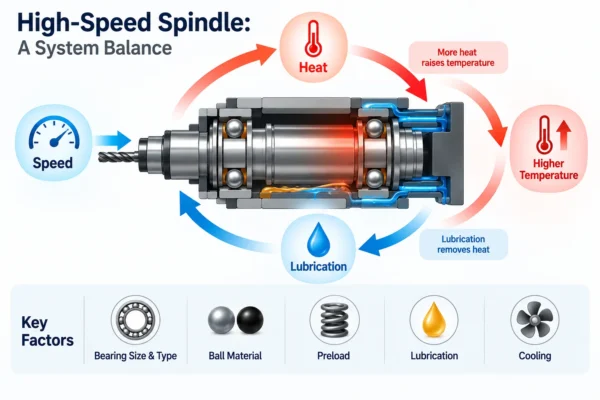
A common mistake is assuming a bearing's catalog "speed limit" is an absolute guarantee. In reality, the maximum achievable RPM of a spindle is a complex system problem, not a single component's rating. The true limiting factor is almost always heat.
Every rotation generates frictional heat. If this heat cannot be dissipated faster than it's created, the bearing's temperature will rise. This leads to thermal expansion of the inner ring, which reduces internal clearance, increases preload, generates even more heat, and can trigger a catastrophic failure loop.
The factors that collectively determine a spindle's sustainable speed include:
- Bearing Size and Type: Larger bearings and those with larger contact angles generally have lower speed limits.
- Ball Material: Hybrid ceramic balls generate less friction and heat at high speeds.
- Preload: Higher preload increases friction and heat, thus lowering the speed limit.
- Lubrication: The type and quantity of lubricant are critical.
- Cooling: External cooling systems for the spindle housing are often necessary at high RPMs.
The n x dm Speed Factor
To compare the speed capabilities of different bearings more accurately, engineers use the n x dm factor.
- n = rotational speed (in RPM)
- dm = mean bearing diameter (in mm), calculated as (bore diameter + outside diameter) / 2
This value helps normalize speed ratings across different bearing sizes. A 30,000 RPM speed is far more demanding on a large bearing than a small one, and the n x dm factor reflects this. High-speed spindles often operate at n x dm values exceeding 1,000,000 mm/min6.
Grease vs. Oil-Air Lubrication
The lubrication method directly impacts both the speed limit and thermal stability7.
| Feature | Grease Lubrication | Oil-Air / Oil-Mist Lubrication |
|---|---|---|
| System Complexity | Simple, self-contained | Complex, requires external pumps, lines, and nozzles |
| Cost | Lower initial and operating cost | Higher initial and operating cost |
| Speed Potential | Good, but limited | Excellent, enables the highest speeds |
| Cooling Effect | Minimal | Significant, as the oil carries heat away |
| Maintenance | Sealed for life or periodic re-greasing | Requires continuous monitoring and maintenance |
For moderate speeds, grease is often sufficient. However, for high-performance and ultra-high-speed spindles, an oil-air system is almost always necessary to provide adequate lubrication while actively removing heat.
How to Select Spindle Bearings for Different Machine Tool Applications
At this point, we've covered the theory. Now, let's translate it into actionable decisions. The ideal bearing configuration depends entirely on what the machine is built to do. A spindle designed for rapid aluminum finishing has very different requirements than one for slow, heavy-duty steel milling.
As a bearing supplier, we often guide customers using a "requirements-first" approach. Start with your application, and let the required speed, load, and accuracy dictate the bearing specifications.
Here is a general selection guide that serves as an excellent starting point for common machine tool applications. Remember to treat this as a directional guide; final specifications should always be verified by an engineer based on detailed calculations.
| Application | Typical Speed | Rigidity Need | Recommended Configuration (Starting Point) |
|---|---|---|---|
| Contact Angle / Preload / Precision / Ball Material | |||
| High-Speed Machining (e.g., finishing, engraving) | Very High (20k-40k+ RPM) | Medium | 15° / Light / P4 or P2 / Hybrid Ceramic |
| General CNC Milling (e.g., mold & die) | High (12k-20k RPM) | High | 15° or 25° / Light-Medium / P4 / Steel or Hybrid |
| Precision Grinding | Very High (15k-60k+ RPM) | High | 15° / Light-Medium / P4 or P2 / Hybrid Ceramic |
| CNC Lathe / Turning Center | Medium (4k-8k RPM) | High | 25° / Medium / P4 / Steel |
| Heavy-Duty Cutting (e.g., roughing) | Low-Medium (<10k RPM) | Very High | 25° or higher / Medium-Heavy / P4 / Steel |
| Woodworking / Routing | High (18k-24k RPM) | Medium-High | 15° or 25° / Light-Medium / P5 or P4 / Steel |
A Practical Selection Logic
When faced with a new application, I follow this mental checklist:
- Define Speed & Load: What is the maximum RPM and what are the expected cutting forces (radial and axial)?
- Select Series & Angle: High speed points to a 719 or 70 series with a 15° angle. High load points to a 70 or 72 series with a 25° angle.
- Determine Rigidity & Precision: How accurate does the machine need to be? This sets the precision (P4/P2) and preload (Light/Medium).
- Choose Material: Does the n x dm factor and thermal sensitivity justify hybrid ceramic balls?
- Verify & Lubricate: Finally, check that the chosen configuration, with the appropriate lubrication method, can operate at the target speed without overheating.
This systematic process ensures all key variables are considered, leading to a reliable and high-performance spindle design.
What Information Should You Provide When Ordering a Machine Tool Spindle Bearing?
You've done the hard work of selecting the perfect bearing configuration. The final step is to communicate your requirements clearly to your supplier to ensure you receive the exact component you need. Ambiguity in an RFQ (Request for Quote) can lead to incorrect parts, project delays, and costly errors.
From my perspective as a manufacturer, the more detail you provide, the better we can serve you. A complete bearing designation is ideal, but even if you don't have the full part number, providing key operational parameters can help us identify the right solution.

Your Spindle Bearing RFQ Checklist
To ensure a smooth and accurate ordering process, aim to provide the following information:
- Full Bearing Designation (if known): e.g.,
7014C/P4ADBA. This is the most precise way to order. - Replacement Information: If you're replacing an existing bearing, provide the brand and part number marked on the old component.
- Dimensions: Bore Diameter (ID) x Outside Diameter (OD) x Width (in mm).
- Contact Angle: 15°, 25°, or another angle.
- Precision Class: P5, P4, or P2.
- Arrangement & Set Size: Duplex (DB, DF, DT), Triplex, or Quadruplex set.
- Preload: Light, Medium, Heavy, or a specific preload value if known.
- Ball Material: Steel or Hybrid Ceramic.
- Cage Material: Phenolic resin and brass are common for high-speed applications.
- Application Details:
- Maximum spindle speed (RPM).
- Lubrication method (Grease or Oil-Air).
- Type of machine (e.g., CNC Mill, Grinder, Lathe).
Example of a Detailed RFQ:
"I need a quote for a duplex pair of super precision angular contact bearings for a CNC milling spindle.
- Arrangement: DB (Back-to-Back) Matched Pair
- Dimensions: 70mm bore x 110mm OD x 20mm width (7014 size)
- Contact Angle: 15°
- Precision: P4
- Preload: Light
- Material: Hybrid Ceramic balls
- Max Speed: 18,000 RPM
- Lubrication: Oil-Air"
Providing this level of detail eliminates guesswork and ensures you get a quote for a bearing that is perfectly matched to your spindle's performance requirements.
Frequently Asked Questions
What is the difference between P4 and ABEC 7 precision grades?
P4 (per ISO 492) and ABEC 7 (per the American ABMA standard) are roughly equivalent precision classes. Both represent "Super Precision" bearings suitable for machine tool spindles. The main difference is the standards body; P4 is the international ISO designation, while ABEC is more common in the US.
Can I directly replace a steel ball bearing with a hybrid ceramic one?
In many cases, yes, but it is not a simple drop-in replacement. Because ceramic balls have a higher stiffness, the preload and system rigidity will change. While a hybrid bearing can often improve performance, the system's speed limits and thermal behavior should be re-evaluated by a qualified engineer to take full advantage of the upgrade and prevent unexpected issues.
How does the bearing cage material affect spindle performance?
The cage (or retainer) separates the balls and is crucial for high-speed performance. Phenolic resin cages are lightweight and have good lubricant absorption properties, making them ideal for ultra-high-speed spindles. Brass cages are strong and perform well at high temperatures. Polyamide (nylon) cages are a good, cost-effective choice for quieter operation at high speeds but have lower temperature limits.
What are the most common causes of premature spindle bearing failure?
The top causes I've seen in my 30+ years of experience are contamination (dirt or moisture entering the bearing), improper installation (which can damage races), incorrect preload (either too high or too low), and inadequate or improper lubrication. Excessive speed beyond the system's thermal limits is another frequent cause of failure.
Conclusion
Selecting the right angular contact bearings for machine tool spindles is a systematic process of balancing competing requirements. It's not about finding the "best" bearing in isolation, but about configuring a complete bearing system that meets the spindle's specific needs for speed, load capacity, and rigidity. By carefully considering the bearing series, contact angle, precision grade, ball material, arrangement, and preload, you can create a solution that delivers both peak performance and long-term reliability. Each decision, from choosing a 15° or 25° contact angle to opting for hybrid ceramic balls, directly impacts the final machining accuracy and productivity of your equipment.
At IHGY Bearing, we specialize in providing professional manufacturing and comprehensive supply solutions for a wide range of bearings, including high-precision angular contact bearings for spindle applications. If you need assistance selecting the correct configuration or are ready to source reliable bearings for your equipment, send our team your technical requirements. We are here to help you find the right solution from a single, dependable supplier.
"Ball Bearings vs Roller Bearings: Which Is Better for Your Industrial ...", https://ihgybearing.com/ball-bearings-vs-roller-bearings-which-is-better-for-your-industrial-applications/. Studies have shown that improper bearing selection can lead to increased wear, reduced precision, and premature failure in machine tool spindles, particularly under high-speed or high-load conditions. Evidence role: general_support; source type: research. Supports: The source should support the claim that incorrect bearing selection can lead to reduced precision and premature failure in machine tool spindles.. ↩
"Radial vs Axial Load in Bearings: How to Choose the Right Bearing ...", https://ihgybearing.com/can-pillow-block-bearings-handle-axial-load-most-failures-start-with-this-wrong-assumption/. Angular contact ball bearings are designed with a contact angle that allows them to support both radial and axial loads, making them ideal for applications requiring high precision and rigidity, such as machine tool spindles. Evidence role: mechanism; source type: education. Supports: The source should explain the engineering design of angular contact ball bearings and their suitability for handling combined loads in machine tool spindles.. ↩
"Selecting preload", https://www.skf.com/us/products/rolling-bearings/principles-of-rolling-bearing-selection/bearing-selection-process/bearing-execution/selecting-internal-clearance-or-preload/selecting-preload. Preloading angular contact bearings eliminates internal clearance, thereby increasing rigidity and reducing deflection under operational loads, which is critical for precision applications. Evidence role: mechanism; source type: research. Supports: The source should explain how preload increases rigidity and reduces deflection in angular contact bearings.. ↩
"Contact angle", https://en.wikipedia.org/wiki/Contact_angle. A smaller contact angle in angular contact bearings minimizes frictional forces, enabling higher rotational speeds, which is advantageous for high-speed machining applications. Evidence role: mechanism; source type: research. Supports: The source should explain how a smaller contact angle reduces friction and increases speed capability in angular contact bearings.. ↩
"C0 vs C3 vs C4 Bearing Clearance: Differences, Applications ...", https://ihgybearing.com/c0-vs-c3-vs-c4-bearing-clearance-differences-applications-selection-guide/. Excessive preload in bearings increases frictional forces, which can cause overheating and accelerate wear, ultimately leading to premature failure. Evidence role: mechanism; source type: research. Supports: The source should explain how excessive preload increases friction and heat, leading to potential bearing failure.. ↩
"The Latest Tech Trends Affecting High Speed Spindle Design", https://www.ibagnorthamerica.com/blog/Tech-Trends-Affecting-High-Speed-Spindle-Design. High-speed spindles are designed to operate at n x dm values exceeding 1,000,000 mm/min, reflecting their capability to handle extreme rotational speeds. Evidence role: statistic; source type: research. Supports: The source should confirm that high-speed spindles operate at n x dm values exceeding 1,000,000 mm/min.. ↩
"Effects of Lubrication on the Performance of High Speed ...", https://ntrs.nasa.gov/api/citations/19890013548/downloads/19890013548.pdf. Lubrication methods, such as grease or oil-air systems, play a critical role in managing friction and heat, directly influencing the speed and thermal stability of spindle bearings. Evidence role: mechanism; source type: research. Supports: The source should explain how different lubrication methods affect the speed and thermal performance of spindle bearings.. ↩