
Sourcing miniature bearings often appears straightforward due to their standardized physical size. However, selecting the wrong 608 bearing variant based purely on external dimensions can lead to premature equipment failure, increased maintenance costs, and end-user complaints. For wholesalers and distributors, understanding the nuanced specifications beyond the basic measurements is crucial for ensuring reliable supply and matching the correct product to diverse customer applications. This guide provides B2B buyers with the essential technical specifications, material options, and selection criteria needed to source reliable 608 bearings.
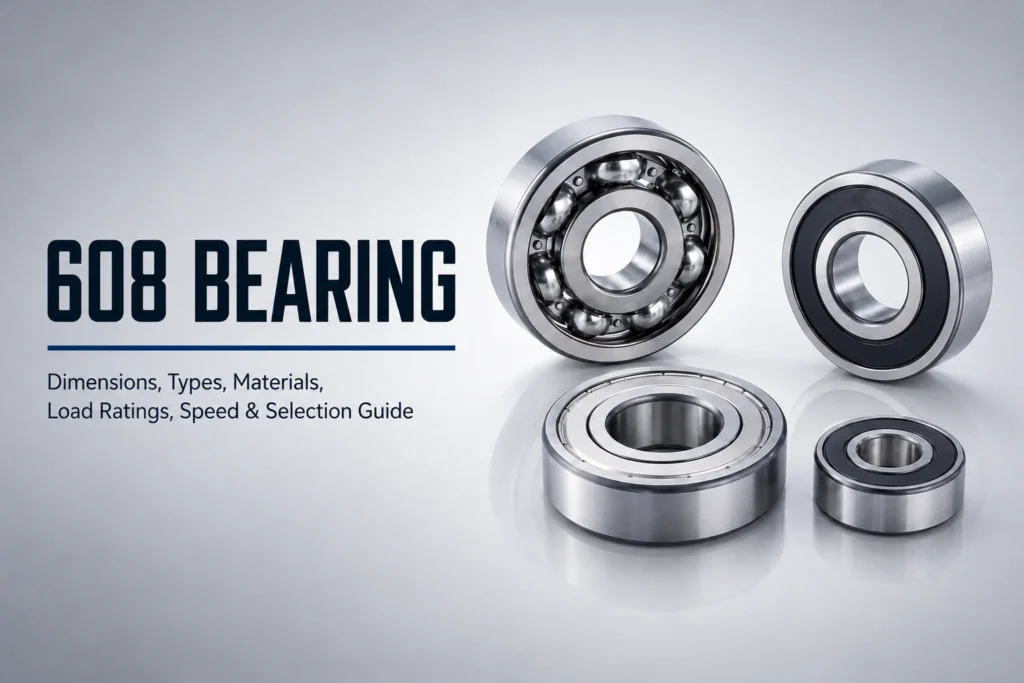
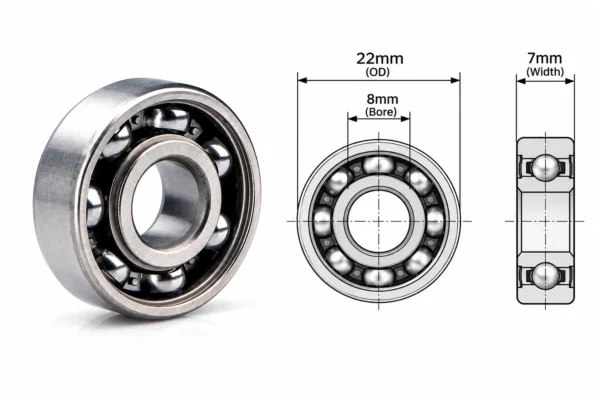
A 608 bearing is a widely used miniature single-row deep groove ball bearing. Its standard dimensions are an 8 mm bore (inner diameter), a 22 mm outside diameter, and a 7 mm width. While these physical measurements define the basic envelope, functional performance is determined by additional factors such as sealing type (open, shielded, or sealed), cage material, precision grade, internal clearance, and the specific lubrication utilized in manufacturing.
Understanding baseline dimensions is only the first step in professional procurement. To ensure consistent performance across various light-duty industrial and commercial applications, buyers must evaluate the specific attributes detailed in the following sections.
What Is a 608 Bearing? Dimensions and Specifications?
Misunderstanding basic specifications often leads to ordering incompatible components for specific machinery or assembly lines.
The standard 608 bearing follows ISO metric dimensions: 8mm ID x 22mm OD x 7mm Width. The "6" denotes a single-row deep groove ball bearing series, while "08" is the specific code for this miniature size. Beyond standard dimensions, critical specifications include dynamic and static load ratings and limiting speeds, which vary significantly based on the materials employed and the type of closures selected.
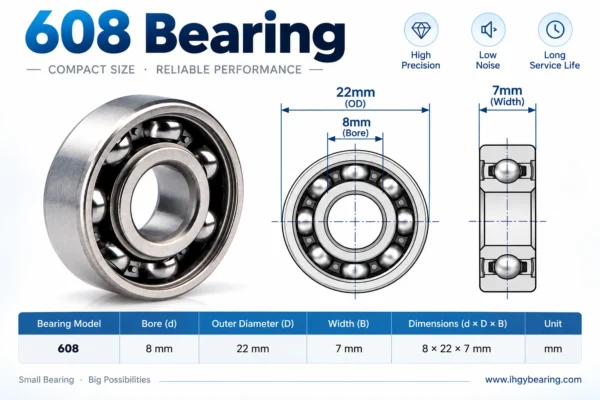
When sourcing 608 bearings in bulk, it is imperative to move beyond the dimensional check. The bearing's ability to handle loads and rotational speeds is defined by its internal geometry and material quality.
Load Ratings and Speed
Load ratings—dynamic (Cr) and static (Cor)—are essential parameters. The dynamic load rating indicates the load at which the bearing can achieve a defined service life (typically 1 million revolutions) under standard testing conditions. The static load rating is the maximum load the bearing can withstand while stationary before permanent deformation occurs to the raceways or balls.
Speed ratings are equally critical and are heavily influenced by the bearing's cage design, lubrication, and, most importantly, the seal type (discussed in the next section).
The table below provides general reference values for standard chrome steel 608 bearings. Note: Buyers must always verify exact load and speed ratings with the specific manufacturer's data sheet, as these depend heavily on steel quality and precision grade.
| Specification Parameter | Metric Value | Imperial Equivalent (Approx.) |
|---|---|---|
| Bore Diameter (d) | 8 mm | 0.3150 inch |
| Outside Diameter (D) | 22 mm | 0.8661 inch |
| Width (B) | 7 mm | 0.2756 inch |
| *Basic Dynamic Load Rating (Cr)1 | ~3.30 kN | ~740 lbs |
| *Basic Static Load Rating (Cor) | ~1.35 kN | ~305 lbs |
| *Limiting Speed (Grease)2 | ~32,000 RPM (Open/ZZ) | N/A |
| *Limiting Speed (Oil) | ~38,000 RPM (Open) | N/A |
*Values are for reference only for standard GCr15 steel and vary by manufacturer and tolerance grade.
608 Bearing Types: Open, ZZ and 2RS?
Choosing the wrong sealing type is perhaps the most common reason for premature 608 bearing failure in contaminated or high-speed environments.
The primary 608 bearing types are defined by their closures, indicated by suffixes. Open bearings have no seals, offering lowest friction; 608ZZ uses non-contact metal shields for basic dust protection and high speeds; and 608-2RS utilizes contacting rubber seals for superior contamination resistance against moisture and fine particulates, but operates with higher friction and lower speed limits.
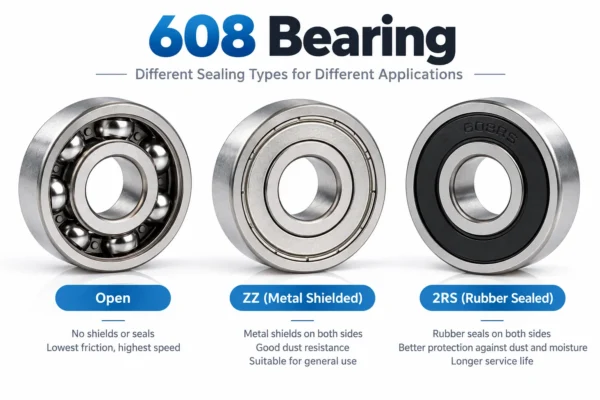
For distributors, stocking the correct mix of closures is essential to meeting varied customer demands. The choice involves a direct trade-off between protection, speed, and torque.
Open 608 Bearings (No Suffix)
Open bearings have no side closures. The balls and cage are visible.
- Advantages: Lowest possible friction and highest speed capability. They allow for easy re-lubrication, particularly in oil-bath applications.
- Disadvantages: Zero protection against contaminants. The lubricant can easily escape.
- Best Use Cases: Clean environments, inside gearboxes where they are lubricated by system oil, or applications requiring minimal starting torque.
Shielded 608 Bearings (Suffix ZZ or 2Z)
Shielded bearings use metal plates retained in the outer ring that do not contact the inner ring.
- Advantages: Low friction (similar to open bearings) allowing for high speeds. Good protection against larger debris and dust. They typically come pre-greased for life.
- Disadvantages: Not effective against fine dust or liquids. Moisture can easily penetrate the gap between the shield and inner ring.
- Best Use Cases: Electric motor fans, small power tools, and dry, moderately dusty environments.
Sealed 608 Bearings (Suffix 2RS, DDU, or LLU)
Sealed bearings use rubber (typically NBR - nitrile butadiene rubber) seals that make physical contact with the inner ring hub.
- Advantages: Excellent protection against fine dust, dirt, and light moisture splashes. Keeps grease effectively contained within the bearing.
- Disadvantages: The contact seal creates significant friction, resulting in higher operating temperatures, increased starting torque, and reduced limiting speeds compared to Open or ZZ types.
- Best Use Cases: Exposed machinery, wheels, dirty environments, or applications where grease leakage cannot be tolerated.
| Closure Type | Common Suffix | Material | Contamination Protection | Seal Friction | Max Speed Potential |
|---|---|---|---|---|---|
| Open | None | N/A | None | Very Low | Highest |
| Shielded | ZZ, 2Z | Steel | Moderate (Dust) | Low (Non-contact) | High |
| Sealed | 2RS, DDU | NBR Rubber | High (Dust & Moisture) | High (Contact) | Moderate |
608 Bearing Clearance, Precision and Lubrication?
Ignoring internal clearance specifications and precision grades often results in noisy operation, excessive heat generation, or seizure under thermal stress.
608 bearing performance depends heavily on internal clearance (e.g., C0 standard vs. C3 loose), precision grades (ABEC or ISO ratings), and the factory-applied lubricant. These factors must be matched to the operating temperature, desired rotational accuracy, and speed requirements of the final application.
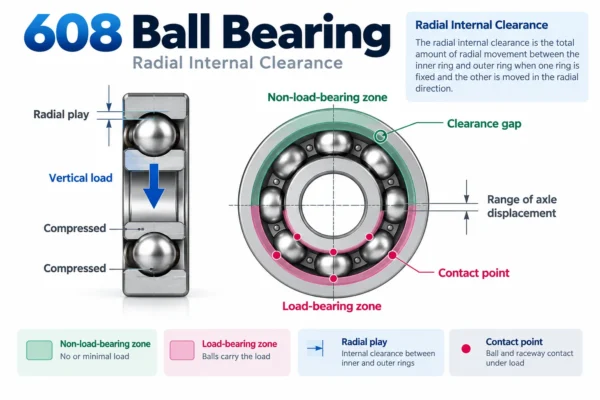
When procuring 608 bearings, specifications often default to "standard," but standard is not suitable for every application.
Internal Clearance (C Ratings)
Radial internal clearance is the total distance one ring can move relative to the other radially.
- CN (or C0): Standard clearance. Suitable for normal operating conditions where temperature build-up is not excessive.
- C3: Greater than standard clearance. This is a critical specification for many industrial applications. C3 clearance allows for thermal expansion of the bearing steel at high speeds or high operating temperatures3. If a standard C0 bearing is used in a high-heat application, it may seize. Conversely, C3 used in low-speed, low-heat applications may feel loose or noisy.
Precision Grades (ABEC / ISO)
Precision ratings define the dimensional tolerances and running accuracy of the bearing.
- ABEC-1 (ISO P0):4 The standard grade for most general industrial applications. Sufficient for moderate speeds and loads. Cost-effective.
- ABEC-3, 5, 7 (ISO P6, P5, P4): Higher precision grades with tighter tolerances. Necessary for very high-speed motors, precision instruments, or applications requiring extremely low runout. Higher precision significantly increases cost and is not always better for general use.
Lubrication
Most sealed (2RS) and shielded (ZZ) 608 bearings supplied in bulk are pre-lubricated with grease for life. The type and fill amount of grease matter.
- Standard Grease: Typically a lithium-based grease suitable for temperatures from -20°C to +120°C.5
- Grease Fill: Standard fill is usually 30-40% of the free space. High-speed applications might require a lower fill (around 20%) to reduce churning heat, while low-speed, high-load applications might use a higher fill.
- Oil: Used primarily in open bearings for very high-speed applications where heat dissipation is required.
608 Bearing Materials: Chrome Steel, Stainless Steel and Ceramic?
Selecting standard steel bearings for corrosive environments will inevitably lead to rust, increased friction, and rapid equipment failure.
While standard 608 bearings are manufactured from high-grade GCr15 chrome bearing steel, demanding applications require alternative materials. Stainless steel (AISI 440C6) options offer essential corrosion resistance, and ceramic hybrids utilize silicon nitride balls for significantly higher speeds, electrical insulation, and extreme durability under stress7.
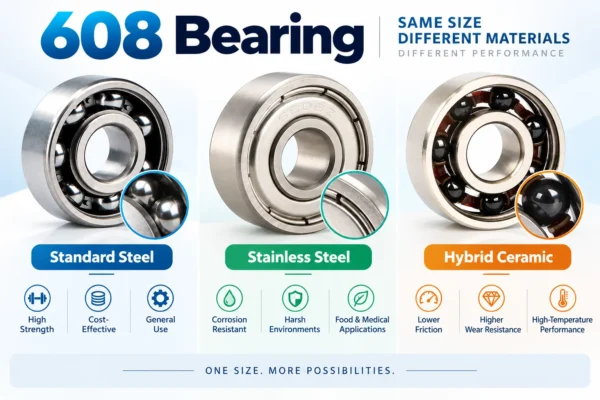
Material selection dictates the bearing's environment, longevity, and cost structure.
Chrome Steel (GCr15 / SAE 52100)
This is the industry standard material for over 90% of 608 bearings.8
- Characteristics: Extremely hard, high load-carrying capacity, excellent fatigue resistance, and cost-effective.
- Limitations: Poor corrosion resistance. It will rust quickly if exposed to moisture without adequate grease or oil protection.
Stainless Steel (AISI 440C)
Usually designated with a prefix, such as S608-2RS.
- Characteristics: Good corrosion resistance against water and mild chemicals. Suitable for food processing, medical equipment, or outdoor applications.
- Limitations: Generally has slightly lower dynamic load ratings compared to chrome steel because 440C is not quite as hard. It is also more expensive.
Hybrid Ceramic (Silicon Nitride Balls)
These feature steel rings with ceramic (Si3N4) balls.
- Characteristics: Ceramic balls are lighter, harder, and smoother than steel. This results in much lower friction, higher limiting speeds, lower operating temperatures, and electrical insulation between rings. They require less lubrication.
- Limitations: Significantly higher cost. They can be more brittle under extreme shock loads.
| Material | Common Designation | Hardness | Corrosion Resistance | Load Capacity | Cost |
|---|---|---|---|---|---|
| Chrome Steel | GCr15 / 52100 | High | Poor | High | Low |
| Stainless Steel | AISI 440C (Prefix 'S') | Medium-High | Good | Medium-High | Medium |
| Hybrid Ceramic | Si3N4 Balls | Very High | Excellent (Balls) | High | High |
608 Bearing Applications?
Buyers often underestimate the sheer variety of equipment utilizing the 608 format, leading to narrow stocking strategies that miss market opportunities.
Due to their versatility, compact 8mm bore size, and balance of load capacity versus speed, 608 bearings are ubiquitous in both industrial and consumer products. Common applications range from small electric motors, cooling fans, and 3D printer gantries to casters, conveyor rollers, and recreational equipment like skateboards.
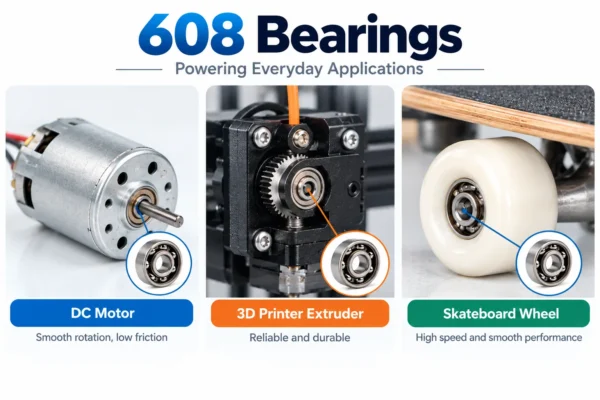
The diverse applications highlight why stocking just one type (e.g., 608ZZ C0) is rarely sufficient for a broad bearing supplier.
Industrial and Commercial Use
- Small Electric Motors: DC motors used in appliances, tools, and automotive auxiliaries often use 608ZZ or 608-2RS depending on the dust environment.
- 3D Printers and CNC: Used extensively in guide pulleys, belt tensioners, and extruder mechanisms due to their precision and small size.
- Instrumentation: Encoders, anemometers, and measuring devices requiring low-torque rotation.
- Automated Equipment: Light-duty conveyor rollers, cash counting machines, and office automation equipment (printers/copiers).
Consumer and Recreational Use
- Skateboards and Rollerblades: Perhaps the most famous application. These usually require 608 bearings optimized for speed and dirt tolerance, sometimes using specialized lubricants or removable seals for cleaning.
- Fidget Spinners & Toys: Applications requiring very low starting torque.
- Fishing Reels: Often use high-precision stainless steel or hybrid 608 variants for smoothness and corrosion resistance.
Common 608 Bearing Problems and Failure Causes?
Unexpected bearing failures interrupt operations and damage supplier reputations, yet the vast majority of failures are preventable through correct selection and handling.
Premature failure in a 608 bearing is rarely due to material fatigue. The most common causes include contamination ingress due to improper seal selection, inadequate or incompatible lubrication, misalignment during installation, and overloading beyond static ratings during assembly or operation.
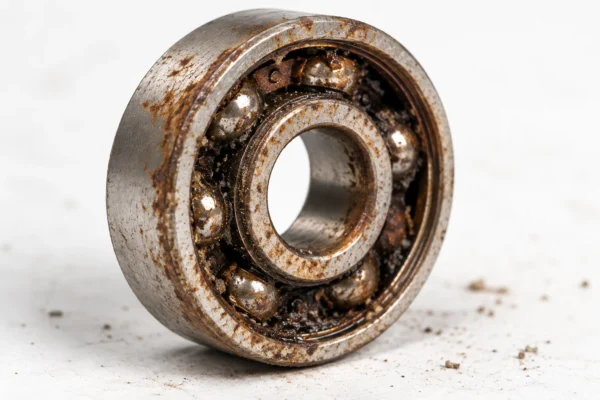
Understanding failure modes helps in advising customers and reducing warranty claims.
- Contamination (The #1 Cause):9 Dust, dirt, or moisture entering the bearing raceways. This turns the lubricant into an abrasive paste, rapidly wearing down the balls and races.
- Prevention: Choosing the right seal (2RS for dirty environments) and ensuring proper external shielding in the application design.
- Lubrication Issues: Using the wrong type of grease, grease drying out over time due to heat, or insufficient grease fill.
- Prevention: Ensuring the factory grease temp rating matches the application and considering C3 clearance for hot environments to prevents grease overheating.
- Improper Installation / Misalignment: If a 608 bearing is pressed onto a shaft by applying force to the outer ring (or vice-versa), the balls can dent the raceways (brinelling), leading to immediate noise and vibration. Misalignment of the shaft bends the bearing, causing edge loading.
- Prevention: Using proper fitting tools that apply force only to the ring being fitted.
- Corrosion: Using standard chrome steel in wet or humid environments. Rust pits the raceways, causing rough operation.
- Prevention: Switching to S608 stainless steel or hybrid bearings.
608 Bearing FAQ
What does the "608" mean on a bearing?
The "6" indicates it is a Single Row Deep Groove Ball Bearing. The "08" is a specific miniature series code indicating the dimensions: 8mm bore, 22mm outer diameter, and 7mm width.
What is the difference between 608ZZ and 608-2RS?
608ZZ has non-contact metal shields, offering low friction for high speeds and basic dust protection. 608-2RS has rubber contact seals, offering superior protection against fine dust and moisture but with higher friction and lower limiting speeds.
Are all 608 bearings the same size?
Yes, standard ISO 608 bearings always have dimensions of 8x22x7mm. However, their functional specifications—such as internal clearance (C3), precision grade (ABEC), materials, and seals—vary significantly.
Can I use a stainless steel 608 bearing instead of chrome steel?
Yes, if corrosion resistance is required. However, be aware that stainless steel (AISI 440C) typically has slightly lower dynamic load capacities than standard GCr15 chrome steel bearings.
Conclusion
Sourcing the ubiquitous 608 bearing requires more than just matching the 8x22x7mm dimensions. For professional buyers and distributors, the value lies in confirming the correct variant for the end-user's application. A 608-2RS is essential for dirty environments, while a 608ZZ C3 may be necessary for high-speed motors generating heat. Material choices like stainless steel or ceramic hybrids further expand the application range but impact cost and load ratings.
Reliable supply depends on understanding these technical trade-offs. IHGY Bearing, as an experienced manufacturer and comprehensive supplier, understands the necessity of providing consistent quality across complementary lines like miniature ball bearings alongside core manufactured products. By focusing on the complete specification—seals, clearance, and material—buyers can ensure reliable performance and reduce the risk of premature failures.
"How to Judge Bearing Quality: 5 Key Indicators Industrial Buyers ...", https://ihgybearing.com/how-to-judge-bearing-quality-5-key-indicators-industrial-buyers-should-know/. Load rating calculation methods for rolling bearings are standardized in ISO 281, which defines dynamic load rating (C) as the constant load a bearing can theoretically endure for one million revolutions. Evidence role: statistic; source type: government. Supports: That dynamic load rating values for miniature deep groove ball bearings such as the 608 series fall within the cited range under standard ISO calculation methods.. Scope note: The standard provides the calculation methodology rather than a specific published value for the 608 size, so the exact figure cited in the article requires manufacturer-specific verification. ↩
"Ball Bearings vs Roller Bearings: Which Is Better for Your Industrial ...", https://ihgybearing.com/ball-bearings-vs-roller-bearings-which-is-better-for-your-industrial-applications/. Engineering references on rolling bearing design describe limiting speed as constrained primarily by cage material, lubricant viscosity, and heat generation at the contact surfaces. Evidence role: mechanism; source type: research. Supports: That limiting speed for grease-lubricated rolling bearings is governed by cage design, lubricant type, and heat dissipation, consistent with the article's framing.. Scope note: General engineering literature explains the governing mechanism but does not confirm the specific 32,000 RPM figure attributed to the 608 bearing in this article. ↩
"C0 vs C3 vs C4 Bearing Clearance: Differences, Applications ...", https://ihgybearing.com/c0-vs-c3-vs-c4-bearing-clearance-differences-applications-selection-guide/. Bearing engineering handbooks note that radial internal clearance must be selected to offset differential thermal expansion between inner and outer rings under operating temperature rise. Evidence role: mechanism; source type: research. Supports: That increased internal radial clearance classes (such as C3) are used in bearing engineering to compensate for thermal expansion of inner rings relative to outer rings during operation.. Scope note: Sources describe this principle in general rolling bearing design contexts, not specifically validated for the miniature 608 series discussed in the article. ↩
"ABEC scale", https://en.wikipedia.org/wiki/ABEC_scale. The Annular Bearing Engineers Committee (ABEC) tolerance system, and its corresponding ISO 492 precision classes, define permissible dimensional and geometric tolerances for rolling bearings. Evidence role: definition; source type: institution. Supports: That ABEC classifications and their ISO P-grade equivalents are formally defined dimensional and running-accuracy tolerance standards for ball bearings.. Scope note: The standard defines general tolerance classes for bearings broadly and does not specifically discuss the 608 series or validate the article's claim that ABEC-1 is sufficient for general industrial use. ↩
"High-Temperature Grease Guide", https://www.machinerylubrication.com/Read/340/high-temperature-grease. Lubrication engineering references classify lithium soap-based greases as general-purpose lubricants with a typical service temperature range of roughly -20°C to +120°C, depending on base oil viscosity. Evidence role: statistic; source type: research. Supports: That lithium-based greases commonly used in bearing lubrication have a typical serviceable temperature range approximating -20°C to +120°C.. Scope note: This range reflects general lubrication engineering guidance rather than a specification verified for the particular grease used in 608 bearings by any given manufacturer. ↩
"440C", https://en.wikipedia.org/wiki/440C. Metallurgical data on martensitic stainless steels indicates that AISI 440C offers good corrosion resistance but typically achieves slightly lower maximum hardness than through-hardened chromium bearing steel such as AISI 52100. Evidence role: general_support; source type: research. Supports: That AISI 440C martensitic stainless steel exhibits corrosion resistance advantages but comparatively lower achievable hardness than chromium bearing steels like 52100/GCr15.. Scope note: Material property comparisons are documented for these steel types generally; the source does not quantify the specific dynamic load rating difference for 608-sized bearings. ↩
"Experimental Study of the Service Performance of Full ...", https://www.mdpi.com/2075-4442/13/10/461. Materials engineering research on hybrid ceramic bearings attributes their higher speed capability and electrical insulating properties to the lower density and non-conductive nature of silicon nitride (Si3N4) compared to bearing steel. Evidence role: mechanism; source type: paper. Supports: That silicon nitride ceramic balls used in hybrid bearings offer lower density, higher hardness, and electrical non-conductivity compared to steel, contributing to higher speed capability.. Scope note: Research findings are drawn from general hybrid bearing studies and are not specific to miniature 608-format bearings. ↩
"Bearing Steel - an overview", https://www.sciencedirect.com/topics/engineering/bearing-steel. Materials science literature on rolling bearing steels identifies chromium steel (AISI 52100/GCr15) as the most widely used material for standard ball and roller bearing production due to its hardness and fatigue resistance. Evidence role: statistic; source type: research. Supports: That chrome bearing steel (GCr15/52100) is the predominant material used in standard rolling bearing manufacturing generally.. Scope note: General materials literature supports chrome steel's prevalence in bearing manufacturing broadly but does not provide a verified percentage specific to the 608 series. ↩
"Study on the failure mechanism and improvement measures ...", https://pmc.ncbi.nlm.nih.gov/articles/PMC12644720/. Bearing failure analysis literature commonly identifies particulate and moisture contamination as among the most frequent root causes of premature rolling bearing failure, alongside inadequate lubrication. Evidence role: expert_consensus; source type: research. Supports: That contamination ingress is widely recognized among bearing failure analyses as a leading, if not the leading, cause of premature rolling bearing failure.. Scope note: Findings are drawn from general rolling bearing failure studies across industrial applications, not specifically from data on ↩