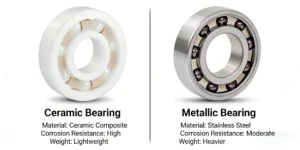
Struggling to choose between ceramic bearings1? A wrong choice can lead to costly equipment failure and downtime. Understanding the key differences is crucial for optimal performance and reliability.
Hybrid bearings blend ceramic balls with metal rings, offering a balanced upgrade for most industrial uses. Full ceramic bearings, made entirely of ceramic, are built for extreme environments involving high heat, corrosion, or electrical insulation, where standard bearings would quickly fail.

We've been in the bearing business for over 30 years, and We've seen the industry evolve. Steel bearings are still the workhorse, but ceramic technology is rapidly gaining ground, especially in tough jobs. The choice between a full ceramic and a hybrid ceramic bearing isn't just a small detail; it's a critical decision that impacts your machine's lifespan, maintenance schedule2, and overall efficiency. Get it right, and you save money and prevent headaches. Get it wrong, and you could be facing unexpected breakdowns. Let's break down the differences so you can make the right call every time.
What Is the Real Structural Difference?
They might look similar from the outside, but their internal makeup is worlds apart. Choosing based on looks alone is a recipe for disaster. Let's look inside.
The main structural difference is the material. Full ceramic bearings use ceramic for every component—inner ring, outer ring, and balls. Hybrid bearings use ceramic only for the balls, keeping the inner and outer rings made of traditional bearing steel or stainless steel.
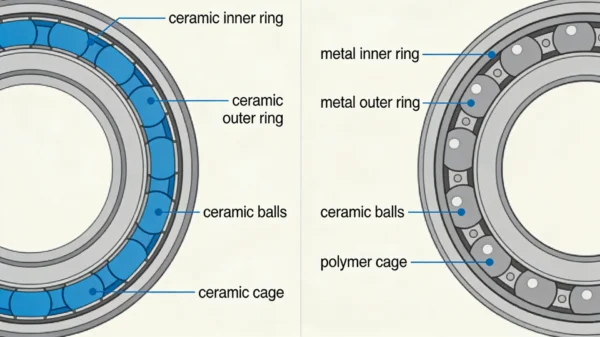
When we talk about the structure, we are really talking about the materials used for each part of the bearing. This choice of material dictates everything about the bearing's performance. In a full ceramic bearing, every critical component is made from advanced ceramic materials like Silicon Nitride (Si₃N₄) or Zirconia (ZrO₂). This creates a uniform product that expands and contracts consistently under heat and is immune to corrosion and magnetism.
A hybrid bearing, on the other hand, takes a "best of both worlds" approach. It combines the hardness, low friction, and light weight of ceramic rolling elements (the balls) with the toughness and impact resistance of metal inner and outer rings. These rings are typically made from standard bearing steel3 (GCr15) for general use or stainless steel (like 440C) for applications needing better corrosion resistance4. This clever combination creates a high-performance bearing that is more robust and affordable than its full ceramic counterpart.
Here’s a simple table to show the difference:
| Component | Full Ceramic Bearing | Hybrid Ceramic Bearing |
|---|---|---|
| Inner Ring | Ceramic (Si₃N₄, ZrO₂) | Metal (GCr15, 440C) |
| Outer Ring | Ceramic (Si₃N₄, ZrO₂) | Metal (GCr15, 440C) |
| Rolling Elements | Ceramic (Si₃N₄, ZrO₂) | Ceramic (Si₃N₄, ZrO₂) |
| Cage | Ceramic or PEEK/PTFE | Metal or Engineered Plastic |
Performance Comparison Under Different Working Conditions?
You know their structure, but how do they actually perform in the real world? A bearing that works in a lab might fail in your high-temp, corrosive factory.
Full ceramic bearings1 excel in extreme conditions like high temperatures (up to 800°C), harsh chemical corrosion, and high-speed, non-lubricated environments. Hybrid bearings offer superior performance to steel but are limited by their metal components, making them ideal for moderate to high-speed industrial applications.
In our experience, matching the bearing to the working condition is the most important step. A full ceramic bearing is the undisputed champion of extreme environments. Its ability to operate at continuous temperatures up to 800°C is something no steel or hybrid bearing can touch. It is also completely inert to most acids and alkalis, making it the only choice for certain chemical processing equipment. Furthermore, since it's non-metallic, it's a perfect electrical insulator and is non-magnetic, which is critical for medical imaging and semiconductor equipment.
Hybrid bearings provide a significant step up from all-steel bearings without the extreme specialization of full ceramics. The ceramic balls are harder and smoother than steel, which reduces friction and allows for higher speeds and lower operating temperatures. This extends grease life and overall bearing longevity. However, their performance is ultimately capped by the metal rings. The temperature limit is usually around 200-300°C, and their corrosion resistance4 depends entirely on whether you choose standard or stainless steel rings.
Let's compare them directly:
| Performance Metric | Full Ceramic Bearing | Hybrid Ceramic Bearing |
|---|---|---|
| Max Temperature | Very High (up to 800°C) | Medium (up to 300°C) |
| Corrosion Resistance | Excellent (Inert to most chemicals) | Good (with stainless steel rings) |
| Max Speed (RPM) | Highest | High (Higher than steel) |
| Electrical Property | Insulating / Non-conductive | Conductive |
| Impact Toughness | Lower | Higher (due to steel rings) |
| Friction Coefficient | Lowest (≈0.001-0.002) | Low (Lower than steel) |
When Should You Choose Full Ceramic Bearings?
Full ceramic bearings1 are powerful, but are they overkill for your application? Paying a premium for features you don't use will only hurt your bottom line.
Choose full ceramic bearings for high-stakes, "no-compromise" environments. This includes aerospace, semiconductor manufacturing, medical equipment, and chemical reactors, where extreme heat, corrosion, high speeds, or non-magnetic properties are absolutely essential for operation and safety.
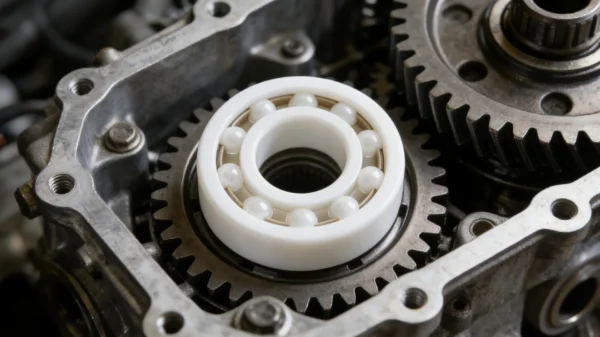
Over the years, We've supplied full ceramic bearings5 to some of the most advanced industries. They aren't just an upgrade; they are an enabling technology. In these fields, a standard bearing simply cannot survive. For example, in semiconductor fabrication, equipment operates in a vacuum or a cleanroom where lubricants would contaminate the process. A full ceramic bearing can run perfectly dry due to its low-friction, self-lubricating properties6. In medical MRI machines, the powerful magnetic fields would instantly destroy a metal bearing, making non-magnetic full ceramic bearings5 the only option.
Think about these specific scenarios. If your equipment involves any of them, full ceramic is likely the right choice:
- Extreme Heat: Inside high-temperature industrial furnaces or aerospace engine components.
- Harsh Corrosion: In chemical pumps and reactors handling strong acids or alkalis.
- High-Purity/Vacuum: For semiconductor wafer processing and scientific instruments.
- Electrical Insulation: To prevent electric arcing in high-performance electric motors or generators.
- Non-Magnetic Needs: For medical imaging (MRI), sensors, and other sensitive electronic devices.
In these cases, the higher initial cost is easily justified by preventing catastrophic failure and ensuring the process runs without interruption.
When Hybrid Ceramic Bearings Are the Smarter Industrial Choice?
You want better performance than steel, but you can't justify the high cost of full ceramic. You feel stuck between a standard part and a premium one. The hybrid bearing is your answer.
Hybrid ceramic bearings are the perfect cost-effective upgrade for conventional machinery. They are ideal for CNC machine spindles, high-speed motors, and power tools where you need higher speeds, longer life, and better wear resistance than steel, but without the extreme environmental demands.
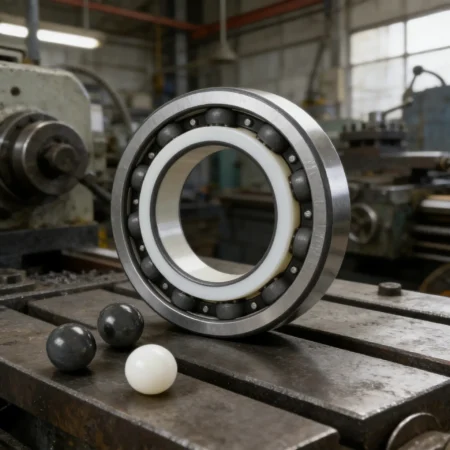
The hybrid bearing is the "sweet spot" for a huge range of industrial customers I work with. They offer a tangible performance boost that you can see in your bottom line. The ceramic balls are significantly harder than steel, meaning they resist wear and deformation under load. This leads to a longer service life and a higher dynamic load capacity7—often up to 1.3 times that of an equivalent all-steel bearing. The lower friction also means the motor or spindle runs cooler and uses less energy, which is a great side benefit.
We remember a client, a European pump manufacturer, who was having issues with shock loads causing premature failures in their full ceramic bearings5. They switched to our hybrid bearings8, which have tough steel rings that handled the impacts perfectly. As a bonus, they reduced their component costs by 40%. This is a classic example of where a hybrid is the smarter choice. It's the go-to for:
- CNC Machines: For faster spindle speeds and greater precision.
- Electric Motors: To increase efficiency, reduce operating temperature, and extend life.
- Textile Machinery: For high-speed components that need long-term reliability.
- Power Tools: To get more power and durability from a compact design.
Cost Difference: Is Full Ceramic Really Worth It?
There is a significant price gap between full ceramic and hybrid bearings8. It's tempting to just pick the cheaper option and hope it works. Let's look at the total cost of ownership9.
The high purchase price of full ceramic bearings is justified only in applications where failure is catastrophic or maintenance is impossible. For most industrial upgrades, the lower initial cost and excellent performance gains of hybrid bearings offer a much better return on investment.
When a customer asks me about price, I always reframe the conversation around value and risk. Yes, a full ceramic bearing can cost many times more than a hybrid. This is due to the difficult and energy-intensive process of manufacturing high-purity ceramic components. However, if that bearing is going inside a satellite or a deep-sea submersible, the cost of the bearing is nothing compared to the cost of failure. In those cases, the reliability and unique properties of a full ceramic bearing make it the only logical choice. The value is in the risk it eliminates.
For the vast majority of my clients, like equipment manufacturers and wholesalers, the math points to hybrid bearings8. They offer perhaps 80% of the performance benefits—higher speed, lower friction, longer life—for a fraction of the cost of going full ceramic. The return on investment is clear: you spend a little more than you would on a standard steel bearing, but you get a machine that runs longer, faster, and more efficiently. This reduces warranty claims, lowers maintenance costs, and makes for a happier end-user. It's an investment that pays for itself.
| Factor | Choose Full Ceramic If... | Choose Hybrid Ceramic If... |
|---|---|---|
| Budget | High; performance is non-negotiable. | Moderate; seeking the best value and ROI. |
| Environment | Extreme (heat, chemical, vacuum, magnetic). | Standard to demanding industrial conditions. |
| Failure Cost | Catastrophic; mission-critical. | Manageable; causes downtime and repair costs. |
| Goal | Ultimate performance and survival. | A significant, cost-effective upgrade from steel. |
Need Help Selecting the Right Type?
You've read all this information, but you're still not 100% sure which bearing is right for your specific machine. Making the wrong choice could still lead to costly mistakes.
Don't leave it to chance. The best way to select the right bearing is to consult an expert who understands the nuances of your application. As a manufacturer with over 30 years of experience, we can help you find the most reliable and cost-effective solution.

Choosing the right bearing is what we do all day, every day. As a source factory with our own casting, housing, and bearing production lines, we have a deep understanding that goes beyond a catalog. We don't just sell parts; we partner with our clients to solve their engineering challenges10. Whether you are an international brand developing a new product line, a distributor needing a stable supply, or an OEM looking for a custom-designed pillow block housing, we have the capability to help. Our daily output of 40 tons of casting and annual production of millions of bearings and housings means we can handle orders of any size.
Tell us about your application. What are the operating speeds and loads? What is the maximum temperature? Is there exposure to moisture or chemicals? With this information, we can guide you to the perfect choice—be it a full ceramic, a hybrid, or one of our many other pillow block bearing solutions. Let our factory-level expertise work for you.
Reach out to us directly for a one-on-one consultation.
Conclusion
Choosing between full ceramic and hybrid bearings depends on your application and budget. Hybrids are a great upgrade for industrial use, while full ceramics are essential for extreme conditions.
Explore the advantages of ceramic bearings to enhance your equipment's performance and reliability. ↩
Discover how the choice of bearings can influence maintenance frequency and costs. ↩
Explore the different types of bearing steel and their applications in various industries. ↩
Explore why corrosion resistance is vital for bearing longevity and reliability in harsh environments. ↩
Discover the specific applications where full ceramic bearings excel and why they are crucial for certain industries. ↩
Discover the benefits of self-lubricating properties in bearings for reduced maintenance. ↩
Learn about dynamic load capacity and its significance in bearing performance. ↩
Learn about hybrid bearings and their unique features that make them suitable for various industrial applications. ↩
Understand the concept of total cost of ownership and its importance in bearing selection. ↩
Learn about the engineering challenges faced in bearing applications and how to overcome them. ↩