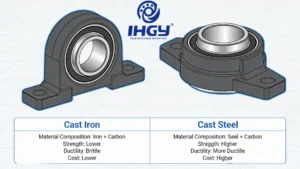
Choosing between cast iron and cast steel bearing housings1 can be confusing and costly if you make the wrong decision. As a bearing housing manufacturer with 30+ years of experience, I've seen many customers struggle with this choice.
The main difference is that cast iron bearing housings2 offer better vibration dampening3 and machinability4 at a lower cost, while cast steel housings provide superior strength and impact resistance5 but at a higher price point. Choose based on your specific load, environment, and budget requirements.

Let me break down the key differences and help you make the right choice for your application, based on my decades of manufacturing experience and thousands of customer cases.
What Are the Key Properties of Cast Iron vs Cast Steel Bearing Housings?
When customers ask me about material selection, I always start by explaining how these two materials fundamentally differ. Understanding these differences is crucial for making the right choice.
Cast iron housings excel in wear resistance6, vibration dampening3, and corrosion resistance7 while being more cost-effective and easier to machine. Cast steel housings offer higher strength, better impact resistance5, and superior load capacity8 but come at a higher cost and are harder to manufacture.
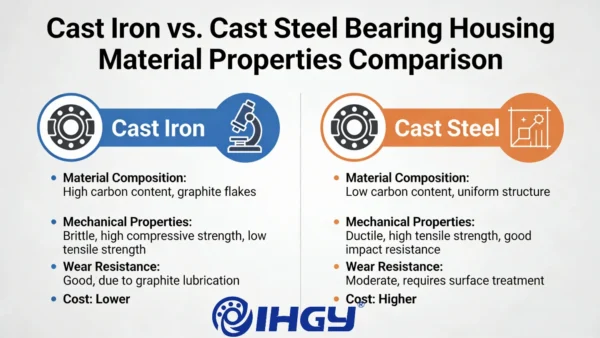
Let's dive deeper into the specific properties and characteristics of each material:
Cast Iron Bearing Housings
-
Mechanical Properties
- Tensile Strength: 150-250 MPa
- Good vibration dampening3
- Excellent wear resistance6
- Moderate impact resistance5
-
Manufacturing Aspects
- Excellent castability
- Superior machinability4
- Lower production costs9
- Complex shapes possible
Cast Steel Bearing Housings
-
Mechanical Properties
- Tensile Strength: 450-700 MPa
- Higher impact resistance5
- Better fatigue strength
- Superior load capacity8
-
Manufacturing Aspects
- More challenging to cast
- Harder to machine
- Higher production costs9
- Better weldability
Which Applications Are Best Suited for Each Material?
After manufacturing millions of bearing housings, I've developed a clear understanding of which material works best in different scenarios.
Cast iron bearing housings are ideal for general machinery, moderate loads (<2000kg), and cost-sensitive applications. Cast steel housings excel in heavy-duty equipment, high-impact environments, and critical applications where failure isn't an option.

Let me share our comprehensive selection guide based on different operating conditions:
Load Environment Considerations
-
Light Load Applications (<500kg)
- Recommended: Gray Cast Iron (Grade 200-250)
- Benefits: Cost-effective, adequate performance
- Typical uses: Conveyor systems, light machinery
-
Medium Load Applications (500-2000kg)
- Recommended: Ductile Iron or Cast Steel (Grade 230)
- Benefits: Good balance of performance and cost
- Applications: General industrial equipment
-
Heavy Load Applications (>2000kg)
- Recommended: Cast Steel (Grade 270-310)
- Benefits: Superior strength and reliability
- Uses: Mining equipment, heavy machinery
Environmental Factors
-
Temperature Conditions
- Normal (-20°C to 100°C): Either material suitable
- High (>100°C): Heat-resistant cast steel recommended
- Low (<-20°C): Special low-temperature grades needed
-
Corrosive Environments
- Mild: Standard materials with surface treatment
- Severe: Stainless steel casting required
- Food grade: Special stainless steel grades needed
How Do Cost and Performance Factor Into the Decision?
Throughout my years in bearing housing manufacturing, cost-performance analysis has always been crucial in helping customers make the right choice.
Cast iron housings typically cost 30-40% less than cast steel alternatives but offer about 60% of the strength. For most general applications, cast iron provides the best value, while cast steel is justified when performance requirements are critical.
Consider these key factors in your decision-making process:
Economic Considerations
-
Initial Investment
- Cast Iron: Lower material and machining costs
- Cast Steel: Higher material and production costs9
-
Lifecycle Costs
- Maintenance requirements
- Expected service life
- Replacement frequency
Performance Requirements
- Critical Factors
- Load capacity needs
- Impact resistance requirements
- Environmental conditions
- Precision requirements
We recommend creating a weighted decision matrix considering these factors:
| Factor | Weight | Cast Iron Score | Cast Steel Score |
|---|---|---|---|
| Cost | 30% | 9 | 6 |
| Strength | 25% | 6 | 9 |
| Machinability | 15% | 8 | 5 |
| Vibration Dampening | 15% | 8 | 6 |
| Corrosion Resistance | 15% | 7 | 7 |
Conclusion
Choose cast iron housings for general applications with moderate loads and cost sensitivity. Opt for cast steel when dealing with heavy loads, high impact, or critical applications where reliability is paramount.
Learn about the superior strength and impact resistance of cast steel bearing housings for demanding applications. ↩
Explore the benefits of cast iron bearing housings, including cost-effectiveness and vibration dampening. ↩
Discover how vibration dampening can enhance the performance and longevity of bearings in machinery. ↩
Discover the factors that influence the machinability of bearing materials and how to choose the right one. ↩
Find out why impact resistance is crucial for bearing housings in heavy-duty applications. ↩
Understand the importance of wear resistance in bearing materials and how it impacts machinery efficiency. ↩
Explore materials that offer excellent corrosion resistance for bearings in harsh environments. ↩
Learn how to assess load capacity for bearing housings to ensure optimal performance in your applications. ↩
Understand the differences in production costs between cast iron and cast steel to make informed decisions. ↩