
Choosing the wrong bearing insert1 often leads to equipment failure. This causes expensive downtime and repairs. Understanding the core designs is key to making a reliable choice from the start.
A mounted bearing insert is the heart of a mounted bearing unit. It is a self-contained ball bearing with a spherical outer surface, a wide inner ring, built-in seals, and a shaft locking device. This design simplifies installation and accommodates shaft misalignment.
As a bearing manufacturer since 1992, I've seen countless engineers face challenges with bearing selection2. It's a critical decision that impacts the lifespan and reliability of your entire machine. A bearing insert1 isn't just a standard bearing; it's a specialized component designed for a specific purpose. Getting it right saves you time, money, and headaches down the road. Let's walk through everything you need to know to select the perfect insert with confidence. This guide will break down the types, features, and selection criteria in a simple way.
What Is a Mounted Bearing Insert?
Are you confused by all the different bearing terms? This confusion can lead to ordering the wrong parts and delaying your projects. Let's make it clear what a bearing insert1 is.
A mounted bearing insert is the core component inside a pillow block or flanged housing. It's a specialized ball bearing with a spherical outer race for self-alignment and a wide inner race that includes a locking mechanism. It also has integrated seals to keep dirt out.
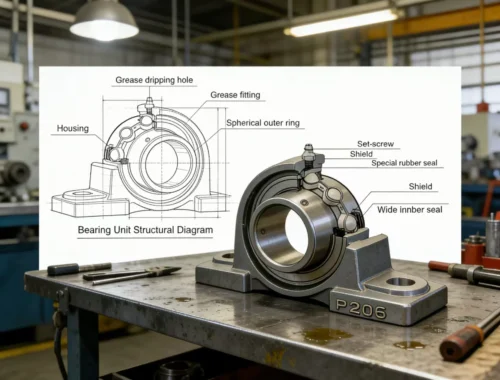
At our company, Yuanguang Bearing, we see the insert as the functional core of any mounted bearing unit. Unlike a standard deep groove ball bearing, which needs to be press-fit into a precision-machined housing, the insert bearing is designed for convenience and adaptability. Its main job is to support a rotating shaft while being held securely within a separate housing. The outer surface of the insert is spherical, while the bore of the housing is matching and concave. This "ball-and-socket" design allows the insert to pivot inside the housing. This is a crucial feature, as it automatically corrects for any initial misalignment between the shaft and the housing, or for any shaft bending that occurs under load. This self-aligning capability makes installation3 much easier and more forgiving. The bearing insert1 is a complete, ready-to-mount solution, widely used in industries like agriculture, conveyor systems, and food processing where precision mounting is not always practical.
Key Design Features of Insert Bearings?
Do all bearing insert1s look the same to you? Choosing based on a quick look can be a big mistake. Let's break down the small features that make a big difference.
Key features include a spherical outer diameter for self-alignment, a wide inner ring for the locking mechanism, and strong seals to block contamination. An anti-rotation pin prevents the outer ring from spinning in the housing, ensuring stable performance.
Every part of a bearing insert1 is designed with a specific purpose in mind. Understanding these features helps you appreciate why one insert works better than another in certain situations. We manufacture these components every day, and the details are what matter most for performance and longevity.
Feature Breakdown: Function and Benefit
Here is a simple breakdown of the most important design features and why they matter for your application.
| Feature | Function | Benefit for You |
|---|---|---|
| Spherical Outer Ring | Mates with the housing to create a ball-and-socket joint. | Allows the bearing to pivot, automatically compensating for initial shaft misalignment. This makes installation easier and reduces stress on the bearing. |
| Wide Inner Ring | Provides a larger surface area on the shaft and houses the locking device. | Offers better shaft support and stability. It's the foundation for the locking mechanism that holds the bearing in place. |
| Seals and Flingers | Create a barrier between the internal components and the outside environment. | Prevents dust, dirt, and moisture from getting in and destroying the bearing. It also keeps the vital lubricating grease from leaking out. |
| Locking Mechanism | A device (e.g., set screws, eccentric collar) that fixes the inner ring to the shaft. | Stops the shaft from spinning inside the bearing's inner ring, ensuring power is transmitted efficiently and preventing shaft wear. |
| Anti-Rotation Device | A pin or dimple on the outer ring that engages with the housing. | Prevents the entire outer ring from spinning within the housing, which could cause heat buildup and damage. |
These features work together to create a robust, easy-to-use bearing unit that can handle tough industrial environments.
Common Types of Mounted Bearing Inserts?
Are you overwhelmed by the different series numbers and types? Picking the wrong one can lead to poor performance. Let's simplify the categories so you can choose with confidence.
Bearing inserts are mainly typed by their outer ring structure and load capacity. Spherical outer rings allow self-alignment and are most common. They also come in standard-duty (e.g., UC200 series) and heavy-duty (e.g., UC300 series) versions for different load requirements.
When selecting an insert, the first step is to understand its basic classification. At our factory, we produce a wide range, but they mostly fall into a few key categories. Thinking about it in terms of structure and strength makes the choice much clearer.
Classification by Outer Ring Structure
The most common type by far is the spherical outer ring insert. As we've discussed, this is the standard for most industrial and agricultural applications because its self-aligning ability is so valuable. However, there is another type: the cylindrical outer ring insert. This type has a straight, flat outer diameter, just like a standard ball bearing. It offers no self-aligning capability. So why use it? It provides higher radial stability and is often used in applications where alignment is already precise, or where the bearing is fitted into a custom-machined sleeve or cartridge.
Classification by Load Capacity
The second major way to classify inserts is by their ability to handle loads. This is usually indicated by the bearing series number.
| Load Series | Key Characteristics | Common Series Prefix | Typical Applications |
|---|---|---|---|
| Standard Duty | Standard ball size and raceway thickness. Balanced for moderate loads and speeds. | UC, NA, ER | General machinery, conveyor systems, HVAC fans, packaging equipment. |
| Heavy Duty | Larger steel balls, thicker inner and outer rings. Designed to handle higher radial loads and shock. | UC300, SA, SB | Agricultural equipment, mining machinery, heavy-duty4 conveyors, construction equipment. |
For example, a UC205 bearing is a standard-duty insert for a 25mm shaft. A UC305 is a heavy-duty4 insert for the same 25mm shaft, but it is physically larger and stronger. Choosing the right load series is critical to prevent premature fatigue failure.
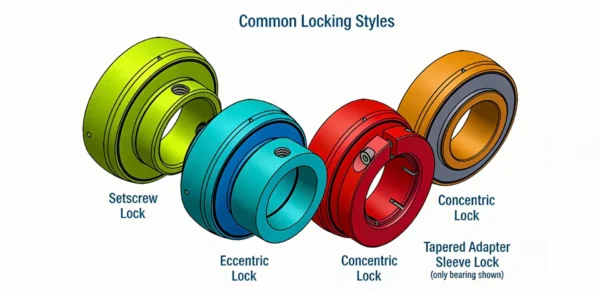
4 Common Bearing Insert Locking Methods?
How do you secure the bearing to the shaft? Using the wrong method can cause slippage or shaft damage. Let's look at the four main ways to do it right.
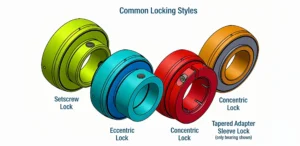
The four common locking methods are the set screw, eccentric locking collar, concentric clamp collar, and adapter sleeve. Each one offers a different balance of holding power, ease of installation, cost, and shaft-friendliness. Your application dictates the best choice.
The locking mechanism5 is what connects the bearing's inner ring to the shaft. Because insert bearings usually have a clearance fit with the shaft, this lock is essential. If the inner ring slips on the shaft, it will cause wear, heat, and eventually, failure. Over my years in the bearing business, I've seen that choosing the right lock is just as important as choosing the right bearing size.
Here's a comparison of the four main methods we produce:
| Locking Method | How It Works | Pros | Cons |
|---|---|---|---|
| Set Screw | Two screws, typically 120° apart, are tightened directly against the shaft. | Simple, low cost, easy to install, good for reversing rotations. | Can mar or damage the shaft. May cause slight imbalance at high speeds. |
| Eccentric Locking Collar | A collar with an eccentric cam is fitted over an extension on the inner ring. It's turned in the direction of rotation and locked with a set screw6. | Self-tightens with rotation, good for high speeds, provides good concentricity. | Only suitable for single-direction rotation. Can be difficult to remove. |
| Concentric Clamp Collar | A separate collar is placed over the inner ring. Tightening screws on the collar squeezes it, clamping the bearing to the shaft with 360° pressure. | Excellent concentricity, minimal vibration, does not damage the shaft. | More expensive, installation3 can be more complex. |
| Adapter Sleeve | A tapered sleeve is placed between the shaft and the tapered bore of the bearing. A locknut tightens the bearing onto the sleeve, which then grips the shaft. | Provides the strongest grip, excellent for heavy loads and high vibration, can be used on undersized shafts. | Most expensive, requires more skill and space to install correctly. |
The most popular by far is the set screw6 lock (like our UC series) due to its simplicity and cost-effectiveness. However, for high-speed or vibration-prone applications, a concentric or adapter sleeve7 lock might be a much better long-term investment.
Set Screw vs Eccentric Locking: Which Is Better?
Are you stuck choosing between a set screw6 and an eccentric locking collar8? It's a common dilemma. Making the wrong choice can lead to failure, especially if your machine reverses direction.
Set screw locking is simple, inexpensive, and works well for reversing or low-speed applications. Eccentric locking collars are great for single-direction, high-speed applications because they self-tighten with rotation. The "better" choice depends on your machine's motion.
These are the two most common locking methods we see customers choosing between. Both are effective, but they are designed for different conditions. I've personally helped customers troubleshoot issues that came down to using an eccentric collar on an application that reversed direction. The collar would simply loosen itself over time. Understanding the fundamental difference is key.
Here's a direct comparison to help you decide:
| Feature | Set Screw Locking (e.g., UC Series) | Eccentric Locking Collar (e.g., NA Series) |
|---|---|---|
| Mechanism | Screws apply direct point pressure on the shaft. | A cam on the collar grips the inner ring, which tightens as the shaft rotates. |
| Direction of Rotation | Works equally well in both forward and reversing directions. | One direction only. If the shaft reverses, the collar will loosen. |
| Holding Power | Good, but can be limited by the screw torque. | Very good in the intended direction of rotation. |
| Shaft Damage | High potential. The screws dig into the shaft, which can make removal difficult and create stress points. | Low potential. The collar applies pressure more broadly, though a set screw is used to lock the collar itself. |
| Vibration | Can introduce a slight imbalance, making it less ideal for very high speeds. | Generally better balanced, making it suitable for higher speeds. |
| Ease of Installation | Very simple. Just tighten the screws with an Allen key. | Simple, but requires turning the collar in the right direction before tightening the set screw. |
My advice is simple: If your machine's shaft spins in only one direction, an eccentric locking collar is an excellent, reliable choice. If the shaft ever needs to reverse, even occasionally, you must use a set screw lock or a more advanced concentric or adapter sleeve lock.
How to Choose the Right Mounted Bearing Insert?
Do you think picking a bearing insert is just about matching the shaft size? This common mistake leads to frequent replacements. Let's cover the full checklist for a durable selection.
To choose the right insert, you must consider the load, speed, alignment needs, and environment (temperature, contamination). Then, evaluate the best locking method, material (e.g., stainless steel), and lubrication requirements for your specific application.
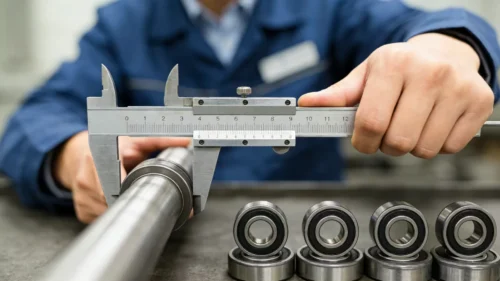
As an OEM/ODM provider, we help equipment manufacturers make this decision daily. A successful design depends on a holistic approach. Simply matching the bore diameter is only the first step. You need to think about how the bearing will live its life inside your machine. A bearing that works perfectly on a clean, low-speed conveyor might fail in weeks on a dirty, high-vibration piece of farm equipment.
Here is a practical checklist I use with clients:
1. Analyze Your Load and Speed
- Load: What is the magnitude (heavy, light) and type (radial, axial, shock) of the load? Heavy or shock loads require a heavy-duty series (like the UC300 series).
- Speed: How fast will the shaft rotate? High speeds generate more heat and may require a bearing with better concentricity, like one with a concentric or adapter lock, to minimize vibration.
2. Assess the Environment
- Contamination: Will the bearing be exposed to dust, dirt, water, or chemicals? If so, you need superior sealing. Look for inserts with multi-lip seals or external flingers.
- Temperature: What is the operating temperature range9? Extreme heat or cold can affect the lubricant, seals, and bearing steel. Special grease or materials may be needed.
- Corrosion: Is the environment humid or corrosive? In food processing or marine applications, a stainless steel insert is often necessary to prevent rust.
- Select the Locking Method and Material
- Based on your speed, load, and rotation direction, choose the appropriate lock (set screw, eccentric, etc.).
- Based on your environment, choose the material (standard chrome steel or stainless steel).
4. Consider Lubrication
- Is the bearing sealed for life, or does it need to be relubricated? Most of our inserts have a grease fitting for adding new grease. High-speed or high-temperature applications will require more frequent relubrication.
By walking through these four steps, you move from a simple size match to a true engineering decision that ensures reliability.
Common Applications of Insert Bearings?
Are you wondering where these versatile bearings are actually used? You might be surprised by how common they are. Understanding their applications can inspire new solutions for your projects.
Insert bearings are workhorses in many industries. You will find them in conveyor systems, agricultural machinery, food and beverage processing equipment, packaging machines, HVAC units, and general industrial fans and blowers due to their easy installation and reliability.

Because we supply to distributors and equipment manufacturers globally, we get a broad view of where our bearings end up. Their robustness and ease of use make them a go-to solution for machinery where perfect alignment isn't guaranteed.
In Agricultural Machinery
This is one of the biggest markets. Think about tractors, combines, and balers. These machines operate in extremely dusty and dirty conditions and experience heavy shock loads. The robust seals and self-aligning nature of insert bearings are perfect for this. Heavy-duty series are common here.
In Conveyor Systems
From airport baggage handling to warehouse logistics, conveyors are everywhere. They often have very long shafts that are difficult to align perfectly. Mounted bearing units with inserts are the ideal solution to support the rollers and drive shafts, making assembly and maintenance simple.
In Food and Beverage Processing
Hygiene is critical in this industry. We supply many stainless steel insert bearings for these applications. They can withstand frequent washdowns with water and cleaning chemicals without rusting. They are often filled with food-grade grease.
In HVAC and Air Handling
The fans and blowers that move air in buildings are often supported by pillow block bearings. The application is typically clean and high-speed. Here, low vibration is important, so bearings with eccentric or concentric locks are often preferred over set screw types.
In Packaging Machinery
Machines that box, wrap, and label products operate at high speeds with continuous motion. Insert bearings are used on rollers, shafts, and moving arms. Their reliability is key to keeping production lines running without interruption.
Common Problems and Maintenance Tips?
Is your bearing failing sooner than you expected? Don't just replace it and hope for the best. Understanding the cause is the only way to prevent a repeat failure.
Common problems include excessive noise, overheating, grease leakage, and vibration. These are often signs of improper installation, lubrication issues, or contamination. Regular visual checks and listening for changes in sound can help you catch problems early.
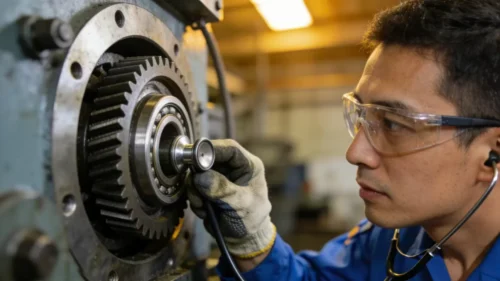
A bearing rarely fails without giving some warning signs. As a manufacturer, our goal is for our products to reach their full calculated lifespan. But that can only happen with proper installation and maintenance. I've seen simple mistakes cut a bearing's life by 90%. Being proactive is the best strategy.
Here are some common problems and what they might mean:
| Problem Symptom | Possible Cause | What You Should Do |
|---|---|---|
| High Temperature / Overheating | Too much or too little grease; operating at speeds too high for the bearing or lubricant. | Check the relubrication schedule. Do not over-grease. Verify the bearing's speed rating. |
| Loud Noise (Squealing, Grinding) | Contamination inside the bearing; damage to the raceways or balls; lack of lubrication. | This is a serious warning. The bearing likely needs to be replaced. Investigate the cause (e.g., failed seals) to protect the new bearing. |
| Vibration | Imbalance from a loose lock; misalignment beyond the bearing's capacity; damage to internal components. | Check the torque on the locking mechanism. Re-check the shaft and housing alignment. If vibration persists, replace the bearing. |
| Grease Leaking from Seals | Over-greasing (purging is normal after initial greasing); damaged seals. | Wipe away excess grease. If leakage continues, the seals may be worn or damaged, and the bearing should be replaced. |
| Reddish-Brown Powder (Fretting) | Micro-movement between the inner ring and the shaft due to a loose fit or insufficient locking force. | This indicates the lock is not secure. Ensure the shaft is within tolerance and the locking mechanism is tightened to the correct specification. |
The best maintenance tip I can give is to simply pay attention. Walk by your machines, listen to them, and look at the bearings. A quick check can save you from a major breakdown.
Frequently Asked Questions About Mounted Bearing Inserts?
Do you still have some specific questions? You're not alone. Many engineers have the same questions. Let's answer the most common ones we get at Yuanguang Bearing.
Common questions are: "Can I relubricate my bearing?", "What do the series letters mean?", and "How much misalignment can it handle?". The answers depend on the specific series, but most are relubricatable and handle a few degrees of static misalignment.
After 30 years in this business, you start to hear the same questions over and over. They are great questions because the answers are critical for proper use. Here are my answers to a few of the most frequent ones.
Can I put any insert into any housing?
Generally, yes, as long as they are from the same series and size. For example, a UC205 insert (for a 25mm shaft) is designed to fit in any 205-series housing (like a UCP205 pillow block or a UCF205 flange unit). The outer dimensions are standardized across the industry. However, for the best possible fit and performance, I always recommend using an insert and housing from the same manufacturer. Small differences in the spherical radius can exist between brands.
What do the letters like 'UC', 'UK', and 'NA' mean?
These prefixes are a shorthand that tells you the type of insert and, most importantly, its locking method. While prefixes can vary slightly between manufacturers, these are the most common ones:
- UC: Set Screw Locking. The most common type.
- NA: Eccentric Locking Collar.
- UK: Tapered Bore for use with an Adapter Sleeve.
- SER: Cylindrical Outer Diameter with a snap ring.
Knowing these prefixes helps you quickly identify the bearing's features when looking at a part number.
How often should I relubricate my bearing insert?
This is the classic "it depends" question. The ideal interval depends on speed, temperature, load, and how dirty the environment is. For normal conditions (moderate speed, under 70°C, clean environment), a yearly relubrication might be fine. For hot, fast, or dirty applications, you might need to relubricate monthly or even weekly. The best practice is to follow the machine manufacturer's recommendation. When in doubt, a small amount of grease added more frequently is better than a large amount added rarely.
Conclusion
Choosing the right mounted bearing insert requires looking at its design, types, and locking methods. This knowledge ensures reliability, prevents downtime, and maximizes your machinery's life.
Explore the definition and importance of bearing inserts in machinery. ↩
Understand the critical factors in bearing selection to avoid costly mistakes. ↩
Get step-by-step guidance on installing mounted bearing inserts correctly. ↩
Learn about heavy-duty bearing inserts and their applications in demanding environments. ↩
Discover the various locking mechanisms used in bearings and their benefits. ↩
Understand the function of set screws in securing bearings to shafts. ↩
Learn how adapter sleeves provide strong connections in bearing applications. ↩
Explore how eccentric locking collars work and their advantages in specific applications. ↩
Discover how temperature variations influence bearing selection and performance. ↩