
Choosing the wrong bearing can lead to costly failures and downtime. Are you struggling to understand the different types of loads bearings face? I'm here to simplify the complex world of radial and axial forces, helping you make the right choice every time.
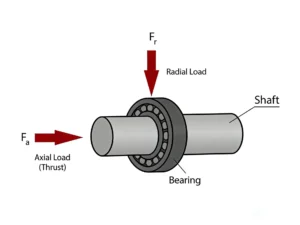
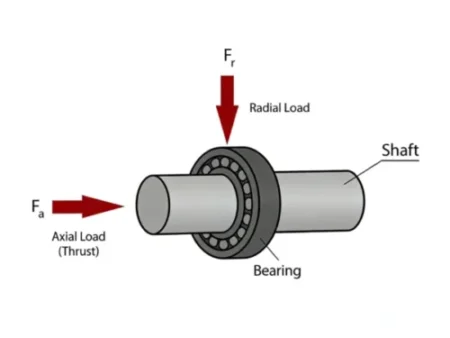
Bearings manage different forces, primarily radial and axial loads. Radial loads push perpendicular to the shaft, like a wheel's weight. Axial loads push parallel to the shaft, such as a car's thrust when braking1. Understanding these load types is crucial for selecting the correct bearing to ensure durability and performance in any application.
As someone who has been immersed in bearing manufacturing since 1992, I've seen firsthand how critical it is to match the right bearing to its intended load. Let me share my insights with you, so we can demystify these fundamental forces and guide you to optimal bearing selection.
What Are Radial and Axial Loads in Bearings?
Do you ever wonder what forces really act on your machine's rotating parts? Misunderstanding these fundamental forces can lead to premature bearing failure and system inefficiency. Let me explain the two primary load types: radial and axial, making it clear how they impact your bearings.
Radial loads act perpendicular to the bearing's axis of rotation, pushing outwards or inwards from the center. Axial loads, also known as thrust loads, act parallel to the bearing's axis, pushing along the shaft's length. Both types of loads are crucial considerations when designing or maintaining machinery.
We've seen many applications over the years where the distinction between radial and axial loads wasn't fully grasped, leading to significant issues. It's a common mistake that can be easily avoided.
Understanding Radial Loads
Imagine a bicycle wheel. When you're riding, the weight of you and the bike pushes down on the axle. This downward force, acting at a right angle to the axle, is a perfect example of a radial load. This force tries to push the shaft sideways, away from its central position. Similarly, in an electric motor2, the weight of the rotor itself and any tension from a belt drive create radial forces on the motor's bearings. These forces continuously try to deflect the shaft. Bearings designed for radial loads, like deep groove ball bearings, have races that can handle this outward or inward pressure effectively, keeping the shaft centered and rotating smoothly. Their internal geometry is optimized to resist these perpendicular forces, ensuring stability and preventing contact between rotating and stationary parts.
Understanding Axial Loads
Now, think about the thrust experienced by a car's wheels when you accelerate or brake. This force pushes the wheel hub along the direction of the axle, not perpendicular to it. This is an axial load, sometimes called a thrust load. Another example is a lathe machine3; when the cutting tool presses against the workpiece, that force is applied parallel to the spindle's axis, creating an axial load on the spindle bearings. Axial loads try to push the shaft lengthwise through the bearing. Bearings like thrust bearings or angular contact ball bearings are specifically engineered to manage these forces, transferring them efficiently along the shaft's axis. These designs prevent the shaft from shifting out of position along its length. Understanding these basic concepts is the first step in ensuring your machinery runs smoothly and lasts longer by preventing incorrect loading.
Key Differences Between Radial Load and Axial Load?
Are you unsure how radial and axial loads fundamentally differ in their impact on bearings? Confusing these two can lead to selecting an unsuitable bearing, risking performance and lifespan. Let me break down the core distinctions between radial and axial forces, showing why each requires specific bearing considerations.
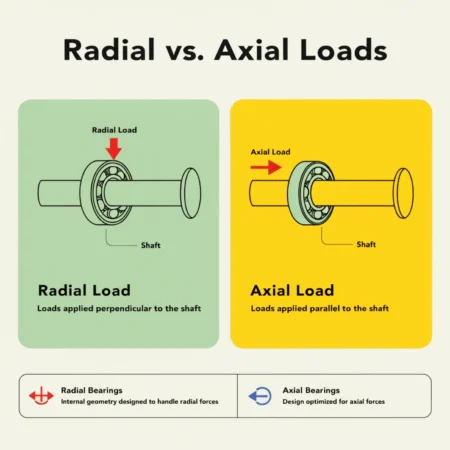
The key difference lies in their direction relative to the shaft: radial loads push perpendicular to the shaft's axis, while axial loads push parallel to it. This directional difference means they stress bearing components in distinct ways, requiring different internal geometries and designs for optimal performance.
When I first started in this industry decades ago, I quickly learned that while both are loads, their impact is very different. It's not just about the direction; it's about how the bearing's internal structure responds to these forces. My experience has shown me that this distinction is crucial for proper engineering.
Direction and Impact
The most obvious difference between radial and axial loads is the direction of the force relative to the rotating shaft. Radial loads act across the shaft, trying to push it sideways or deflect it from its center. Think of it like someone pushing on the side of a spinning top, attempting to knock it off balance. Axial loads, on the other hand, act along the length of the shaft, trying to push it forward or backward, similar to pushing down on the top of that spinning top, forcing it downwards. This fundamental difference in direction dictates how the load is distributed within the bearing's rolling elements and raceways. A bearing designed for radial loads will have its rolling elements and raceways optimized to resist forces that try to separate the inner and outer rings sideways. Conversely, a bearing for axial loads will be structured to transfer forces efficiently along the axis, often with robust shoulders or specific contact angles.
Bearing Component Stress
Each load type places unique stress on the bearing's internal components. For radial loads, the outer and inner rings, along with the rolling elements (balls or rollers), are primarily stressed in a way that resists outward or inward movement. The clearances within the bearing are vital for managing these forces and ensuring smooth rotation without excessive play. If a pure radial bearing encounters significant axial force, its balls or rollers might not make proper contact with the raceway shoulders, leading to skidding and premature wear. For axial loads, the shoulders of the raceways and the contact points of the rolling elements are stressed differently. Bearings designed for axial loads often have steeper contact angles or specific designs to transfer these forces effectively through the bearing, preventing brinelling or deformation4 from direct thrust. This table summarizes the key distinctions I've observed in our many years of manufacturing:
| Feature | Radial Load | Axial Load |
|---|---|---|
| Force Direction | Perpendicular to shaft axis | Parallel to shaft axis |
| Effect on Shaft | Tries to bend or deflect shaft sideways | Tries to push shaft lengthwise |
| Primary Stress | On circumference/sides of raceways and elements | On shoulders/ends of raceways and elements |
| Key Bearing Types | Deep groove ball, cylindrical roller | Thrust ball, thrust roller, angular contact |
| Examples | Weight on wheel, belt tension | Car braking, drill press thrust |
Which Bearings Are Best for Radial and Axial Loads?
Faced with diverse load types, how do you know which bearing will stand up to the challenge? Guessing or choosing incorrectly can lead to premature failure, costly repairs, and operational delays. I will guide you through the best bearing types for pure radial, pure axial, and even combined load scenarios, ensuring optimal performance.
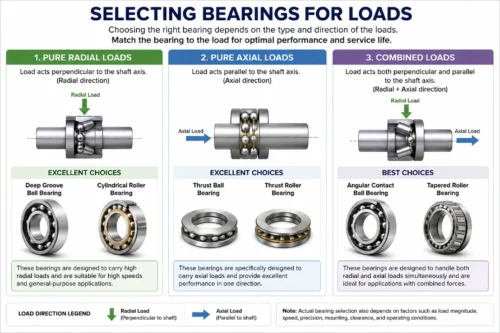
For pure radial loads, deep groove ball bearings and cylindrical roller bearings are excellent choices. For pure axial loads, thrust ball bearings and thrust roller bearings excel. When dealing with combined loads, angular contact ball bearings and tapered roller bearings are often the most suitable, as they can manage both forces simultaneously.
From my perspective, after supplying countless bearings worldwide, I can tell you that selecting the right bearing is an art backed by science. It's about matching the bearing's inherent design strengths to the application's demands. We always start with understanding what forces the bearing will primarily encounter, as this dictates the fundamental bearing type.
Bearings for Pure Radial Loads
When the primary force is perpendicular to the shaft, you need bearings specifically designed to resist side-to-side deflection. These bearings excel at supporting components from moving outward or inward from their central axis.
- Deep Groove Ball Bearings5: These are incredibly versatile and widely used due to their simplicity and reliability. They handle moderate radial loads very well and can tolerate some axial load in both directions, typically up to a fraction of their radial capacity. They are simple, reliable, and cost-effective, making them a default choice for many general industrial applications like electric motors, small gearboxes, and home appliances. Their design ensures smooth rotation with minimal friction under radial stress.
- Cylindrical Roller Bearings6: These bearings are champions for heavy radial loads. Because their rollers have a larger line contact area with the raceways compared to the point contact of balls, they can distribute the load over a wider surface. This makes them incredibly robust for applications that demand high radial capacity, such as large gearboxes, rolling mills, and heavy-duty electric motors. They offer high stiffness and are often used where precise shaft guidance under heavy radial loads is required, as they can also handle high speeds.
Bearings for Pure Axial Loads
For applications where the force acts directly along the shaft's length, specialized thrust bearings are essential. These bearings are designed to withstand forces that attempt to push the shaft longitudinally, either inward or outward.
- Thrust Ball Bearings7: These are designed specifically for axial loads in one direction only. They are not meant to handle radial loads at all and will fail quickly if subjected to them. Think of them in turntable applications, vertical shafts supporting weight, or crane hooks where the weight pushes straight down and there's no significant side load trying to displace the component radially. Their design allows for efficient transfer of pure axial forces.
- Thrust Roller Bearings8 (Cylindrical, Tapered, Spherical): These offer significantly higher axial load capacity than thrust ball bearings. They are used in heavy-duty applications where both the axial load is substantial and robustness is critical. They can handle heavier thrust applications, such as in large industrial machinery, heavy-duty gearboxes, and large pumps, where extreme axial forces need to be managed with reliability and durability.
Bearings for Combined Loads (Radial & Axial)
Many real-world applications involve a mix of both radial and axial forces. Here, specific designs are needed that can effectively manage both types of forces simultaneously without compromising performance or longevity.
- Angular Contact Ball Bearings9: These are my go-to for applications with both radial and significant axial loads. Their unique contact angle allows them to transfer forces through the bearing in a way that supports both directions, distributing the combined stress effectively. They are often used in pairs (duplex arrangements) to handle axial loads in both directions and provide greater stiffness, common in machine tool spindles, pumps, and gear drives where precision and combined load capacity are paramount.
- Tapered Roller Bearings10: These are robust and handle very heavy radial and axial loads. Their tapered design allows them to effectively distribute both types of forces over a large contact area, making them exceptionally strong. They are commonly found in demanding applications like automotive wheel hubs, industrial transmissions, gear drives, and heavy machinery where strength and durability under severe combined stresses are paramount.
The ultimate choice always depends on the specific ratios of radial to axial loads, the required stiffness, speed ratings, and any potential for misalignment in the system.
Common Applications of Radial and Axial Loads?
Do you struggle to see how these abstract load types manifest in real-world machinery? Without practical examples, understanding radial and axial forces can remain a theoretical concept, hindering your ability to diagnose issues. Let me illustrate where radial and axial loads are commonly found, bringing these forces to life with everyday examples.
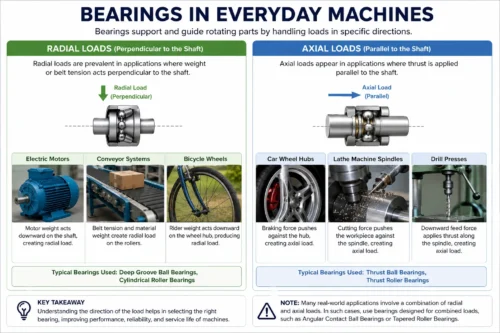
Radial loads are prevalent in applications like electric motors, conveyor systems, and bicycle wheels, where weight or belt tension acts perpendicular to the shaft. Axial loads appear in car wheel hubs during braking, lathe machine spindles during cutting, and drill presses, where thrust is applied parallel to the axis.
Having been in the bearing business for over three decades, I've seen bearings in almost every imaginable machine. It's fascinating how these fundamental load types underpin the function of so much equipment around us, from the simplest bicycle to complex industrial machinery that powers our world.
Real-World Radial Load Scenarios
Radial loads are all about supporting weight or resisting forces that push components sideways, keeping a shaft centered while it rotates.
- Bicycle Wheels: As I mentioned earlier, the rider's weight pressing down on the wheels creates a classic radial load on the wheel bearings. This downward force is constantly acting perpendicular to the axle, and the bearings allow the wheel to spin freely despite this load.
- Electric Motors: The weight of the motor's rotor itself, along with any forces from a coupled belt or gear (like belt tension), apply significant radial loads to the motor shaft bearings. Our deep groove ball bearings and cylindrical roller bearings are frequently used here because they excel at managing these side forces, ensuring the rotor spins freely without unwanted contact with the stator.
- Conveyor Systems: The weight of the conveyed materials, the conveyor belt itself, and the tension in the belt create substantial radial loads on the idler and drive shaft bearings. Our spherical roller bearings or deep groove ball bearings, often housed in our cast iron or ductile iron pillow block units, are commonly specified for these roles due to their ability to withstand heavy radial forces and sometimes accommodate slight misalignment.
Real-World Axial Load Scenarios
Axial loads occur when there's a pushing or pulling force along the axis of rotation, trying to move the shaft lengthwise.
- Car Wheel Hubs11: When you hit the brakes or accelerate, a powerful thrust is generated along the axle, applying an axial load on the wheel bearings. This thrust attempts to push the wheel assembly inward or outward. This is precisely why robust tapered roller bearings are so crucial in automotive applications; they are designed to manage these powerful axial forces generated during driving.
- Lathe Machines: The cutting force exerted by the tool on the workpiece pushes directly along the spindle's axis. This requires spindle bearings, often angular contact bearings, to handle substantial axial loads with high precision, maintaining workpiece stability and preventing chatter during machining operations.
- Drill Presses: When you push down on the handle to drill a hole, that downward force is an axial load on the spindle bearing. This direct thrust needs to be efficiently transferred, often by thrust bearings or angular contact bearings, to ensure accurate drilling without excessive wear on the internal components.
Combined Load Examples
Many applications feature both types of loads working together, creating complex stress profiles that our engineers must address to ensure robust performance.
- Car Suspension Systems: Wheel bearings in a car simultaneously experience the vehicle's weight (a radial load, pushing down) and the forces from cornering, accelerating, or braking (significant axial loads, pushing along the axle). This combination requires bearings that can handle both effectively, like tapered roller bearings, which are robust against these dual forces.
- Wind Turbines12: The main shaft bearings in a wind turbine face an incredibly demanding environment. They must handle the massive weight of the rotor and blades (a radial load, pulling downwards) and the immense thrust from the wind pushing on the blades (a powerful axial load, pushing along the shaft). This is a critical application for specialized, heavy-duty bearings like spherical roller bearings or large tapered roller bearings, designed for maximum resilience under these severe combined stresses.
Understanding these real-world scenarios helps in appreciating why specific bearing types are chosen for specific tasks, and why a one-size-fits-all approach simply doesn't work in our industry.
What Happens If the Wrong Bearing Is Selected?
Are you aware of the serious consequences that arise from choosing an unsuitable bearing? A misstep in bearing selection can lead to catastrophic equipment failure, costly downtime, and even safety hazards. Let me walk you through the real-world implications of using the wrong bearing, emphasizing why proper selection is non-negotiable.
Selecting the wrong bearing for a given load type drastically reduces its lifespan, leading to premature failure. This can cause increased friction, overheating, excessive vibration, component damage, and ultimately, complete machinery breakdown, resulting in significant repair costs and lost productivity.
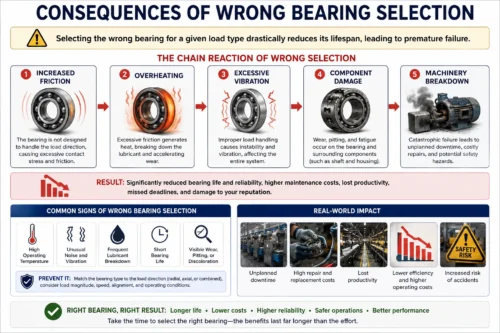
In my long career at Yuanguang Bearing Co., Ltd., I've witnessed firsthand the fallout from incorrect bearing choices. It's a costly mistake that can be easily avoided with proper knowledge and a thorough understanding of the application's demands. This is why we are so passionate about helping our customers make the right choice every time, preventing these avoidable failures.
Premature Failure and Wear
This is the most common and immediate outcome. If a bearing designed primarily for radial loads is subjected to significant axial loads, its internal components aren't equipped to handle that stress efficiently. The balls or rollers might skid instead of roll, leading to excessive wear on the raceways and rolling elements. The contact points will be stressed beyond their design limits, causing pitting, spalling, and rapid degradation of the surface. Conversely, an axial-load bearing used radially will quickly fail as its design offers little support against perpendicular forces, leading to quick breakdown of the raceway shoulders and loss of containment for the rolling elements. Such failures significantly shorten the operational life of the bearing, sometimes by orders of magnitude, making replacement necessary far sooner than expected.
Increased Friction and Overheating
When a bearing is overloaded or improperly loaded, its components rub against each other inefficiently. The rolling elements may not roll smoothly as intended, leading to increased sliding friction rather than efficient rolling friction. This generates excessive heat within the bearing, which can rapidly degrade the lubricant, breaking down its protective properties. As the lubricant breaks down, its protective film weakens, leading to metal-to-metal contact, further friction, and ultimately, thermal failure of the bearing material itself. I remember a case where a customer used a standard deep groove ball bearing in an application with unexpected high axial thrust; it heated up so much that the grease turned to carbon, and the bearing seized completely within weeks. This type of overheating can also affect adjacent components.
Excessive Vibration and Noise
A failing bearing, especially one operating under incorrect load conditions, will typically produce noticeable vibration and noise. This isn't just an annoyance; it's a critical symptom of internal damage such as worn raceways, damaged rolling elements, or increased internal clearance. This excessive vibration can transfer stress to other machine components, potentially causing a cascade of failures throughout the system, affecting gear teeth, shafts, and other precision parts by subjecting them to unintended dynamic loads. The noise itself can be an indicator of the type of failure occurring, with grinding or rattling sounds often signaling impending doom for the bearing.
Damage to Adjacent Components
When a bearing fails, fragments of metal can break off and contaminate the machinery's lubrication system. These abrasive particles can then circulate and damage other bearings, gears, and seals within the system, accelerating wear throughout. Furthermore, the increased play or misalignment caused by a failing bearing can put undue stress on shafts, gears, and seals, leading to their early demise. A shaft that's no longer properly supported can bend or vibrate excessively, causing catastrophic damage to the entire system, potentially requiring costly replacements of multiple parts. This secondary damage often far exceeds the cost of replacing the bearing itself.
Downtime and Cost
The ultimate consequence of incorrect bearing selection is unplanned downtime. Production stops unexpectedly, maintenance teams scramble to identify and rectify the issue, and replacement parts are needed, sometimes custom ones from specialized suppliers. The cost of a new bearing is usually small compared to the lost production time, labor expenses, and potential damage to reputation due to production delays. For our OEM/ODM customers and distributors, these unplanned stops are a major concern, directly impacting their profitability and customer satisfaction. That's why we emphasize getting the selection right the first time to ensure their products deliver consistent reliability.
It's clear that a small oversight in bearing selection can have a ripple effect throughout an entire operation, making careful consideration essential for long-term success.
How to Choose the Right Bearing for Combined Loads?
Most real-world applications involve both radial and axial forces, making bearing selection complex. Without a clear strategy, choosing the optimal bearing for combined loads feels like a guessing game, risking efficiency and longevity. I'll share my proven approach to selecting the perfect bearing for applications experiencing both radial and axial forces, ensuring robust performance.
For combined loads, consider angular contact ball bearings or tapered roller bearings, as they are specifically designed to handle both radial and axial forces simultaneously. The choice depends on the load magnitude, ratio of radial to axial force, speed, and desired stiffness, often requiring consultation with bearing specialists.
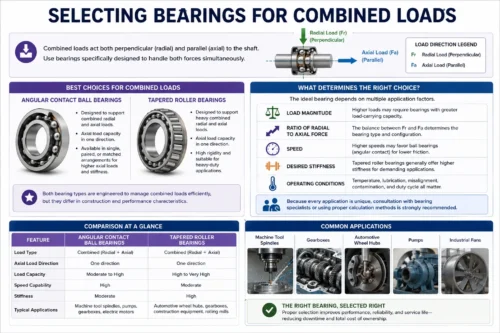
Choosing a bearing for combined loads is where experience truly comes into play. It's rarely just one type of force; usually, it's a complex mix that challenges even seasoned engineers. At Yuanguang Bearing, this is a common challenge our engineers help customers solve every day, often involving a detailed analysis to ensure the perfect fit for OEM/ODM specifications and optimal performance.
Analyze the Load Profile Thoroughly
The first and most critical step is always to quantify both the radial (Fr) and axial (Fa) loads accurately. This means understanding not just the maximum radial load and maximum axial load, but also how these loads behave over time. Are these loads constant, or do they fluctuate significantly with operational cycles? Is there any potential for shock loading, sudden impacts, or reversal of direction for axial forces? We also consider the direction of the axial load – is it unidirectional, or does it reverse? This detailed data forms the foundation of any reliable bearing selection. Without precise and comprehensive load information, even the most experienced engineer is just guessing, leading to suboptimal choices.
Calculate the Fa/Fr Ratio
The ratio of axial load to radial load (Fa/Fr) is a key factor in determining the appropriate bearing type. This ratio helps us understand which type of bearing geometry and internal design will best distribute the combined stresses, providing the best balance of load handling.
- Low Fa/Fr Ratio: If the axial load is much smaller than the radial load (e.g., Fa is less than 0.1 * Fr), a standard deep groove ball bearing might suffice, provided its inherent axial capacity isn't exceeded. These bearings have some capability to handle minor axial thrust in addition to their primary radial function.
- Moderate Fa/Fr Ratio: For applications where axial loads are significant but not dominant (e.g., Fa is between 0.1 Fr and 1 Fr), angular contact ball bearings are often an excellent choice. Their specific contact angle allows them to effectively manage both radial and axial forces. A larger contact angle (e.g., 40°) means higher axial load capacity, while a smaller angle (e.g., 15-25°) favors radial loads and higher speeds, offering a range of options for fine-tuning.
- High Fa/Fr Ratio: If the axial load is comparable to or greater than the radial load (e.g., Fa is greater than 1 * Fr), then robust tapered roller bearings or spherical roller bearings are typically needed for their superior combined load capacity. These bearings are designed to handle very heavy axial thrust while simultaneously supporting substantial radial forces, making them ideal for demanding applications.
Consider Other Critical Factors
Beyond the load ratio, several other application-specific factors significantly influence the final selection process:
- Operating Speed: Higher rotational speeds often favor ball bearings due to their lower friction and reduced heat generation. Roller bearings, while incredibly robust, might generate more heat at very high speeds, potentially requiring more elaborate cooling or lubrication systems.
- Required Stiffness: Applications demanding high rigidity and minimal shaft deflection (like precision machine tool spindles or robotics) might require preloaded angular contact bearings or pairs of tapered roller bearings to achieve the necessary stiffness for accurate operation.
- Space Constraints: The physical dimensions and available mounting space can severely influence the bearing type and series chosen. Sometimes, a compact solution might involve a specially designed single bearing that handles multiple functions within a tight envelope.
- Lubrication Method: The type of lubrication (grease or oil) and its ability to handle the generated heat, operating environment (temperature, contaminants), and expected service life is also important for bearing longevity and overall system efficiency.
- Potential for Misalignment: If there's a possibility of shaft misalignment or housing distortion due to manufacturing tolerances, thermal expansion, or structural settling, self-aligning ball bearings or spherical roller bearings are excellent choices as they can accommodate angular displacement without detrimental internal stress build-up.
Consulting Bearing Experts
For complex combined load situations, I always recommend consulting with experienced bearing manufacturers like Yuanguang Bearing. We have the engineering tools, advanced software for load simulation, and decades of application knowledge to analyze stresses and recommend the optimal bearing solution. We can even provide OEM/ODM services, developing customized bearings tailored precisely to your application's unique combined load requirements, ensuring maximum performance, reliability, and service life. Our goal is to make sure your machinery operates perfectly with the right bearing, providing peace of mind and long-term value.
Conclusion
Understanding radial and axial loads is fundamental to bearing selection. Radial loads act perpendicular, axial loads parallel to the shaft. Mischoosing leads to premature failure and costly downtime. For combined loads, expert analysis of load ratios and application specifics ensures optimal bearing performance and longevity.
"Bad Wheel Bearing = Brake Failure??? Why checking ... - YouTube",
. Tapered roller bearings in automotive wheel hubs are designed to withstand axial loads generated during braking, where the thrust force acts parallel to the axle. These bearings facilitate smooth wheel rotation while managing the axial forces from braking. Evidence role: case_reference; source type: research. Supports: Tapered roller bearings in car wheel hubs experience axial loads during braking due to the thrust generated.. Scope note: The exact magnitude of axial load during braking varies based on vehicle speed, braking force, and road conditions. ↩"Motor Sizing Basics Part 4 - How to Calculate Radial Load and Axial ...", https://blog.orientalmotor.com/motor-sizing-basics-part-4-radial-load-and-axial-load. Electric motor bearings experience radial loads due to the rotor's weight and belt tension, which act perpendicular to the shaft. These forces necessitate bearings designed to handle radial stress to ensure smooth operation and prevent premature failure. Evidence role: case_reference; source type: research. Supports: The weight of the rotor and belt tension in electric motors create radial loads on the bearings.. Scope note: The magnitude of radial load varies based on motor size, rotor weight, and belt tension. ↩
"[PDF] Cutting Forces in Turning Operations - UPCommons", https://upcommons.upc.edu/server/api/core/bitstreams/41a080fb-49e9-4f68-9a6c-5e2d04eb950f/content. In lathe machines, the cutting force exerted by the tool on the workpiece generates an axial load on the spindle bearings. This force, acting parallel to the spindle's axis, requires bearings designed to withstand axial stress to maintain precision and stability during machining. Evidence role: case_reference; source type: research. Supports: The cutting force in a lathe machine creates an axial load on the spindle bearings.. Scope note: The magnitude of axial load varies based on cutting depth, feed rate, and material hardness. ↩
"[PDF] design, analysis, and testing of high performance bearings in a high ...", https://oaktrust.library.tamu.edu/bitstream/1969.1/163500/1/T2331-42.pdf. Axial load bearings incorporate design features such as steeper contact angles to distribute thrust forces effectively, preventing brinelling or deformation of the raceways and rolling elements. These design adaptations ensure the bearing can withstand axial stress without compromising its structural integrity. Evidence role: mechanism; source type: research. Supports: Bearings designed for axial loads prevent brinelling or deformation through specific design features.. Scope note: The effectiveness of these design features depends on the magnitude and consistency of the axial load. ↩
"Deep groove ball bearings: what are they and what are they used for?", https://www.umbragroup.com/media/news/3954/deep-groove-ball-bearings-what-are-they-and-what-are-they-used-for. Deep groove ball bearings are widely used due to their versatility in handling radial and axial loads, simplicity in design, and reliability in various applications. Evidence role: general_support; source type: encyclopedia. Supports: Deep groove ball bearings are versatile and widely used.. ↩
"Cylindrical roller bearings | SKF", https://www.skf.com/group/products/rolling-bearings/roller-bearings/cylindrical-roller-bearings. Cylindrical roller bearings are designed to handle heavy radial loads due to their large contact area, making them suitable for applications requiring high load capacity and stiffness. Evidence role: general_support; source type: research. Supports: Cylindrical roller bearings are used for heavy radial loads.. ↩
"The Secret to Smooth Operation for Thrust Ball Bearings - PIB Sales", https://pibsales.com/bearings/the-secret-to-smooth-operations-thrust-bearings/?srsltid=AfmBOor6ZTK8NT6TG2B4GTrZG7OmoYRUHrIZ8xbwE0LVIAmyuMQDHUpk. Thrust ball bearings are specifically designed to handle axial loads in a single direction, providing efficient support for thrust forces while precluding radial load capacity. Evidence role: definition; source type: encyclopedia. Supports: Thrust ball bearings are designed for axial loads in one direction only.. ↩
"Estimating the max axial (thrust) load of a deep groove ball bearing", https://www.reddit.com/r/engineering/comments/11dfo0f/estimating_the_max_axial_thrust_load_of_a_deep/. Thrust roller bearings, including cylindrical, tapered, and spherical types, offer significantly higher axial load capacity compared to thrust ball bearings due to their increased contact area and robust design. Evidence role: statistic; source type: research. Supports: Thrust roller bearings have higher axial load capacity than thrust ball bearings.. ↩
"Guide To Angular Contact Ball Bearing Combinations In Varying ...", https://decentmachinery.com/guide-to-angular-contact-ball-bearing-combinations-in-varying-applications/. Angular contact ball bearings are designed to handle both radial and axial loads simultaneously, making them suitable for applications requiring combined load support and high precision. Evidence role: general_support; source type: encyclopedia. Supports: Angular contact ball bearings are used for both radial and axial loads.. ↩
"Tapered roller bearing - Wikipedia", https://en.wikipedia.org/wiki/Tapered_roller_bearing. Tapered roller bearings are designed to manage heavy radial and axial loads due to their tapered design, which distributes forces effectively over a large contact area. Evidence role: general_support; source type: research. Supports: Tapered roller bearings handle heavy radial and axial loads.. ↩
"Bad Wheel Bearing = Brake Failure??? Why checking ... - YouTube",
. In car wheel hubs, braking and acceleration generate axial loads on the wheel bearings due to the thrust forces along the axle, necessitating the use of robust bearings like tapered roller bearings to manage these loads effectively. Evidence role: case_reference; source type: research. Supports: Braking or accelerating generates axial load on the wheel bearings in car wheel hubs.. Scope note: The magnitude of axial load varies based on vehicle speed, braking force, and road conditions. ↩"[PDF] Wind Turbine Design Guideline DG03: Yaw and Pitch Bearings", https://docs.nrel.gov/docs/fy24osti/89161.pdf. Wind turbine main shaft bearings are subjected to both radial loads from the weight of the rotor and blades, and axial loads from wind thrust, requiring specialized bearings designed for combined load conditions. Evidence role: case_reference; source type: research. Supports: Wind turbines experience both radial and axial loads on their main shaft bearings.. Scope note: The specific load distribution varies based on turbine design and wind conditions. ↩