
Are you struggling to pick the right bearing for your industrial machinery? The wrong choice can lead to costly breakdowns and efficiency loss. Let's cut through the confusion and help you decide between ball bearings and roller bearings.
Ball bearings and roller bearings serve similar functions but differ in how they manage loads. Ball bearings handle lighter loads at higher speeds with less friction due to point contact, while roller bearings support much heavier radial loads and impact forces thanks to their line contact1, making them ideal for demanding industrial applications.
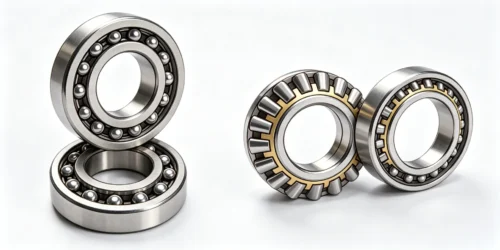
Choosing the correct bearing type is crucial for your equipment's performance and longevity. As a company with decades of experience in bearing manufacturing, we've seen firsthand how the right selection impacts everything from operational efficiency to safety. Let's explore the key differences and help you make an informed decision for your specific needs.
What’s the Difference Between Ball Bearings and Roller Bearings?
Ever wonder what makes bearings work differently? The core distinction lies in how they contact surfaces. This small detail changes everything about their performance. Let's uncover the fundamental mechanics.
The primary difference is their contact mechanism: ball bearings use point contact, offering lower friction and higher speeds, whereas roller bearings use line contact, providing superior load-carrying capacity for heavy-duty radial forces.
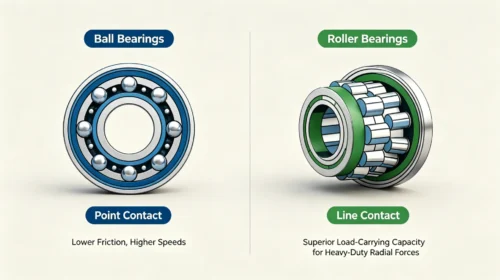
When we talk about bearings, the way the rolling elements meet the raceway is super important. I often tell our customers that this contact form is the most basic difference. Ball bearings use a "point contact." This means the ball touches the raceway at a very small spot. Because this contact area is tiny, it generates less friction, which is great for fast-moving parts and smooth starts. However, this small contact point also means high stress if the load is too heavy. In contrast, roller bearings use "line contact." Their rolling elements – which can be cylinders, cones, or spheres – touch the raceway along a line. This spreads the load over a much bigger area. As a result, roller bearings can handle much larger radial loads, sometimes two to four times more than a ball bearing of the same size2. This line contact also makes them tougher against shock loads. This is why you often see roller bearings in heavy machinery that deals with lots of vibration.
Point vs. Line Contact
Ball bearings use a point contact. This means the pressure from the load is concentrated in a tiny spot. Roller bearings use a line contact. This means the load's pressure is spread out along a longer line.
Radial Load Capabilities
Ball bearings work well for light to medium radial loads. Roller bearings are much better for heavy radial loads. This is their main strength.
Axial and Impact Loads
Some ball bearings, like angular contact types, can handle axial loads in both directions. Tapered roller bearings also manage axial loads, but they often need to be paired to balance forces. For shock loads, roller bearings are stronger because their line contact resists denting or marking the raceway better than ball bearings. Ball bearings can get indentations if hit hard.
| Feature | Ball Bearings | Roller Bearings |
|---|---|---|
| Contact Type | Point Contact | Line Contact |
| Contact Area | Very small | Significant |
| Radial Load Capacity | Light to medium | High to very high (2-4x) |
| Axial Load Capacity | Good (angular contact) | Good (tapered roller, paired) |
| Shock Load Resistance | Less resistant (indentation) | Highly resistant (tougher) |
Ball Bearings vs Roller Bearings — Load Capacity Comparison?
Are your machines struggling under heavy loads? The type of bearing you choose directly impacts how much weight your equipment can handle. Let's see which one stands up best.
Roller bearings typically offer 2 to 4 times the radial load capacity of ball bearings of the same size because their line contact distributes stress over a larger area, making them superior for heavy industrial applications.
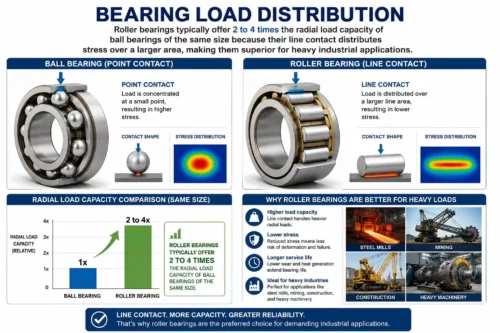
When our customers talk about heavy equipment, I always emphasize load capacity. The line contact in roller bearings is a game-changer here. Think of it like this: if you push a sharp pencil point onto a surface, it makes a deep mark (point contact). If you lay the pencil flat and push, the pressure is spread out, making a lighter, longer mark (line contact). That's why roller bearings, with their line contact, can support significantly more weight. They spread the load over a larger area. This reduces the stress on any single point in the bearing. This makes them much more robust for applications that deal with heavy radial forces, such as in rolling mills or large electric motors. For example, a cylindrical roller bearing is a top choice for pure radial loads because its design is all about maximizing that line contact. Ball bearings, on the other hand, are limited. They work for light to medium radial loads. If you put too much weight on them, the small contact points get overloaded, leading to early failure from fatigue.
Radial Load Dominance
If your work mostly involves heavy radial loads, I always recommend roller bearings. Cylindrical roller bearings are especially good here. Ball bearings are fine for lighter radial loads but not for very heavy ones.
Managing Axial Forces
Angular contact ball bearings are designed to handle both radial and axial loads. They are quite versatile. Tapered roller bearings also handle axial loads, often when used in pairs. This setup helps them balance forces.
Withstanding Shock Loads
Roller bearings are very good at handling sudden impacts and vibrations. Their line contact gives them better resilience. This is why they are often chosen for construction machinery. Ball bearings can get damaged more easily under strong shocks, sometimes leaving dents on the raceway that lead to early failure.
| Load Type | Ball Bearing Suitability | Roller Bearing Suitability |
|---|---|---|
| Radial Load | Light to medium; good for general use | Heavy to very heavy; primary strength |
| Axial Load | Angular contact ball bearings excel | Tapered roller bearings (paired) good |
| Combined Load | Angular contact, deep groove (limited) | Tapered roller, spherical roller |
| Shock Load | Prone to brinelling/indentation | High resistance; more robust |
Which Bearing Type Performs Better at High Speed?
Do your operations demand high-speed precision? Not all bearings can handle intense rotational speeds without overheating or failing. Let's discover which bearing is built for speed.
Ball bearings generally perform better at high speeds due to their lighter rolling elements and point contact, which generate less friction and heat compared to roller bearings, allowing for higher limiting speeds and better thermal stability.
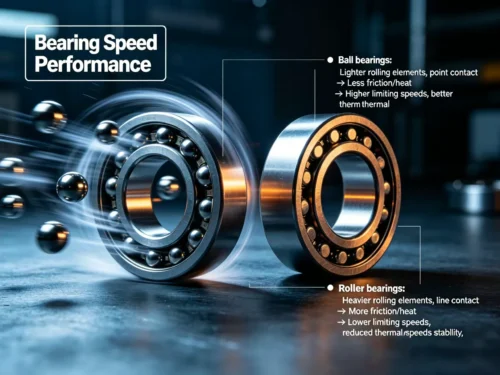
When speed is the main concern, I tell my customers to look at ball bearings first. Ball bearings have lighter rolling elements, which means less centrifugal force pushing them outwards when they spin fast3. Their point contact also creates less friction. This leads to less heat being generated. This is critical for high-speed operations. This is why deep groove ball bearings or angular contact ball bearings are usually the go-to for applications like machine tool spindles, high-speed motors, or turbine machinery where speeds can exceed 10,000 RPM4. Roller bearings face challenges at high speeds. The "line contact" that gives them great load capacity also creates more friction as speed increases. Specifically, the ends of the rollers can rub against the flanges, causing a lot of heat. This can lead to lubrication breakdown and rapid failure. Even with special designs, like optimized roller end shapes or special cages, roller bearings struggle to match the high-speed performance and thermal stability of ball bearings.
Friction and Heat Generation
Ball bearings have lower friction. This means they produce less heat when running. Roller bearings create more friction, especially at high speeds, leading to more heat.
Limiting Speeds Explained
Ball bearings typically have a much higher limiting speed. This is because they have lighter parts and less rubbing. Roller bearings have lower limiting speeds. If they go too fast, they can overheat and seize.
Thermal Stability in Action
Ball bearings keep their cool better at high speeds. They are more thermally stable. Roller bearings need special features to handle high-speed heat. Without them, they can fail quickly.
| Factor | Ball Bearings | Roller Bearings |
|---|---|---|
| Rolling Element | Lighter, less centrifugal force | Heavier, higher centrifugal force |
| Friction Torque | Lower (start-up and running) | Higher (especially at speed) |
| Heat Generation | Lower | Higher, requires special designs |
| Limiting Speed | Higher (often significantly) | Lower (unless specially designed) |
| Best Use Case | Spindles, high-speed motors, turbines | Heavy-duty, lower to moderate speeds |
Maintenance, Lubrication, and Service Life Comparison?
Are you tired of constant bearing maintenance? The long-term costs and upkeep demands vary greatly between bearing types. Let's look at what goes into keeping them running.
Ball bearings often require simpler lubrication and maintenance, sometimes offering "lubricated for life" options, while roller bearings demand more rigorous lubrication schedules and higher-viscosity lubricants due to their heavy load and impact nature5.
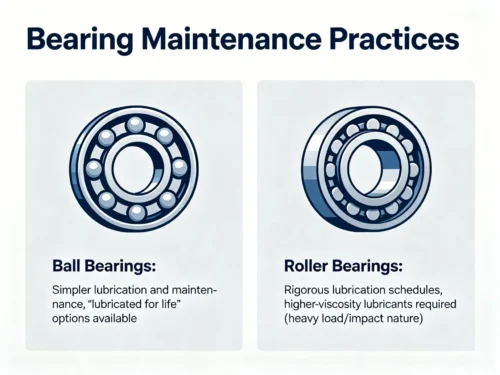
When customers ask about the total cost of ownership, I always bring up maintenance and lubrication. Ball bearings often have simpler lubrication needs. Many sealed ball bearings are "lubricated for life," meaning you install them and don't worry about adding grease later. This cuts down on maintenance time and labor costs. They are also less sensitive to the precise type or cleanliness of the lubricant. This simplicity makes ball bearings a good fit for mass-produced items and many consumer products. Roller bearings are different. Because they handle heavier loads and often experience more friction, especially at speed, they need more careful lubrication. They often require higher viscosity lubricants. Also, you need to add grease or change oil more often. The cleanliness of the lubricant is also super important for roller bearings because small particles can cause wear in the line contact area. While their initial cost might be higher, roller bearings can offer a longer service life in heavy-duty applications, if maintained correctly. For critical equipment like wind turbine gearboxes6, investing in robust roller bearings, despite the higher initial cost and maintenance, can prevent very expensive unscheduled downtime.
Lubrication Regimes
Ball bearings often need less frequent lubrication. Many come sealed and pre-lubricated for their entire life. Roller bearings demand more attention. They need higher quality, thicker lubricants and often require regular re-greasing or oil changes to prevent wear.
Expected Service Life
If selected correctly for their specific application, both bearing types can offer long service lives. However, roller bearings, when used in their intended heavy-load conditions, often provide superior longevity due to their robust design. Ball bearings can last a long time in light to medium load settings.
Total Cost of Ownership
Ball bearings typically have a lower initial cost and lower maintenance costs. This makes them good for general use. Roller bearings might cost more to buy and need more maintenance. But for heavy-duty, critical machines, their long, reliable life can actually make them more cost-effective overall by avoiding expensive breakdowns.
Noise and Vibration Footprint
Ball bearings generally run quieter and smoother. This makes them suitable for applications where low noise is important, like home appliances. Roller bearings, especially under heavy loads, can produce more noise and vibration. Sometimes, extra sound dampening is needed.
| Aspect | Ball Bearings | Roller Bearings |
|---|---|---|
| Lubrication | Simpler, less frequent; "lubed for life" options | More demanding, higher viscosity, regular top-ups |
| Maintenance | Lower | Higher, crucial for heavy-duty applications |
| Initial Cost | Generally lower, high standardization | Generally higher, specialized designs |
| Downtime Risk | Higher if overloaded | Lower in heavy loads (if correctly selected) |
| Noise/Vibration | Lower, smoother operation | Can be higher, especially under heavy loads |
| Lifetime (correct use) | Good | Excellent in heavy-duty conditions |
Best Bearing Types for Different Industrial Applications?
Unsure which bearing fits your specific machine? Matching the right bearing to its application is critical for optimal performance and avoiding premature failure. Let's find the perfect fit.
For applications with light to medium loads and high speeds, ball bearings are often ideal, while roller bearings are the go-to for heavy radial loads, impact, and where robust performance under harsh conditions is paramount.
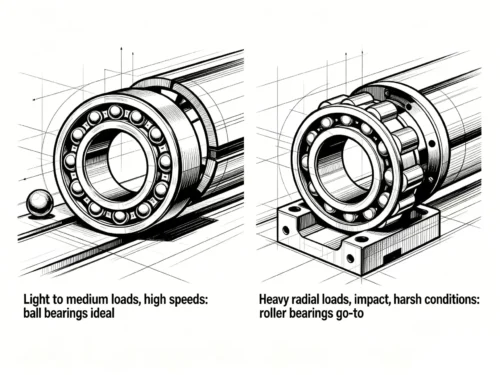
From my experience, choosing the right bearing is never a one-size-fits-all solution. It's about matching the bearing's strengths to the specific demands of the machine. For instance, if you have a high-speed motor or a precision spindle, a deep groove ball bearing or an angular contact ball bearing is usually the best choice. These bearings offer the precision and low friction needed for such applications. On the other hand, if you're working with a heavy-duty gearbox in a wind turbine or a large piece of construction equipment, then spherical roller bearings or tapered roller bearings are what you need. They are built to handle the immense radial and sometimes axial loads, along with the constant vibrations and impacts. We also consider things like alignment. If your shaft might flex or if the installation isn't perfectly aligned, you need a self-aligning bearing. Self-aligning ball bearings work well for lighter loads and misalignment, while self-aligning roller bearings offer much higher load capacity for misaligned, heavy-duty situations7. We also look at space. For example, needle bearings, a type of roller bearing, are fantastic when you need high load capacity but have very little radial space8.
Applications for Ball Bearings
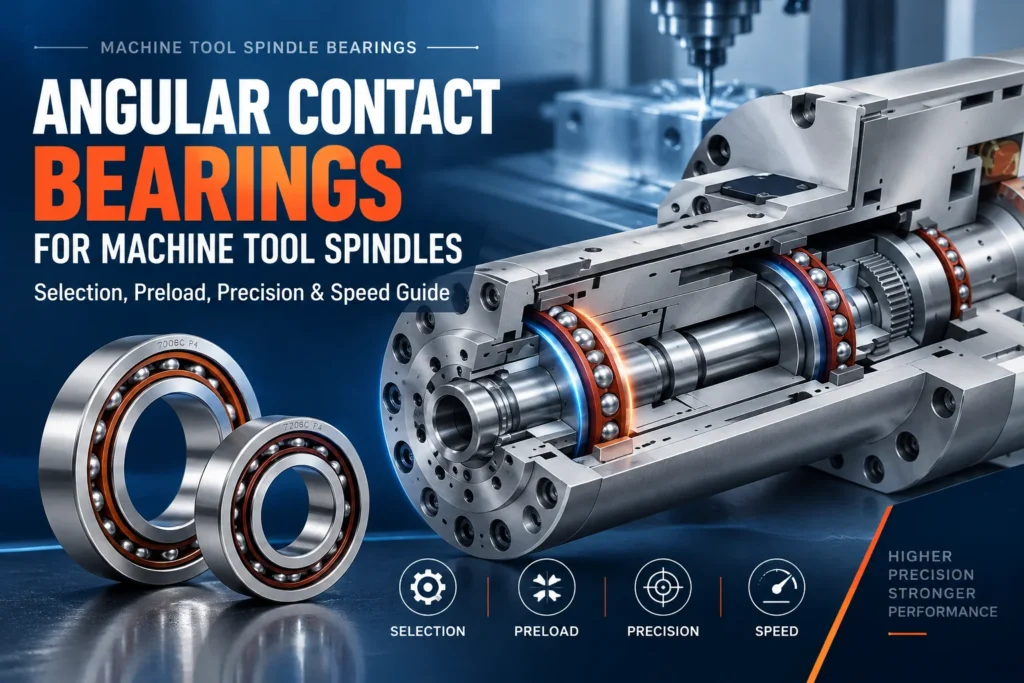
Ball bearings are great for high-speed electric motors, smaller pumps, and general machinery where loads are not too heavy. They are also common in household appliances and office equipment because they run smoothly and quietly. Angular contact ball bearings are essential for machine tool spindles where precision and speed are key9.
Applications for Roller Bearings
Roller bearings are the workhorses for heavy industry. You find them in large gearboxes, mining equipment, rolling mills, and agricultural machinery. Spherical roller bearings are perfect for applications with heavy loads and possible shaft misalignment10. Cylindrical roller bearings excel in very high radial load situations.
Specialized Needs (Alignment, Space, Precision)
If a shaft might bend, we often suggest self-aligning ball or roller bearings. If space is tight but you need strength, needle roller bearings are excellent. For high-precision jobs, specific classes of angular contact ball bearings are commonly used.
| Application Type | Recommended Ball Bearing | Recommended Roller Bearing | Key Consideration |
|---|---|---|---|
| High-Speed Motors | Deep Groove, Angular Contact | (Not ideal, unless specialized) | Speed, low friction |
| Heavy Gearboxes | (Not ideal for primary load) | Spherical Roller, Tapered Roller | Heavy radial, combined loads |
| Agricultural Machinery | Deep Groove (lighter sections) | Spherical Roller, Tapered Roller | Dirt, shock, misalignment |
| Machine Tool Spindles | Angular Contact (precision) | (High precision roller is rare) | Precision, speed |
| Wind Turbine Gearboxes | (Limited use) | Spherical Roller, Cylindrical | Extreme loads, reliability |
| Conveyors/Pumps | Deep Groove | Cylindrical Roller | Moderate to heavy loads |
How to Choose the Right Bearing for Your Equipment?
Feeling overwhelmed by all the choices? Picking the perfect bearing can seem daunting, but it doesn't have to be. Let's simplify the decision process together.
To choose the right bearing, assess your application's load type (radial, axial, impact), speed requirements, alignment needs, environmental conditions, and budget, then match these factors to the inherent strengths of ball or roller bearings.
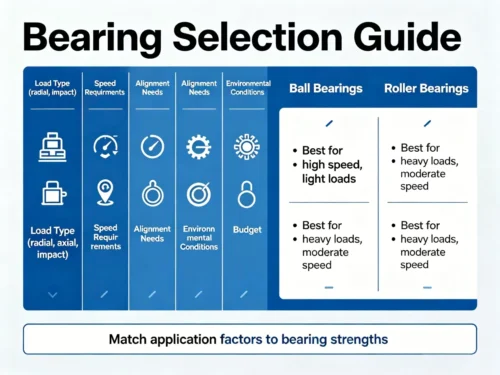
Choosing the right bearing is a critical engineering decision, not just a guess. I always tell our customers to start by truly understanding their application's needs. First, you must know your load. Is it mostly radial, or is there a lot of axial force? Are there frequent impact loads or heavy vibrations? This tells you if you need the line contact strength of a roller bearing or if a ball bearing can handle it. Second, consider the speed. High speeds usually point towards ball bearings because they create less friction and heat. Third, think about alignment. If your shafts might not be perfectly straight, you need a self-aligning type. Fourth, check your space limits. Sometimes, a needle roller bearing is the only option in a very tight spot with high loads. Also, be careful about trying to swap bearings without proper calculations. If you try to replace a roller bearing with a ball bearing in a heavy-duty application, the ball bearing will likely fail very quickly due to being overloaded11. And if you replace a high-speed ball bearing with a standard roller bearing, the roller bearing might overheat and seize up. Always do a detailed load analysis and life calculation. Do not just swap them based on size. When in doubt, always ask an expert.
Assessing Your Load Profile
First, determine the type and magnitude of the loads your equipment will experience. This includes radial, axial, and any potential impact loads. If loads are heavy and constant, roller bearings are usually the clear winner.
Considering Speed and Environment
High operating speeds favor ball bearings. Also, think about the environment. Is it dirty, wet, or very hot? These conditions can affect lubrication and overall bearing life, influencing your choice of sealed bearings or specialized materials.
Evaluating Alignment and Space
If your shafts might get out of alignment, you need a self-aligning bearing. Also, check the available space in your design. Some bearings, like needle roller bearings, offer high capacity in very compact radial spaces.
The Risks of Bearing Substitution
Do not substitute a bearing type without careful engineering analysis. Replacing a roller bearing with a ball bearing in a heavy load situation can lead to premature failure. Replacing a high-speed ball bearing with a roller bearing might cause overheating. Always make sure the substitute can handle the load and speed.
When to Seek Expert Advice
If you are unsure about any of these factors, it is always best to consult with bearing manufacturers or engineers. We have the tools and experience to help you make the best decision for your specific application. This will save you time and money in the long run.
| Decision Factor | Ball Bearing Preference | Roller Bearing Preference |
|---|---|---|
| Primary Load | Light to moderate radial, good for combined/axial | Heavy radial, high impact, heavy combined |
| Operating Speed | High speed, low friction | Moderate to lower speed (unless specialized) |
| Misalignment | Some tolerance (deep groove), good (self-aligning ball) | Less tolerance (cylindrical), good (spherical roller) |
| Space Constraint | Good for general compact designs | Good for high load in radial-restricted space (needle) |
| Precision Needs | High precision available (angular contact) | High precision available but more costly/complex |
| Cost (Initial) | Generally lower | Generally higher |
| Maintenance | Lower, simpler lubrication | Higher, demanding lubrication, more robust inspection |
| Replacement Risks | Under-capacity, early failure if replacing roller | Overheating, seizing if replacing ball bearing at speed |
Conclusion
Choosing between ball and roller bearings comes down to a careful match of application needs against their unique strengths. Prioritize load capacity and impact resistance with roller bearings, or opt for speed and lower friction with ball bearings, ensuring optimal performance and longevity for your industrial equipment.
"[PDF] Comparison of Life Theories for Rolling-Element Bearings", https://ntrs.nasa.gov/api/citations/19950020354/downloads/19950020354.pdf. Engineering mechanics texts explain that line contact in roller bearings distributes stress over a significantly larger area compared to the point contact of ball bearings, enabling higher load-carrying capacity for the same bearing envelope dimensions. Evidence role: mechanism; source type: education. Supports: Line contact in roller bearings distributes loads over a larger area than point contact in ball bearings, resulting in higher load capacity. Scope note: The exact load capacity advantage depends on specific bearing design, materials, and operating conditions rather than contact geometry alone. ↩
"Comparison of Load Capacity between Ball Bearings and Roller ...", https://www.motorsportsbearings.com/ball-bearings-and-roller-bearings/. Bearing engineering references indicate that roller bearings commonly achieve radial load capacities 2 to 4 times greater than ball bearings of similar boundary dimensions, though the exact ratio varies with bearing type, series, and specific design parameters. Evidence role: statistic; source type: education. Supports: Roller bearings typically provide 2-4 times higher radial load capacity than ball bearings of comparable dimensions. Scope note: This ratio represents typical cases and can vary significantly based on bearing series, internal geometry, and whether dynamic or static load ratings are compared. ↩
"[PDF] Rolling-Element Bearings - NASA Technical Reports Server", https://ntrs.nasa.gov/api/citations/19830018943/downloads/19830018943.pdf. Bearing dynamics literature explains that centrifugal force on rolling elements increases with both mass and the square of rotational speed, making the lighter spherical elements in ball bearings advantageous for high-speed applications compared to heavier cylindrical or tapered rollers. Evidence role: mechanism; source type: education. Supports: Lighter rolling elements in ball bearings produce lower centrifugal forces at high rotational speeds. ↩
"Frequently Asked High Speed Spindle Questions", https://www.ibagnorthamerica.com/high-speed-spindle-faq. Machine tool engineering literature documents that precision angular contact ball bearings in spindle applications commonly operate at speeds exceeding 10,000 RPM, with specialized designs reaching significantly higher speeds under appropriate lubrication and cooling conditions. Evidence role: case_reference; source type: education. Supports: Ball bearings in precision applications such as machine tool spindles routinely operate above 10,000 RPM. Scope note: Achievable speeds depend heavily on bearing size, preload, lubrication method, and cooling, with smaller bearings generally capable of higher speeds. ↩
"How to Properly Lubricate a Rolling Element Bearing", https://precisionlubrication.com/articles/lubricate-rolling-element-bearing/. Tribology and bearing lubrication references explain that the higher contact pressures and larger contact areas in roller bearings under heavy loads require lubricants with higher viscosity to maintain adequate film thickness, and the increased friction and heat generation typically necessitate more frequent lubrication intervals compared to lightly loaded ball bearings. Evidence role: mechanism; source type: education. Supports: Roller bearings operating under heavy loads require higher viscosity lubricants and more frequent lubrication intervals. ↩
"[PDF] Wear Analysis of Wind Turbine Gearbox Bearings - INFO", https://info.ornl.gov/sites/publications/files/Pub23554.pdf. Wind energy engineering research documents that wind turbine gearboxes typically utilize spherical roller bearings and cylindrical roller bearings in critical positions due to their ability to accommodate the heavy radial loads, shock loads, and shaft misalignment inherent in wind turbine operation. Evidence role: case_reference; source type: research. Supports: Wind turbine gearboxes commonly employ roller bearings to handle extreme loads and operating conditions. ↩
"Comparative Analysis of Self-aligning Ball Bearings and Other ...", https://www.weeyh-bearing.com/knowledge_show/comparative_analysis_of_self_aligning_ball_bearings_and_other_types_of_bearings.html. Bearing selection guides explain that while both self-aligning ball bearings and self-aligning roller bearings can accommodate angular misalignment through their spherical outer ring raceway design, the roller variants provide significantly higher radial load capacity due to their line contact geometry, making them suitable for heavy-duty applications with alignment challenges. Evidence role: general_support; source type: education. Supports: Self-aligning roller bearings provide substantially higher load capacity than self-aligning ball bearings while accommodating shaft misalignment. ↩
"What Are Needle Bearings? Compact, High-Capacity Design", https://www.lily-bearing.com/resources/blog/what-are-needle-bearings-compact-high-capacity-design?srsltid=AfmBOoqyQbo3PkVrYL0oPVsFwgBTe9hvQc74SG6v5OZ4Fx9U-JoN0iRR. Bearing design references explain that needle roller bearings use rollers with a length-to-diameter ratio of at least 2.5:1 and typically much higher, allowing them to provide load capacities comparable to larger cylindrical roller bearings while occupying significantly less radial space, making them ideal for compact, high-load applications. Evidence role: mechanism; source type: education. Supports: Needle roller bearings achieve high load capacity in minimal radial space through their small-diameter, long rollers. ↩
"Machine Tool Spindle Angular Contact Ball Bearing Shaft 7004c ...", https://www.amazon.com/Machine-Spindle-Angular-Contact-Bearing/dp/B0GH7P7KTH. Machine tool design literature establishes that angular contact ball bearings, typically arranged in matched sets with precise preload, are the standard bearing configuration for high-precision, high-speed spindles due to their ability to simultaneously handle radial and axial loads while maintaining tight runout tolerances and achieving the high rotational speeds required for modern machining operations. Evidence role: expert_consensus; source type: education. Supports: Angular contact ball bearings are the predominant bearing type for precision machine tool spindles. ↩
"Spherical Bearings in High-Load Applications - GMT Rubber", https://www.gmtrubber.com/the-role-of-spherical-bearings-in-high-load-applications/. Bearing application guides describe spherical roller bearings as particularly suitable for heavy-duty applications where shaft deflection or misalignment is expected, as their barrel-shaped rollers running on a spherical outer raceway provide both high radial load capacity and the ability to accommodate several degrees of angular misalignment without inducing edge loading or premature failure. Evidence role: general_support; source type: education. Supports: Spherical roller bearings are well-suited for heavy radial loads combined with shaft misalignment. ↩
"Bearings Can Fail Because There's Not Enough Load!", https://intechbearing.com/blogs/news/the-five-most-common-causes-of-bearing-failure?srsltid=AfmBOor2h7XOxe3A8YIC1LIaURf0IAnlwcGk0VSbt1KHPU-s_oi8A9I6. Bearing failure analysis literature explains that when a ball bearing is subjected to loads significantly exceeding its rated capacity—as would occur if substituted for a roller bearing in a heavy-duty application—the high contact stresses at the ball-raceway interface lead to rapid subsurface fatigue, surface spalling, and premature bearing failure, often within a fraction of the calculated rating life. Evidence role: mechanism; source type: education. Supports: Installing a ball bearing in place of a roller bearing in heavy-load applications typically results in rapid failure due to exceeding the ball bearing's load capacity. ↩