
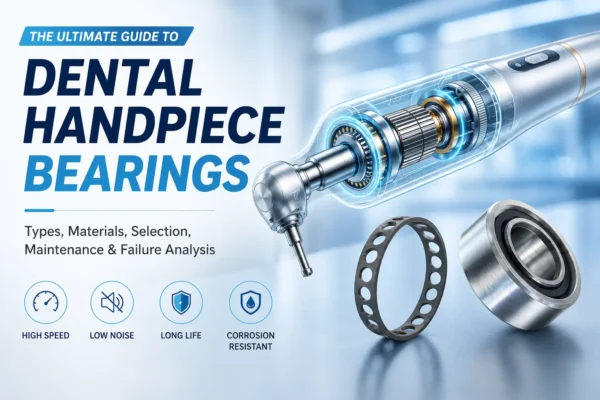
Have you ever sat in a dental chair and felt your palms sweat the moment that high-pitched whirring started? That tiny spinning instrument causes more anxiety than almost any other tool in medicine. But here is the thing most people never think about: the real engineering story is happening inside that handpiece, not outside it. At the core of every dental handpiece is a bearing so precisely built that it outperforms almost every other bearing in the industrial world. This guide breaks down everything you need to know about dental handpiece bearings, from what they are, to how to pick the right one, to why they fail.
A dental handpiece bearing is a miniature precision rolling element bearing that supports the turbine spindle inside a dental handpiece. It allows the spindle to rotate at speeds up to 400,000 RPM while maintaining stability, low noise, and positional accuracy. Without it, the handpiece cannot function safely or effectively.
We have spent over thirty years working with precision bearings, and I can say with confidence that dental handpiece bearings sit in a category of their own. The operating conditions inside a dental handpiece are extreme by any engineering standard. Most industrial bearings never have to deal with anything close to what these tiny components face every single day. The sections below walk you through every important aspect of these bearings, from types and materials to selection logic and failure patterns.
What Are Dental Handpiece Bearings and Why Are They Important?
Most people know that a dental drill spins fast. But few people understand just how fast, or what that means for the components inside.
Dental handpiece bearings are the mechanical heart of the handpiece.1 They allow the cutting bur to spin at speeds between 200,000 and 400,000 RPM. At these speeds, even a tiny defect in the bearing translates directly into vibration, noise, reduced cutting accuracy, and accelerated wear. A failing bearing does not just reduce performance — it can compromise patient safety.
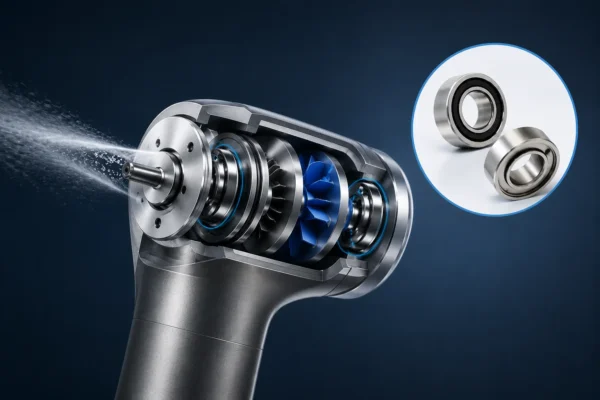
To understand why the bearing matters so much, it helps to put 300,000 RPM into context.
How Does 300,000 RPM Compare to Other Machines?
| Machine | Typical Max Speed (RPM) |
|---|---|
| Household hair dryer fan | ~1,500 |
| Power drill (full speed) | 2,000–3,000 |
| F1 race car engine | ~15,000 |
| F1 tire rotation | ~2,500–3,000 |
| Dental handpiece turbine | 200,000–400,000 |
At 300,000 RPM, the turbine spindle completes 5,000 full rotations every single second.2 This creates four simultaneous engineering challenges that the bearing must survive:
High-frequency vibration. At these speeds, even microscopic imbalances generate intense vibration. The bearing must absorb and dampen this vibration without passing it to the cutting bur.
Thermal buildup. Friction generates heat. In a sealed, compact instrument, heat has nowhere to go. The bearing materials must resist thermal expansion and degradation under continuous thermal load.
Corrosive environment. Saliva, blood, and chemical sterilants create a chemically aggressive environment. The bearing is exposed to these substances both during use and during the autoclave sterilization cycle.
Extreme space constraints. The entire bearing fits inside a housing roughly the size of your fingernail. Every micron of dimensional tolerance matters.
A standard industrial bearing fails quickly under these conditions. Dental handpiece bearings are purpose-built to survive them, and the material choices and manufacturing standards that make this possible are covered in detail in the sections below.
What Are the Main Types of Dental Handpiece Bearings?
Not all dental handpiece bearings are the same. Different handpiece designs and clinical applications require different bearing configurations.
The most common types of dental handpiece bearings are open-type angular contact ball bearings, shielded bearings, and sealed bearings. Angular contact designs are preferred for high-speed turbine handpieces because they handle both radial and axial loads simultaneously. Shielded and sealed versions add protection against contamination in specific applications.
Angular Contact Ball Bearings vs. Deep Groove Ball Bearings
| Feature | Angular Contact | Deep Groove |
|---|---|---|
| Load type handled | Radial + axial (combined) | Primarily radial |
| Typical contact angle | 15°–25° | ~10° |
| Speed capability | Higher | Moderate |
| Preload compatibility | Excellent | Limited |
| Dental handpiece use | Dominant for turbine heads | Some contra-angle applications |
Angular contact bearings are the standard choice for high-speed air turbine handpieces. The contact angle allows the bearing to carry the combined axial and radial forces generated during cutting. When two angular contact bearings are mounted as a matched pair with a defined axial preload, they create a stable, rigid support system for the spindle.
Open, Shielded, and Sealed Configurations
| Configuration | Dust Protection | Lubrication Retention | Sterilization Compatibility | Typical Use |
|---|---|---|---|---|
| Open | None | Low | High (no seals to degrade) | Basic turbine bearings |
| Shielded (ZZ / dust cover) | Moderate | Medium | High | Premium turbine bearings |
| Sealed (rubber seal) | High | High | Lower (seals may degrade) | Specific slow-speed applications |
For high-speed turbine handpieces, shielded bearings with ceramic balls and a polyimide cage represent the current industry standard. The shield keeps debris out without creating the thermal and speed limitations that a rubber seal would introduce.
Preloaded Bearing Pairs
High-speed handpieces almost always use a pair of bearings mounted with a controlled axial preload of 1–2 N. This preload eliminates internal clearance, improves spindle stiffness, reduces vibration, and prevents the balls from skidding at high speed. The preload is typically set by selecting the correct spacer or washer thickness during assembly.
What Materials, Precision Grades, Sizes, and Specifications Define a Dental Handpiece Bearing?
The material choices in a dental handpiece bearing are not arbitrary. Each component material is selected to solve a specific engineering problem created by the extreme operating environment.
Dental handpiece bearings use 440C stainless steel rings for corrosion resistance, silicon nitride (Si₃N₄) ceramic balls for low weight and thermal stability, and polyimide (TORLON) cages for high-temperature durability. Together, these materials allow the bearing to survive repeated autoclave sterilization, continuous high-speed operation, and exposure to oral fluids.
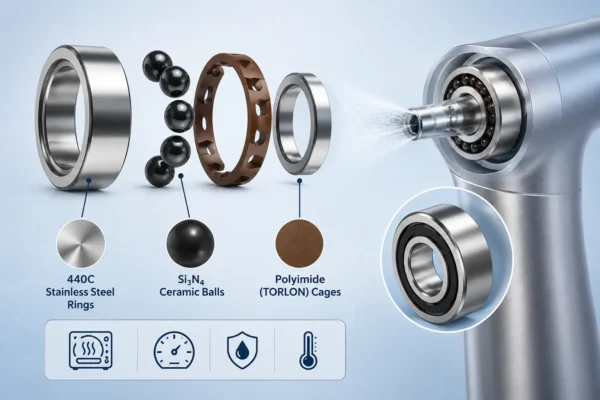
Material Comparison: Ceramic Balls vs. Steel Balls
| Property | Silicon Nitride (Si₃N₄) Ceramic | 440C Stainless Steel |
|---|---|---|
| Density (g/cm³) | 3.2 | 7.7 |
| Hardness (Vickers) | ~1,600 HV | ~700 HV |
| Thermal expansion coefficient | 2.8 × 10⁻⁶/°C | 10.2 × 10⁻⁶/°C |
| Corrosion resistance | Excellent | Good |
| Self-lubrication | Yes (partial) | No |
| Relative weight vs. steel ball | ~40% (60% lighter) | Baseline |
The lower density of ceramic balls directly reduces centrifugal force at high speed. Less centrifugal force means less pressure on the outer ring, less heat generation, and longer bearing life. The thermal expansion coefficient of ceramic is roughly one-quarter that of steel, which means the internal clearance of the bearing remains stable even as the handpiece heats up during use.
Cage Material Comparison
| Cage Material | Max Operating Temp | Impact Resistance | Chemical Resistance | Use Case |
|---|---|---|---|---|
| Polyimide (TORLON) | ~260°C | High | Excellent | High-speed dental bearings |
| PEEK | ~250°C | Medium | Excellent | Medical and precision bearings |
| Brass | ~150°C | Medium | Moderate | General industrial bearings |
| Nylon (PA66) | ~120°C | Low | Moderate | Light-duty applications |
Polyimide is the preferred cage material for dental handpiece bearings.3 It survives repeated autoclave cycles at 135°C, resists the chemical sterilants used in dental practices, and provides low friction contact with the ceramic balls during operation.
Ring Material: Why 440C Stainless Steel?
The inner and outer rings are made from 440C stainless steel or its equivalent (9Cr18Mo in Chinese standards). This grade offers:
- Hardness after heat treatment: 58–62 HRC
- Strong resistance to pitting and crevice corrosion from saliva and blood
- Dimensional stability through repeated heating and cooling cycles
- Compatibility with the medical cleaning and sterilization process
Common Dental Handpiece Bearing Sizes and Models
| Bearing Model | Bore (mm) | OD (mm) | Width (mm) | Typical Application |
|---|---|---|---|---|
| SR144 | 3.175 | 6.35 | 2.38 | High-speed turbine handpiece |
| SR2 | 3.175 | 6.35 | 2.78 | Air turbine handpiece |
| SR2A | 3.175 | 6.35 | 2.78 | Precision handpiece |
| SR144TLK | 3.175 | 6.35 | 2.38 | Premium dental handpiece |
| SR144TZWN | 3.175 | 6.35 | 2.38 | Low-noise applications |
Precision Grade Requirements
Dental handpiece bearings are manufactured to ABEC 7 or ABEC 9 precision grades (ISO P4 or P2 equivalent). Standard industrial bearings are typically ABEC 1 or ABEC 3. The table below shows the difference.
| Precision Grade | Bore Tolerance (μm) | Runout Tolerance (μm) | Typical Application |
|---|---|---|---|
| ABEC 1 (ISO Normal) | ±8 | 15 | General industry |
| ABEC 3 (ISO P6) | ±5 | 8 | Machine tools (light duty) |
| ABEC 7 (ISO P4) | ±2.5 | 3 | High-speed spindles, dental |
| ABEC 9 (ISO P2) | ±1.5 | 1.5 | Ultra-precision dental, metrology |
At 300,000 RPM, a bore tolerance error of just 5 μm creates measurable vibration. Dental handpiece bearings must be manufactured to the tightest tolerances to maintain cutting precision and patient comfort.
How Do You Choose the Right Dental Handpiece Bearing?
Selecting the wrong bearing leads to premature failure, increased vibration, and potential damage to the handpiece head. The selection process is not complicated, but it requires attention to a few key parameters.
To choose the right dental handpiece bearing, match the bearing model to the OEM specification of the handpiece, confirm the bore diameter, outer diameter, and width, then select the appropriate ball material (ceramic for high-speed turbine use) and cage material (polyimide for autoclave environments). Verify the precision grade meets ABEC 7 or higher.

Step 1: Identify the Handpiece Type
| Handpiece Type | Speed Range | Recommended Bearing Type |
|---|---|---|
| High-speed air turbine | 200,000–400,000 RPM | Angular contact, ceramic balls, ABEC 7/9 |
| Slow-speed contra-angle | 0–40,000 RPM | Deep groove or angular contact, steel or ceramic |
| Implant motor handpiece | 0–60,000 RPM | Angular contact, ceramic balls, high load rating |
| Low-speed straight | 0–20,000 RPM | Deep groove, steel balls acceptable |
Step 2: Match OEM Dimensions
Most major dental handpiece brands — including those manufactured in Japan, Germany, and the UK — use standardized bearing dimensions. The SR144, SR2, and SR2A models listed in the size table above are compatible with a large proportion of handpieces currently in clinical use. Always verify the bore, OD, and width against the original bearing before placing an order.
Step 3: Evaluate the Operating Environment
Consider the following factors when making a final selection:
| Factor | Impact | Recommended Response |
|---|---|---|
| Daily autoclave sterilization | Degrades rubber seals, stresses cage material | Choose shielded (not sealed) bearings with TORLON cage |
| High-volume clinical practice | Increases thermal and mechanical fatigue | Upgrade to full ceramic ball configuration |
| Chemical disinfectant exposure | Attacks standard steel grades | Confirm 440C or 9Cr18Mo ring material |
| Long-bur overhang (cantilever load) | Increases radial load on front bearing | Select bearings with higher dynamic load rating |
Step 4: Confirm Preload Compatibility
When replacing bearings in a high-speed turbine head, always replace the bearing pair together. Mixed wear states between old and new bearings create uneven preload distribution and accelerate failure in the newer bearing. Preload value should be confirmed at 1–2 N after assembly.
What Are the Most Common Dental Bearing Failures and How Can They Be Prevented?
Even the best dental handpiece bearing has a finite service life. Understanding how and why bearings fail is the most practical way to extend that life and catch problems before they cause damage.
The most common dental handpiece bearing failures are spalling from fatigue, corrosion from inadequate drying or cleaning, contamination from debris ingress, cage fracture from impact or improper preload, and lubrication failure from skipped maintenance cycles.4 Most of these failures are preventable with a consistent maintenance protocol.

Failure Mode Reference Table
| Failure Mode | Visual Signs | Root Cause | Prevention |
|---|---|---|---|
| Fatigue spalling | Pitting, flaking on raceway | Exceeding service life, overload | Follow replacement intervals, avoid side loading |
| Corrosion | Brown staining, surface pitting | Moisture not removed before storage, incompatible sterilant | Dry thoroughly, use compatible cleaning agents |
| Contamination | Gritty feel, dark discoloration | Debris ingress during use or cleaning | Use shielded bearings, follow clean-down protocol |
| Cage fracture | Rattling noise, sudden failure | Impact shock, incorrect preload, wrong cage material | Avoid dropping handpiece, verify preload, use TORLON cage |
| Lubrication failure | High temperature, noise increase | Skipped lubrication, lubricant evaporation at high temp | Use manufacturer-specified oil, lubricate before each session |
| False brinelling | Indentations on raceway | Vibration during storage or transport while stationary | Store properly, avoid prolonged vibration during transit |
Maintenance Protocol: Key Steps
Step 1 — Clean after every use. Remove the handpiece from the coupling. Apply the manufacturer-recommended cleaning solvent through the drive air port. Hold the bur chuck stationary and run compressed air for several seconds to flush debris and residual moisture. Do not use acetone or ethanol, as these damage bearing cage materials and rubber components.
Step 2 — Lubricate before sterilization. Apply 1–2 drops of manufacturer-approved turbine oil through the drive air port. Run the handpiece briefly to distribute the oil throughout the turbine assembly. This step creates a fresh oil film that protects the bearing during the autoclave cycle.
Step 3 — Autoclave at the correct settings. Follow the handpiece manufacturer's recommended temperature and cycle time. Typically, this means 134°C for three minutes in a Class B autoclave. Avoid exceeding the recommended temperature. Avoid rapid cooling after the cycle, as thermal shock creates stress in both the bearing rings and the cage.
Step 4 — Inspect regularly. After every autoclave cycle, listen for changes in sound during a brief free.
"Miniature Ball Bearings Used in Dental Handpieces - PIB Sales", https://pibsales.com/industries/miniature-ball-bearings-used-in-dental-handpieces/?srsltid=AfmBOopdMHD-Hm-kpdSXoTsqCbppMaGJD8rU1tgoTp0hmr36UxroRqmO. Educational resources on dental handpiece mechanics describe bearings as vital components for high-speed operation and precision. Evidence role: mechanism; source type: education. Supports: Dental handpiece bearings are essential for maintaining stability, accuracy, and safety during operation.. Scope note: The source may focus on general mechanical principles rather than specific safety implications. ↩
"A Dynamic Decade: Speeding Up the Handpiece", https://dentalmuseum.pacific.edu/a-dynamic-decade-speeding-up-the-handpiece/. Technical specifications from dental equipment manufacturers confirm turbine speeds of up to 300,000 RPM. Evidence role: statistic; source type: institution. Supports: Dental handpiece turbines can reach speeds of 300,000 RPM, creating significant engineering demands.. Scope note: The data may vary slightly depending on the specific handpiece model. ↩
"Biocompatibility of Polyimides: A Mini-Review - PMC", https://pmc.ncbi.nlm.nih.gov/articles/PMC6804260/. Studies on bearing materials highlight polyimide's resistance to high temperatures and sterilization chemicals. Evidence role: mechanism; source type: research. Supports: Polyimide is preferred for dental handpiece bearings due to its durability under autoclave conditions and chemical exposure.. Scope note: The preference may depend on specific sterilization protocols or bearing designs. ↩
"Failure analysis of the ball bearings of dental air turbine handpieces", https://pubmed.ncbi.nlm.nih.gov/24320910/. Research on dental bearing failures identifies these modes as prevalent in clinical settings. Evidence role: case_reference; source type: research. Supports: Common failure modes of dental bearings include fatigue, corrosion, contamination, cage fracture, and lubrication issues.. Scope note: Failure modes may vary depending on maintenance practices and operating conditions. ↩