
Do you buy P4 bearings just to get better quality? High precision costs more money. It does not always work well. I will help you pick the exact right bearing.
The ISO precision classes for bearings are P0, P6, P5, and P4.1 P0 is the standard class. P4 is the highest precision class.2 P4 bearings cost seven times more than P0 bearings.3 You must match the bearing precision to your machine speed and load to save money.
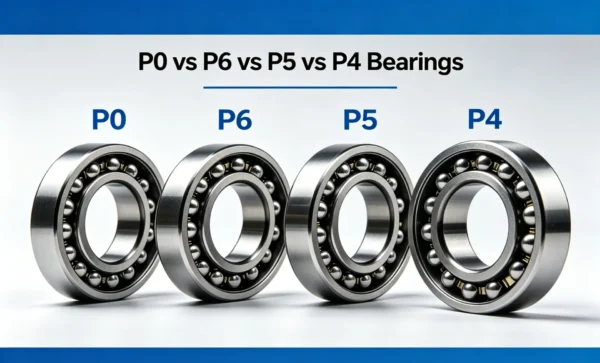
Many buyers make a big mistake. They think higher precision means a longer lifespan. I have seen many bearing importers double their budgets for no reason. Let us look at the real differences below.
What are the exact differences between P0, P6, P5, and P4 classes?
Do you struggle to see the physical difference between bearing grades? Wrong choices cause machine failures. Here is the direct breakdown of dimensional error and rotational runout.
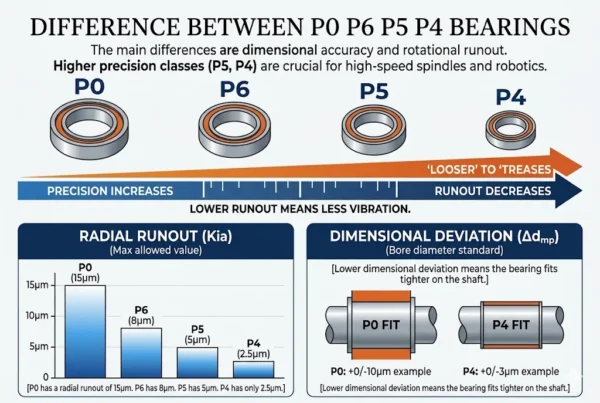
The main differences are dimensional accuracy and rotational runout. P0 has a radial runout of 15μm. P6 has 8μm. P5 has 5μm. P4 has only 2.5μm.4 Lower runout means less vibration.5 Lower dimensional deviation means the bearing fits tighter on the shaft.
The Core Factors of Bearing Precision
We must look at two main things. The first thing is dimensional accuracy. This means the exact size of the inner ring, outer ring, and width. The second thing is rotational accuracy. This means the amount of shake when the bearing spins. We call this radial runout and axial runout. Both numbers matter for your machines.
Tolerance and Price Comparison
I have worked at Yuanguang Bearing Co., Ltd. since 1992. We make many types of bearings. We cast iron and steel. We produce ductile iron pillow block bearing housings. We also make various self-aligning ball bearings. I see many buyers get confused about precision numbers. The ISO standard numbers get smaller. The physical rules get stricter. The factory manufacturing process becomes much harder. The final price goes up very fast. You must understand the exact numbers. You will make a good buying decision. Let us look at a common deep groove ball bearing.
| Precision Class | Inner Ring Deviation | Radial Runout | Price Ratio |
|---|---|---|---|
| P0 (Standard) | -10 μm | ≤ 15 μm | 1x |
| P6 (Medium) | -8 μm | ≤ 8 μm | 1.5x |
| P5 (High) | -5 μm | ≤ 5 μm | 2x |
| P4 (Ultra-High) | -3 μm | ≤ 2.5 μm | 7x |
The price of a P4 bearing is seven times the price of a P0 bearing. You might blindly choose high precision. You just waste your budget. You do not gain extra life for the bearing.
When should you choose P0 or P6 bearings?
Are you overpaying for standard equipment parts? Buying premium bearings for simple machines ruins your profit margins. Choose P0 or P6 grades to balance your cost perfectly.
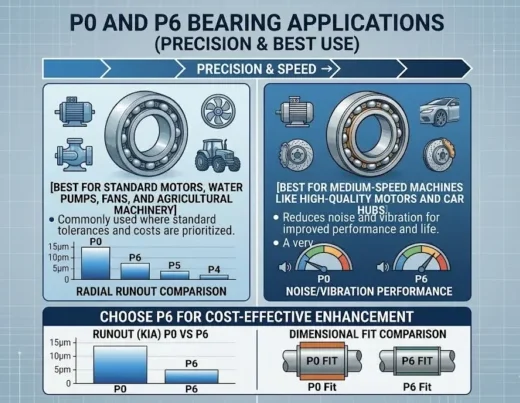
You should use P0 bearings for standard motors, water pumps, fans, and agricultural machinery.6 P0 offers the best cost performance. You should use P6 bearings for medium-speed machines like high-quality motors and car hubs.7 P6 reduces noise and vibration at a very fair price.
Understanding P0 Standard Bearings
P0 is the most basic class. It is also the most widely used class in the world. Many factories do not write "P0" on the bearing model number. The tolerance is the lowest. The noise is very noticeable. The price is the cheapest. The production process is very mature. Our Yuanguang factory in Henan makes thousands of P0 pillow block bearing housings every day. P0 is perfect for low-speed machines. Your conveyor belt or farm tractor only needs to spin. P0 does the job perfectly. You save a lot of money.
Upgrading to P6 Medium Precision
P6 gives you a great balance. It is one step above P0. The size deviation is smaller. The radial runout drops to 8μm or less. The bearing spins much smoother. It makes less noise. It handles higher speeds better. The price is about fifty percent higher than P0. I talk to many bearing wholesalers. I always tell them to stock P6 for general industrial use. It is a very safe choice.
| Bearing Class | Best Application Scenarios | Cost Performance Focus |
|---|---|---|
| P0 Class | Agricultural machines, fans, water pumps, conveyors | Lowest cost, basic durability |
| P6 Class | Quality motors, car hubs, general gear reducers | Better noise control, medium speed |
When do you really need P5 or P4 precision bearings?
Does your CNC machine lose its cutting accuracy? Using low-grade bearings in precision tools causes severe errors and product rejections. You must use P5 or P4 bearings.
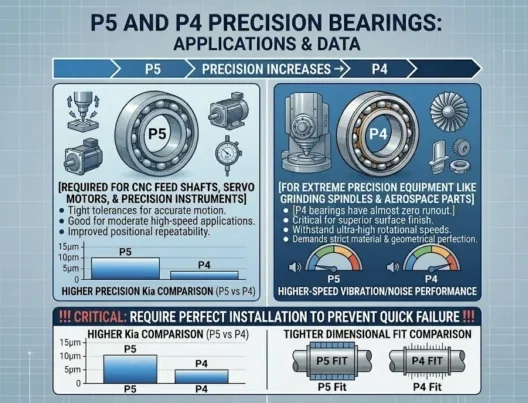
You need P5 bearings for CNC machine tool feed shafts, servo motors, and precision instruments.8 You need P4 bearings for extreme precision equipment like grinding machine spindles and aerospace parts.9 P4 bearings have almost zero runout.10 They require perfect installation to prevent quick failure.
The Strict Demands of P5 Bearings
P5 is a true high-precision grade. The tolerance rules become very tight. The radial runout is 5μm or less. The bearing positions the shaft very exactly. The factory needs top-quality steel. The factory also needs advanced grinding machines to make P5 bearings. The price is double the price of a P0 bearing. You must use P5 in high-speed machines. You must use it in high-accuracy machines. The spindle bearing might shake by a few extra micrometers. The CNC machine will cut metal wrong. P6 simply cannot meet this strict need.
The Extreme Rules of P4 Bearings
P4 is the highest grade in normal industry. The radial runout drops to 2.5μm or less. The bearing spins with almost zero vibration. It creates almost zero noise. The factory must use top-level machines. The factory must use strict testing tools to make P4 bearings. P4 is an exclusive product for extreme cases. P4 is seven times more expensive than P0. Do not use P4 in a standard motor. The tight tolerance causes too much friction. The bearing gets hot quickly. It breaks faster than a cheap P0 bearing.
| Precision Class | Target Machines | Key Benefit |
|---|---|---|
| P5 Class | CNC machine axes, servo motors, gearboxes | High positioning accuracy, stable spinning |
| P4 Class | Grinding spindles, machining centers, aerospace | Ultimate zero-runout performance |
Does a higher precision grade mean a longer bearing life?
Do you think expensive bearings will last forever? Believing this myth leads to huge maintenance bills and ruined machinery. Bearing life depends on completely different mechanical rules.
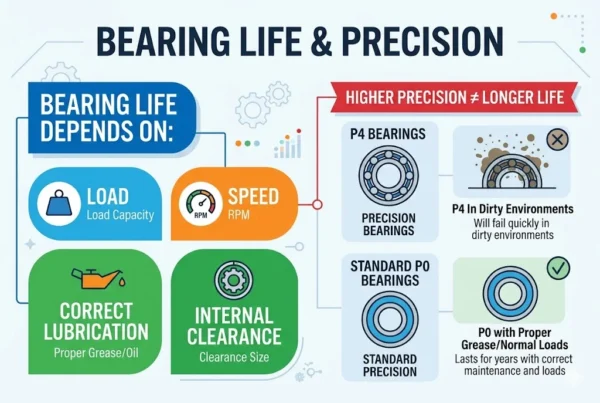
Higher precision does not mean longer bearing life. A bearing's life depends on load, speed, correct lubrication, and internal clearance.11 P4 bearings will fail quickly in dirty environments.12 Standard P0 bearings will last for years with proper grease and normal loads.
The Big Misunderstanding in the Industry
I talk to many bearing importers every week. They often want P4 bearings. They want the longest lifespan. This idea is completely wrong. Precision grade only controls the physical shape. It only controls the spinning accuracy. It does not make the steel stronger. It does not fight friction better.
What Truly Decides Bearing Life?
You want a bearing to last a long time. You must focus on the real working conditions. First, you must calculate the load correctly. Do not put a heavy load on a small bearing. Second, you must control the speed. Third, you must use good grease or oil. Good lubrication stops metal from touching metal. Fourth, you need the right internal clearance.
Matching Precision to the Job
I run a comprehensive bearing factory. We have casting, machining, and assembly lines. We provide OEM and ODM services for many bearing brand owners. I know the real truth about bearing failure. You might put a P0 bearing in a precision CNC machine. The spindle will shake too much. The machine will fail. You might put a super tight P4 bearing in a dirty farm tractor. The dirt will enter the bearing. The dirt will jam the steel balls. The tight fit will create huge heat. The expensive P4 bearing will die in just a few days. You waste your budget. You also stop your production line.
| False Belief | True Fact |
|---|---|
| Higher precision equals longer life. | Load, speed, and lubrication decide the real life. |
| P4 is always the best choice. | P4 is a bad choice for dirty standard machines. |
Conclusion
Match bearing precision to your machine needs. Use P0 or P6 for standard equipment. You will save money. Reserve P5 and P4 for ultra-precise machines. Stop overspending today.
"Tolerances | SKF", https://www.skf.com/us/products/rolling-bearings/principles-of-rolling-bearing-selection/general-bearing-knowledge/tolerances. ISO 492 (Rolling bearings—Radial bearings—Tolerances) defines accuracy classes as Normal (often abbreviated PN), 6, 5, 4, and 2; in common practice PN is equated with the ‘P0’ designation used in some national standards. Evidence role: definition; source type: institution. Supports: That ISO defines standardized tolerance classes for radial bearings and the standard class corresponds to what many markets call P0.. Scope note: Terminology differs by standard system (ISO vs. JIS/GB), and the ISO class set includes Class 2, which the article’s list does not mention. ↩
"Tolerances and tolerance classes for bearings", https://koyo.jtekt.co.jp/en/support/bearing-knowledge/7-1000.html. Under ISO 492, Class 2 (P2) has tighter tolerances than Class 4 (P4); therefore, P4 is not the highest ISO precision class. Evidence role: definition; source type: institution. Supports: Clarify the hierarchy of ISO tolerance classes and whether a class higher than P4 exists.. Scope note: Some product lines or suppliers may not offer P2 bearings, leading practitioners to treat P4 as the highest available class in specific catalogs. ↩
"Bearing Precision Grades: Why P4 Costs More Than P0 | TFL", https://tflbearing.com/blog/bearing-precision-grades-p4-costs-more-than-p0.html. Engineering selection guides note that moving from standard (PN/P0) to higher accuracy classes entails tighter tolerances and additional manufacturing and inspection steps, leading to higher cost; however, no universal multiplier applies across sizes and suppliers. Evidence role: general_support; source type: education. Supports: That higher accuracy classes generally increase manufacturing complexity and cost relative to standard class bearings.. Scope note: Literature supports the direction of cost change but does not establish a fixed ‘7×’ ratio for all bearings. ↩
"Tolerances | SKF", https://www.skf.com/us/products/rolling-bearings/principles-of-rolling-bearing-selection/general-bearing-knowledge/tolerances. ISO 492 provides tabulated runout tolerances that tighten from Normal (PN/P0) to P6, P5, and P4; for small-to-medium bore deep-groove ball bearings, typical outer-ring radial runout limits are roughly on the order of ~15 μm (Normal), ~8 μm (P6), ~5 μm (P5), and ~2.5–3 μm (P4). Evidence role: statistic; source type: institution. Supports: That allowable runout values decrease with higher ISO tolerance classes and are on the order given for common deep-groove ball bearing sizes.. Scope note: Exact limits vary with bore diameter, ring, and measurement location; the figures are representative rather than universal. ↩
"Analysis of total rotor runout components with multi-probe ...", https://www.sciencedirect.com/science/article/pii/S0263224121004115. Technical descriptions of runout explain that eccentricity and geometric deviations cause periodic displacement of the rotating axis, producing measurable vibration during operation. Evidence role: mechanism; source type: encyclopedia. Supports: That geometric runout introduces periodic displacement during rotation, which manifests as vibration.. Scope note: Vibration can also arise from imbalance, surface waviness, defects, misalignment, and structural resonance; runout is one of several contributors. ↩
"Bearing Fits and Tolerances in Electric Motors | TFL", https://www.insulated-bearings.com/blog/understanding-bearing-fits-tolerances-in-electric-motors/. Machine design and bearing selection teaching materials typically indicate that normal (PN/P0) tolerance bearings are suitable for general-purpose machinery such as standard electric motors, pumps, and fans where extreme precision or very low noise is not required. Evidence role: expert_consensus; source type: education. Supports: That normal (PN/P0) accuracy is generally adequate for common industrial machinery at moderate speeds and loads.. Scope note: Specific duty cycles, noise/vibration targets, and fit conditions can justify higher accuracy in particular designs. ↩
"Bearing tolerance class - SKF", https://www.skf.com/us/products/rolling-bearings/principles-of-rolling-bearing-selection/bearing-selection-process/bearing-execution/bearing-tolerance-class. Engineering references on bearing selection for motors and automotive wheel ends report the use of higher accuracy classes (often P6) to achieve tighter runout and improved NVH performance relative to normal class bearings. Evidence role: expert_consensus; source type: education. Supports: That many motor and wheel-end applications use higher-than-normal bearing accuracy (e.g., P6) to manage runout and NVH at elevated speeds.. Scope note: Manufacturers may specify different classes depending on design tolerances, measurement criteria, and NVH targets. ↩
"[PDF] Super Precision Bearings for Machine Tool - NSK", https://www.nsk.com/content/dam/nsk/am/en_us/documents/bearings-americas/Super-Precision-Bearings-for-Machine-Tool.pdf. Texts on machine tool and servomechanism design indicate that high-accuracy bearings, typically ISO P5 or better with appropriate preload, are used in precision feed drives and servomotors to meet positioning and repeatability requirements. Evidence role: expert_consensus; source type: education. Supports: That high-accuracy rolling bearings (around ISO P5 or better) are commonly specified for precision feed axes and servomotor applications.. Scope note: Exact class depends on bearing type, preload strategy, speed, and required positioning accuracy; some applications use P4. ↩
"Spindle bearings - SLF Fraureuth", https://www.slf-fraureuth.de/us/products/spindle-bearings/. Machine tool spindle design sources describe P4 or P2 accuracy rolling bearings as standard for high-speed grinding and machining center spindles; aerospace mechanisms frequently demand high-precision bearings to meet tight alignment and stability requirements. Evidence role: expert_consensus; source type: education. Supports: That machine tool spindles for high-precision machining commonly use P4 or P2 bearings, and aerospace mechanisms often require high-precision bearings.. Scope note: Many high-end grinding spindles specify P2; aerospace requirements vary by subsystem and may include additional environmental specifications. ↩
"Bearing Tolerances and Precision Levels - AST Bearings", https://www.astbearings.com/bearing-tolerances-precision-levels.html. ISO 492 specifies micrometer-level runout limits for P4 bearings; for common bore ranges the allowable runout is small but explicitly nonzero. Evidence role: definition; source type: institution. Supports: That P4 runout tolerances are very small (a few micrometers) but nonzero.. Scope note: Permissible runout depends on ring, size range, and measurement plane; ‘almost zero’ is qualitative and may mislead without numeric context. ↩
"Load carrying capacity and life | Schaeffler medias", https://medias.schaeffler.us/en/knowledge-center/rolling-bearings/load-carrying-capacity-and-life. ISO 281 defines bearing rating life as a function of dynamic load and includes life modification factors for lubrication and contamination; ISO 5753-1 addresses internal clearance, which influences operating temperature, load distribution, and thus service life. Evidence role: definition; source type: institution. Supports: That bearing rating life depends on load and operating conditions and that lubrication quality and internal clearance affect life.. Scope note: In-service life also depends on mounting accuracy, misalignment, material quality, and environmental factors beyond those explicitly modeled in simplified rating equations. ↩
"[PDF] Effect of filtration on rolling-element-bearing life in a contaminated ...", https://ntrs.nasa.gov/api/citations/19780020514/downloads/19780020514.pdf. Government and laboratory studies on rolling bearings report that abrasive particulate contamination dramatically reduces fatigue life and can lead to rapid failure even in high-precision bearings due to surface damage and lubricant degradation. Evidence role: mechanism; source type: government. Supports: That particulate contamination significantly reduces rolling bearing life and can cause early failure regardless of precision class.. Scope note: Failure severity depends on contaminant size/hardness, lubrication regime, sealing, and load; ‘quickly’ is application-dependent. ↩