A noisy wheel, stiff steering, or rough engine can start as a small bearing problem. If it is ignored, it can become a safety risk.
**Motorcycle bearings support rotating parts, reduce friction, carry load, and help engine power move to the wheels.A normal motorcycle may use 20 to 30 bearings in the engine, transmission, wheels, steering system, and chassis. Good selection and maintenance improve safety, durability, and ride quality.
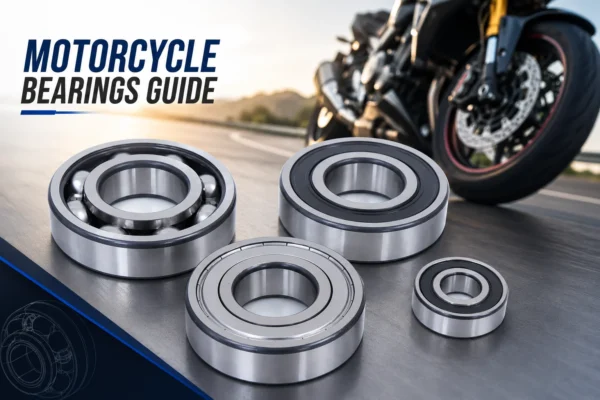
Motorcycle bearings look small, but they work in harsh places. They face high speed, mud, water, heat, shock load, and poor roads.1 In our bearing factory work, I often see that many bearing failures are not caused by one big problem. They come from small mistakes. The seal is not good enough. The grease is washed out. The bearing is pressed in the wrong way. The wheel is adjusted too tight. The oil is used for too long.
I wrote this guide for importers, wholesalers, repair businesses, and motorcycle parts brands that need a clear view of motorcycle bearings. I also wrote it for anyone who wants to understand what bearing type fits each motorcycle position, what sizes are common, and why some bearings fail early.
What Are Motorcycle Bearings and Why Are They Important?
A motorcycle can still move with a weak bearing for a short time.2 That is the danger. The rider may not feel the problem until damage grows.
Motorcycle bearings are precision parts that support rotation in the engine, wheels, transmission, steering, and chassis. They reduce friction, guide movement, carry radial or axial load, and help the motorcycle run smoothly with less vibration and less energy loss.
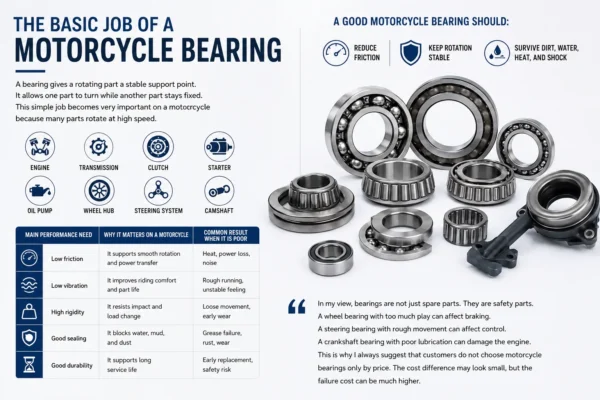
The basic job of a motorcycle bearing
A bearing gives a rotating part a stable support point. It allows one part to turn while another part stays fixed. This simple job becomes very important on a motorcycle because many parts rotate at high speed. The crankshaft, camshaft, wheel hub, gearbox shaft, clutch parts, starter, oil pump, and steering system all need smooth movement.
A good motorcycle bearing should do three things well. It should reduce friction. It should keep rotation stable. It should survive dirt, water, heat, and shock. This is why motorcycle bearings need good steel, correct heat treatment, smooth raceways, proper clearance, strong cages, and good sealing.
| Main performance need | Why it matters on a motorcycle | Common result when it is poor |
|---|---|---|
| Low friction | It supports smooth rotation and power transfer | Heat, power loss, noise |
| Low vibration | It improves riding comfort and part life | Rough running, unstable feeling |
| High rigidity | It resists impact and load change | Loose movement, early wear |
| Good sealing | It blocks water, mud, and dust | Grease failure, rust, wear |
| Good durability | It supports long service life | Early replacement, safety risk |
In my view, bearings are not just spare parts. They are safety parts. A wheel bearing with too much play can affect braking. A steering bearing with rough movement can affect control. A crankshaft bearing with poor lubrication can damage the engine. This is why I always suggest that customers do not choose motorcycle bearings only by price. The cost difference may look small, but the failure cost can be much higher.
Where Are Bearings Used in a Motorcycle?
Many buyers only think about wheel bearings first. That is normal. Wheel bearings are easy to see. Yet a motorcycle uses many more bearings inside.
Bearings are used in the motorcycle engine, gearbox, clutch, wheels, steering column, swingarm, chassis, starter, oil pump, and other rotating systems. A normal motorcycle often has about 20 to 30 bearings, based on engine size, design, and model type.
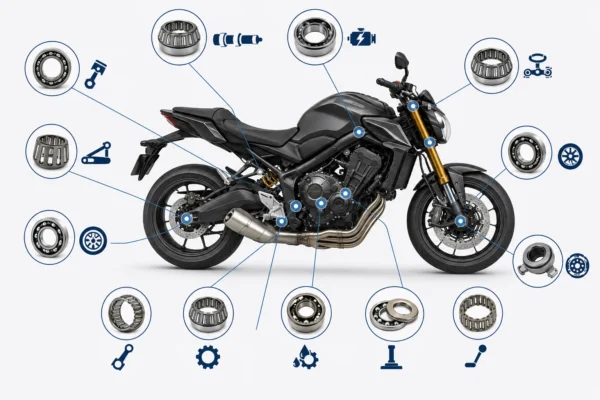
Main bearing positions in a motorcycle
Motorcycles have different structures. A scooter, street bike, dirt bike, cruiser, and three-wheeler may use different bearing layouts. Still, the bearing positions are usually similar. The engine and transmission need bearings because they have fast rotating shafts. The wheels need bearings because they carry road load and support continuous rotation. The steering system needs bearings because it must turn smoothly under front load. The chassis may also use bearings in swingarms and link systems.
| Motorcycle area | Bearing position | Common bearing type |
|---|---|---|
| Engine | Crankshaft main bearing | Ball bearing, cylindrical roller bearing |
| Engine | Connecting rod crank pin | Needle roller bearing with cage |
| Engine | Camshaft and timing system | Needle roller bearing, ball bearing |
| Auxiliary system | Starter | Needle roller bearing |
| Auxiliary system | Oil pump | Needle roller bearing, ball bearing |
| Gearbox | Main shaft and drive shaft | Ball bearing, roller bearing |
| Gearbox | Idle gear | Split light plastic cage bearing |
| Clutch | Clutch release position | Clutch release bearing |
| Shift system | Shift shaft and small rotating parts | Ball bearing, needle roller bearing |
| Chassis | Steering column, swingarm, linkage | Ball bearing, needle bearing, tapered roller bearing |
| Wheel | Front wheel and rear wheel hub | Deep groove ball bearing |
| Steering | Upper and lower steering bearing | Ball bearing, tapered roller bearing, thrust bearing |
I often tell customers that the bearing environment decides the bearing requirement. An engine bearing works in heat, speed, oil, and impact. A wheel bearing works near water, road dust, and mud. A steering bearing does not rotate fast, but it must carry impact load from the road. A gearbox bearing carries changing load and needs stable clearance.
This is also why one bearing brand or one bearing grade cannot solve every problem. The right part must match the position. A sealed wheel bearing can help in wet road use.3 A strong needle bearing can support compact, high-load engine design. A tapered roller bearing can handle combined load in steering or chassis positions. The application must guide the selection.
Common Types and Sizes of Motorcycle Bearings?
Choosing a bearing without knowing the type is risky. Choosing a bearing only by outer size is also risky. The inside design matters.
Common motorcycle bearings include deep groove ball bearings, needle roller bearings, cylindrical roller bearings, tapered roller bearings, angular contact ball bearings, and thrust needle bearings.4 Common wheel sizes include 6200, 6201, 6300, 6301, 6202, 6302, 6203, 6204, 6205, 6206, and related metric series.
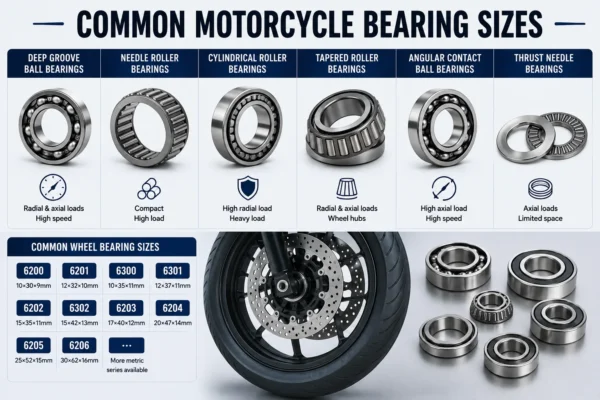
Bearing types and where they fit
Deep groove ball bearings are the most common type in motorcycle wheels and many transmission positions.5 They support radial load and some axial load. They are easy to source and easy to install when the size is correct. Needle roller bearings are common in compact parts. They carry high radial load in a small space. They are often used in connecting rods, cam systems, starters, oil pumps, and some gear positions. Cylindrical roller bearings are used when high radial load and high speed are needed. Tapered roller bearings can carry radial load and axial load together. They are common in steering or chassis positions on some models.
| Bearing type | Simple feature | Typical motorcycle use |
|---|---|---|
| Deep groove ball bearing | Common, stable, low friction | Wheel hub, gearbox, engine side |
| Needle roller bearing | High load in small space | Connecting rod, camshaft, starter, oil pump |
| Cylindrical roller bearing | High radial load and high speed | Crankshaft and engine positions |
| Tapered roller bearing | Handles radial and axial load | Steering column, chassis support |
| Angular contact ball bearing | Handles combined load | Special chassis or wheel design |
| Thrust needle bearing | Handles axial load | Clutch or steering related positions |
For small motorcycles under 100cc, the front wheel often uses 6200, 6201, 6300, or 6301.6 The rear wheel often uses 6301. For 125cc and 150cc motorcycles, the front wheel often uses 6301. The rear wheel may use 6202, 6302, 6200, 6201, 6203, 6204, 6205, 6206, 6300, 6301, or 6302, based on the hub and axle design.
| Engine size or position | Common bearing sizes |
|---|---|
| Under 100cc front wheel | 6200, 6201, 6300, 6301 |
| Under 100cc rear wheel | 6301 |
| 125cc and 150cc front wheel | 6301 |
| 125cc and 150cc rear wheel | 6202, 6302, 6200, 6201, 6203, 6204, 6205, 6206, 6300, 6301, 6302 |
| Other common motorcycle sizes | 6000, 6001, 6002, 6003, 6004, 62/22, 62/28, 62/32, 63/22, 63/28, 63/32 |
These sizes are common, but they are not a final rule. I always suggest checking the old bearing code, the motorcycle parts manual, and the actual shaft and housing size. Some models use special seals, special clearance, or special cage design. A size code gives a start, but it does not tell the whole story.
How to Select the Right Motorcycle Bearings?
A wrong bearing may fit into the hole and still fail early. That is why selection must go beyond the size number.
To select the right motorcycle bearing, check the application position, load direction, speed, temperature, sealing need, clearance, grease or oil condition, installation method, and exact size. Then match the bearing type, material, cage, seal, and quality grade to that working condition.
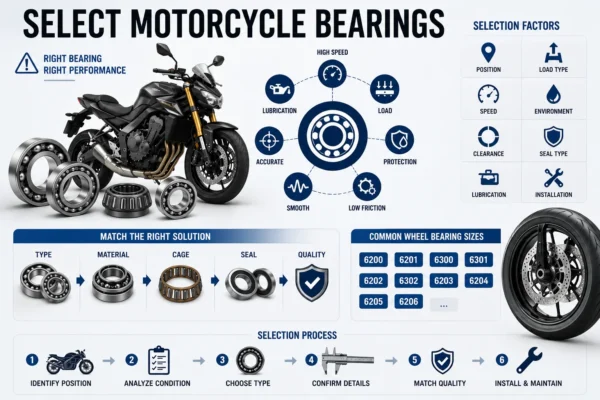
A practical selection process
I usually start with the position. A wheel bearing needs sealing and water resistance. An engine bearing needs speed, heat resistance, and clean lubrication. A gearbox bearing needs stable load capacity and reliable clearance. A steering bearing needs smooth turning and good impact resistance. After the position is clear, I check the load. Some parts mainly carry radial load. Some parts carry axial load. Some parts carry both. This choice affects whether a ball bearing, roller bearing, tapered roller bearing, or needle bearing is better.
| Selection factor | What to check | Why it matters |
|---|---|---|
| Position | Wheel, engine, gearbox, steering, chassis | Each position has a different working condition |
| Load type | Radial load, axial load, shock load | Load decides bearing type |
| Speed | Low, medium, high speed | High speed needs low friction and stable cage |
| Environment | Water, mud, dust, heat | Bad environment needs better sealing or lubrication |
| Clearance | Normal, C3, special clearance | Wrong clearance can cause heat or loose movement |
| Seal type | Open, ZZ, 2RS, special seal | Seal choice affects dirt protection and friction |
| Lubrication | Grease, engine oil, gear oil | Poor lubrication causes fast wear |
| Installation | Press fit, housing fit, alignment | Bad installation damages raceways |
For importers and wholesalers, I suggest making a clear list before buying. The list should include bearing code, motorcycle model, position, seal type, clearance, quantity, target market, and expected quality level. This reduces mistakes. It also helps the supplier choose the right structure, not just the right outside size.
Quality control also matters. In our factory work, I pay attention to steel material, heat treatment, grinding accuracy, noise level, seal fitting, grease filling, and packaging. A motorcycle bearing may be small, but it must pass many checks. If a bearing is used in wet roads or off-road motorcycles, I would rather choose a stronger seal and stable grease. If it is used in a high-speed engine position, I would focus more on internal accuracy, cage strength, clearance, and heat resistance.
A good buying decision is not always the cheapest decision. It is the decision that matches the working condition and reduces return risk.
Common Causes of Motorcycle Bearing Failure?
Bearing failure often looks sudden to the rider. In many cases, the cause started much earlier and stayed hidden.
Common causes of motorcycle bearing failure include poor lubrication, water entry, dirt entry, wrong installation, wrong clearance, over-tight assembly, loose assembly, poor oil quality, shock load, misalignment, and harsh road conditions.7 If these problems are not corrected early, they can damage wheels, engines, steering, and safety systems.

Why bearings fail early
Wheel hub bearings and rear sprocket bearings often fail because water gets inside. Deep water, frequent washing, or poor sealing can let water reach the grease. The grease loses its function. Then the rolling groove and balls wear fast. The internal clearance becomes larger. The rider may feel noise, shaking, brake rubbing, or higher rolling resistance.
Assembly is another common cause. If the front or rear wheel is installed too tight, the bearing can heat and seize. If it is too loose, the bearing can move in the housing. The cage can be damaged. The wheel can become unstable. The brake disc may rub against the hub or caliper area. This increases resistance and creates safety risk.
| Failure cause | Common position | Typical sign |
|---|---|---|
| Water entry | Wheel hub, rear sprocket bearing | Rust, rough rotation, grease loss |
| Poor lubrication | Engine, crankshaft, gearbox | Heat, wear, noise, seizure |
| Wrong clearance | Wheels, engine, steering | Loose feel or tight rotation |
| Over-tight assembly | Wheels, steering column | Stiff movement, heat, early wear |
| Loose assembly | Wheels, sprocket, chassis | Play, vibration, cage damage |
| Dirt or metal chips | Engine, gearbox, rebuild parts | Raceway damage, blocked movement |
| Misalignment | Crankshaft, housing, wheel | Uneven load and early failure |
| Shock load | Off-road, poor roads, sidecar use | Brinelling, cracking, cage damage |
Crankshaft connecting rod roller bearings and side ball bearings are sensitive to lubrication. In two-stroke engines, poor oil quality or too little oil can cause fast damage. High engine temperature increases friction. The working surface can soften. Fatigue peeling can appear early. Small peeled particles can enter the cage area. The bearing may run rough. The cage can break. In the worst case, the crank and connecting rod can seize.
In four-stroke engines, fake oil or old oil reduces lubrication. Dirt can block oil passages. After new assembly or overhaul, hard particles from dirty tools or a dirty work area can enter the raceway. A crankshaft that is pressed out of center can also increase bearing load. These are not small issues. They often lead to expensive repair.
Steering column bearings can fail when front shock absorbers are weak, grease is not enough, or the upper and lower tightening force is wrong. The rider may feel stiff steering, center notch, or pulling to one side. This affects riding safety directly.
Motorcycle Bearing Maintenance and Replacement Tips?
A bearing is cheaper than the parts it can damage. Good maintenance is the easiest way to protect the motorcycle and the rider. Maintain motorcycle bearings by keeping water and dirt out, using correct lubrication, checking wheel play, avoiding over-tight adjustment, replacing damaged seals, using proper tools, and installing bearings squarely.Replace bearings when rotation is rough, noisy, loose, rusty, overheated, or visibly damaged.
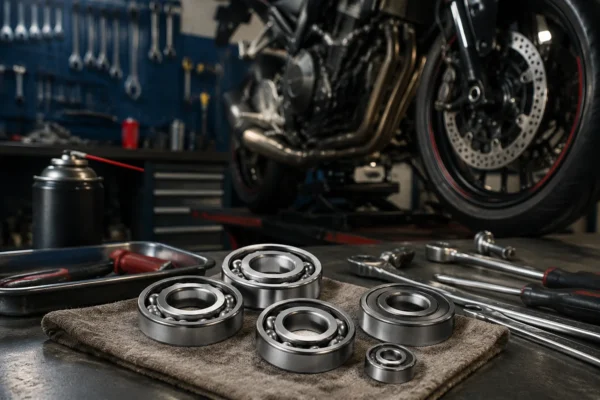
How to maintain and replace bearings correctly
I suggest checking motorcycle bearings during tire replacement, brake service, chain service, engine repair, and steering adjustment. A mechanic can turn the bearing by hand and feel roughness. The wheel can be shaken to check play. The seal can be checked for cracks or water marks. If the bearing feels rough after cleaning, it should not be reused. A noisy bearing is already warning the rider.
| Maintenance point | What to do | What to avoid |
|---|---|---|
| Washing | Do not spray high-pressure water directly at seals | Do not force water into wheel hubs |
| Water crossing | Check wheel and sprocket bearings after deep water | Do not ignore muddy grease |
| Lubrication | Use correct engine oil or grease type | Do not mix dirty grease with new grease |
| Installation | Press on the correct race with proper tools | Do not hammer through the balls |
| Adjustment | Keep correct tightness and clearance | Do not make the wheel or steering too tight |
| Inspection | Check noise, play, rust, heat, and seal damage | Do not wait until the bearing seizes |
When replacing a wheel bearing, the bearing seat should be clean. The new bearing should be pressed in straight. The force should be applied to the correct ring. If the bearing is pressed into a housing, force should go through the outer ring. If it is pressed onto a shaft, force should go through the inner ring. Hammering across the rolling elements can create small dents on the raceway. These dents may not be seen at first, but they can create noise and early failure later.
For rear sprocket bearings, I suggest paying special attention after washing or riding through deep water. This position is easy to ignore. It can fail because of water entry, too tight chain adjustment, too loose assembly, or heavy load. After replacement, the wheel should rotate freely and should not have clear play.
For steering bearings, the adjustment should be smooth. It should not be loose. It should not be too tight. If the handlebar turns with a sticky feeling or stops at the center, the bearing may have raceway damage. It should be inspected and replaced when needed.
For engine bearings, clean work is very important. During repair, dust, metal chips, and hard particles must be kept away from the bearing and oil passage. The oil must be correct and changed on time. A cheap or fake oil can cost far more than it saves.
Conclusion
Motorcycle bearings protect rotation, power transfer, and safety. The right type, size, sealing, installation, and maintenance can prevent early failure and costly repair.
"[PDF] Off-Road and Into Court: The Tenth Circuit Appropriately Allows ...", https://scholarship.law.missouri.edu/cgi/viewcontent.cgi?article=1211&context=jesl. Motorcycle bearings are engineered to withstand high-speed rotation, environmental contaminants, and mechanical stress, as detailed in studies on bearing durability. Evidence role: mechanism; source type: research. Supports: The environmental challenges faced by motorcycle bearings, including exposure to mud, water, and shock loads.. Scope note: Specific conditions may vary by motorcycle model and usage. ↩
"[PDF] Development of Test Methodology for Evaluation of Fuel Economy in ...", https://engagedscholarship.csuohio.edu/cgi/viewcontent.cgi?article=1854&context=etdarchive. Motorcycles may continue functioning with compromised bearings, but prolonged use can lead to safety hazards and mechanical failure, as noted in engineering analyses. Evidence role: mechanism; source type: research. Supports: Motorcycles can operate temporarily with weak bearings, though this poses risks.. Scope note: The duration and extent of functionality depend on the bearing's condition and position. ↩
"[PDF] An overview of grease water resistance - LSU Scholarly Repository", https://repository.lsu.edu/cgi/viewcontent.cgi?article=2173&context=mechanical_engineering_pubs. Sealed wheel bearings are effective in preventing water and dirt ingress, making them suitable for motorcycles used in wet conditions, as detailed in bearing design research. Evidence role: mechanism; source type: research. Supports: The advantages of sealed wheel bearings in protecting against water and dirt.. Scope note: Effectiveness depends on seal quality and maintenance. ↩
"Bearings - Industrial Solutions Lab - UNC Charlotte", https://isl.charlotte.edu/bearings/. Motorcycles utilize various bearing types, including deep groove ball bearings and needle roller bearings, to meet diverse mechanical needs, as outlined in engineering textbooks. Evidence role: definition; source type: education. Supports: The variety of bearing types used in motorcycles for specific applications.. ↩
"irjet- chainless bicycle with ball bearing drive shaft - Academia.edu", https://www.academia.edu/44314609/IRJET_CHAINLESS_BICYCLE_WITH_BALL_BEARING_DRIVE_SHAFT. Deep groove ball bearings are commonly used in motorcycle wheels and transmission systems due to their versatility and efficiency, as noted in mechanical design studies. Evidence role: general_support; source type: research. Supports: The widespread use of deep groove ball bearings in motorcycle wheels and transmissions.. Scope note: Specific applications may vary by motorcycle model. ↩
"Wheel Bearings: What Causes Them To Go Bad? | UTI", https://www.uti.edu/blog/automotive/what-causes-wheel-bearings-to-go-bad. Small motorcycles under 100cc often use front wheel bearings such as 6200 and 6301, as noted in vehicle component catalogs. Evidence role: statistic; source type: education. Supports: The typical bearing sizes used in the front wheels of small motorcycles under 100cc.. Scope note: Specific sizes may vary by manufacturer and model. ↩
"Wheel Bearings: What Causes Them To Go Bad? | UTI", https://www.uti.edu/blog/automotive/what-causes-wheel-bearings-to-go-bad. Motorcycle bearing failure is often caused by poor lubrication, misalignment, and environmental stresses, as documented in mechanical failure analyses. Evidence role: general_support; source type: research. Supports: The factors contributing to motorcycle bearing failure, such as poor lubrication and misalignment.. Scope note: Specific causes may vary by bearing type and usage. ↩