
Miniature bearings are small, but the problems they cause are not. Wrong lubrication, poor storage, or a wrong selection can stop your entire machine. This guide covers everything you need to know.
Miniature ball bearings are small rolling-element bearings, also called instrument bearings.1 They consist of an inner ring, outer ring, cage, seals, and balls. They are designed for high-speed, low-noise, and low-friction applications where space is limited. Common series include 68, 69, 60 (metric), and R-series (inch).
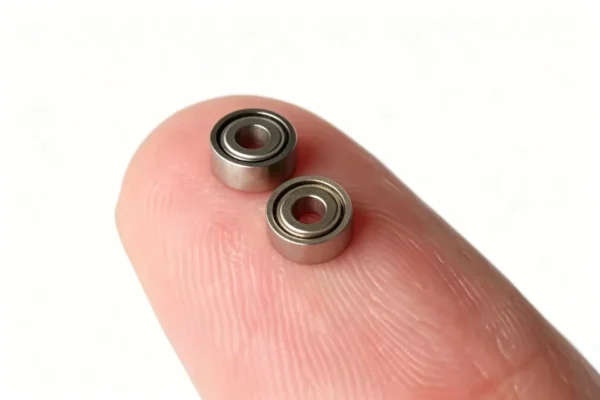
Miniature bearings are used in medical devices, robotics, semiconductors, and dozens of other industries. Getting the selection right matters. Getting the maintenance right matters even more. In this guide, I will walk you through everything — from types and sizes to applications and how to pick the right one for your needs.
What Exactly Are Miniature Ball Bearings?
They are called miniature, but do not underestimate them. A wrong choice here will cost you time, money, and machine downtime. Understanding what they are is the first step to using them correctly.
Miniature ball bearings are a type of small bearing that uses balls as rolling elements. They are built with an inner ring, outer ring, cage, seal, and balls. Their key performance indicators include radial and axial runout, fit tolerance, noise level, speed, and service life.
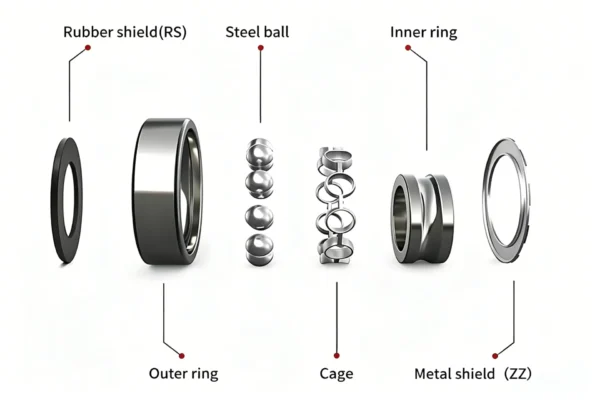
Miniature ball bearings are more than just small versions of standard bearings. They are precision-engineered components. Here is what makes them stand out.
Precision Grades
Precision is one of the most critical quality factors for miniature ball bearings. During manufacturing, engineers measure radial and axial runout, inner and outer diameter fit tolerance, and noise levels. These measurements directly determine the bearing's precision grade.
Most miniature bearings on the market are rated at ABEC 3.2 For more demanding applications, ABEC 5 and above are used. Higher-grade bearings have better raceway geometry and surface finish. This means smoother operation, less noise, and longer life.
ABEC Precision Grades Comparison
| Grade | Best For | Key Advantage |
|---|---|---|
| 🟢 ABEC 3 | General Industrial Equipment | Cost-effective standard precision |
| 🔵 ABEC 5 | Medical & Electronic Devices | Better accuracy and smoother rotation |
| 🟣 ABEC 7 | Aerospace & Precision Machinery | High-speed stability and superior finish |
| 🟡 ABEC 9 | Ultra-Precision Applications | Maximum accuracy and minimal runout |
Key Performance Attributes
Based on my years of experience working with bearing customers, four attributes define a quality miniature ball bearing:
- High speed capability — Miniature bearings are designed for very high rotational speeds.
- Low noise — Quiet operation is critical in instruments, medical, and electronic devices.
- Minimum runout — Both radial and axial runout must be kept as low as possible.
- Long service life — A bearing that wears out quickly causes machine downtime and increases costs.
These four factors should be your checklist when evaluating any miniature bearing supplier.
Materials Used
Chrome steel is the most common material for miniature ball bearings. It offers high load capacity and low noise. Stainless steel is also widely used. Because miniature bearings are not designed for heavy-load applications, and because they use very little material, stainless steel is a practical and popular choice.
Both chrome steel and stainless steel provide a high strength-to-wear ratio. This is essential for extending bearing life and keeping the bearing running efficiently over time.
What Types and Sizes of Miniature Ball Bearings Are Available?
There are so many types and sizes. If you pick the wrong one, it simply will not fit — or it will fail early. Knowing the series and their differences will save you from costly mistakes.
Miniature ball bearings are available in metric series (68, 69, 60) and inch R-series. They also come in several configurations: ZZ (steel shields), RS (rubber seals), PTFE seals, and flanged types. Popular models include 688ZZ, 686ZZ, and MR128ZZ.
Metric Series vs. Inch Series
The two main sizing systems for miniature ball bearings are the metric system and the inch system. Each has its own range of bore diameters and dimensions.
Metric Series
The metric series covers the most common miniature bearing sizes used globally. The three main families are:
Common Miniature Ball Bearing Series
| Series | Bore Size Range | Key Characteristics | Typical Applications |
|---|---|---|---|
| 🟢 68 Series | 2 mm – 10 mm | Ultra-thin cross-section, low friction, optimized for high-speed operation | Precision instruments, miniature motors, medical devices, electronic equipment |
| 🔵 69 Series | 3 mm – 10 mm | Higher load capacity than 68 Series while maintaining a compact design | Electric tools, small machinery, gearboxes, automation equipment |
| 🟣 60 Series | 10 mm and above | Balanced design offering good load capacity and versatility | Light industrial equipment, pumps, fans, conveyors, general machinery |
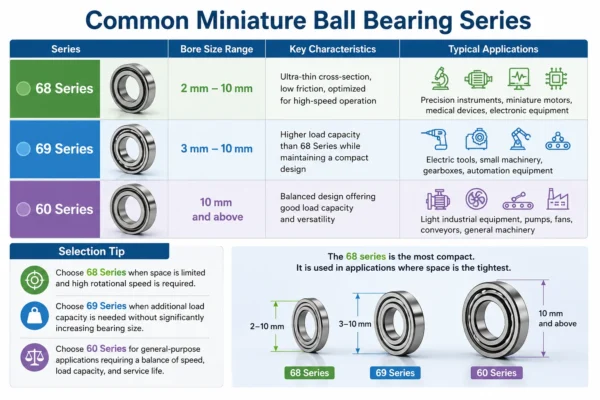
Selection Tip
- Choose 68 Series when space is limited and high rotational speed is required.
- Choose 69 Series when additional load capacity is needed without significantly increasing bearing size.
- Choose 60 Series for general-purpose applications requiring a balance of speed, load capacity, and service life.
The 68 series is the most compact. It is used in applications where space is the tightest.
Inch (Imperial) Series
The R-series covers six standard sizes for inch-based applications. These are common in the U.S. market and in industries where inch dimensions are standard, such as aerospace and some medical device manufacturing.
Seal and Shield Configurations
After choosing your series, you need to choose your seal type. This matters because the seal affects lubrication retention, contamination protection, and maximum speed.
Bearing Closure & Configuration Comparison
| Type | Protection Level | Speed Capability | Typical Applications |
|---|---|---|---|
| 🛡️ ZZ Shielded | Medium | ★★★★★ | Motors, fans, industrial equipment |
| 🔒 2RS Sealed | High | ★★★★☆ | Medical devices, machinery, outdoor equipment |
| 🧪 PTFE Sealed | Very High | ★★★★☆ | Chemical processing, high-temperature systems |
| 📍 Flanged | Depends on seal type | ★★★★☆ | Electronics, instruments, compact assemblies |
| ⚡ Open | None | ★★★★★ | Precision instruments, clean-room equipment |
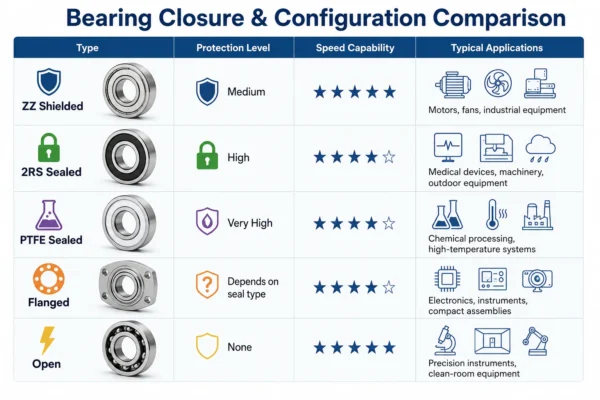
Quick Guide:
ZZ = Low Friction · 2RS = Better Protection · PTFE = Extreme Conditions · Flanged = Easy Mounting · Open = Maximum Speed
Models like 688ZZ, 686ZZ, and MR128ZZ are among the most popular in the market. They have unique dimensional combinations and are known for low friction and low noise. These models appear in a wide range of consumer electronics, toys, and small equipment.
Where Are Miniature Ball Bearings Used?
The application list is almost endless. But that does not mean every miniature bearing fits every job. Knowing where and how they are used will help you match the right bearing to your specific need.
Miniature ball bearings are used in medical devices, dental tools, semiconductor equipment, robotics, aerospace gyroscopes, electronic devices, DSLR cameras, CD players, and small motors. They are chosen for their compact size, high speed, low noise, and high precision.
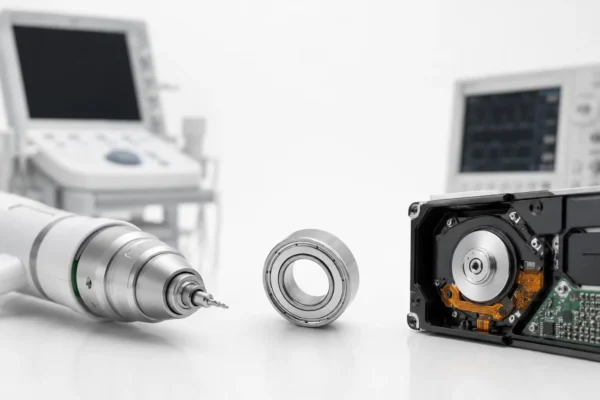
Mechanical Manufacturing
In mechanical manufacturing, miniature bearings are used in small electric motors, miniature gearboxes, toys, clocks and watches, door and window hardware, crushers, and pencil sharpeners. Their small size and high precision make them a natural fit for any device with a rotating part that must be compact and reliable.
Typical Miniature Bearing Applications
| Application | Key Bearing Requirements | Recommended Features |
|---|---|---|
| ⚡ Miniature Motors | High speed, low noise, low vibration | ABEC 5/7 precision, ZZ shield, low-friction design |
| ⌚ Clocks & Watches | Ultra-small bore size, minimal starting torque | Miniature open bearings, high precision, lightweight construction |
| 🧸 Toys & Hobby Products | Cost-effective performance, moderate precision | Standard ABEC 3 bearings, durable and economical design |
| ✏️ Pencil Sharpeners | Compact size, wear resistance, long service life | Shielded bearings with good contamination protection |
| 🏥 Medical Devices | Quiet operation, precision movement, corrosion resistance | Stainless steel bearings, ABEC 5 or higher |
| 💻 Electronic Equipment | Compact dimensions, smooth rotation, reliability | Miniature deep groove ball bearings with low torque |
| 🤖 Robotics & Automation | Precision positioning, high repeatability | High-precision bearings with low runout |
| 📷 Optical & Measuring Instruments | Maximum accuracy, minimal vibration | ABEC 7/9 precision bearings |
Quick Selection Guide
- Speed First? → Choose bearings for miniature motors and electronics.
- Precision First? → Choose ABEC 7 or ABEC 9 bearings.
- Cost First? → Standard ABEC 3 bearings are suitable for toys and consumer products.
- Durability First? → Shielded or sealed bearings are ideal for repeated-use applications.
Precision Instruments
Precision instruments demand the highest quality miniature bearings. These include fiber optic amplifiers, semiconductor lasers, photoelectric converters, scanners, high-precision engravers, automatic spinning machines, blood separators, and surgical tools.
In these applications, even the smallest runout or noise is not acceptable. ABEC 5 and above grades are standard here. The raceway geometry and surface finish must be perfect. A single defect in the bearing can ruin the measurement or the procedure.
Electronic Devices
Electronic devices are one of the largest markets for miniature bearings. CD players, mobile phones, precision electronic watches, and DSLR cameras all rely on miniature bearings to maintain stability and reliability.3
For example, in a DSLR camera, the shutter mechanism and lens autofocus system both use miniature bearings. The bearing must operate quietly, smoothly, and consistently — thousands of times per day.
Other Industrial Applications
Miniature bearings are also found in office equipment, laser engravers, floppy disk drives, pressure rollers, hard disk motors, stepper motors, VCR drum assemblies, computer cooling fans, banknote counters, and fax machines.
Beyond these, miniature bearings play important roles in:
- Medical devices — Including miniature medical linear guides used in surgical and diagnostic equipment.
- Space and satellite systems — Gyroscopes on satellites use ultra-precision miniature bearings.
- Wind turbines — Small-scale wind bearing components in turbine control systems.
How Do You Select the Right Miniature Ball Bearing?
Selecting the wrong bearing is one of the most common and costly mistakes I see buyers make. It is not just about the size. There are at least four key factors you must check before placing an order.
To select the right miniature ball bearing, you must evaluate speed requirements, load conditions (radial and axial), available space, precision grade, material, seal type, and operating environment. For most applications, miniature bearings handle moderate radial and thrust loads at low operating torque.
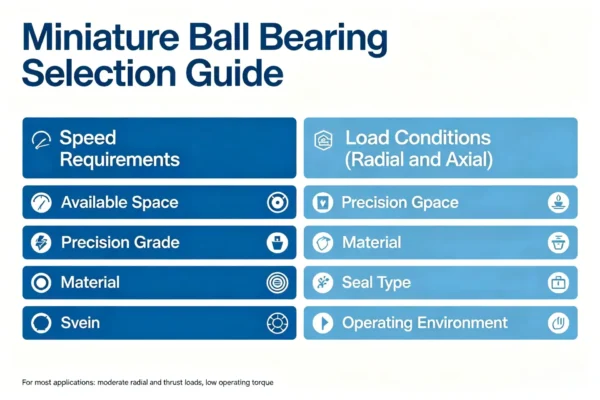
The Four Main Selection Factors
Let me break down the four factors I always walk my customers through.
1. Speed
Miniature bearings are built for high-speed applications. When selecting, always check the bearing's rated maximum speed. The seal type affects maximum speed — open and ZZ bearings run faster than RS sealed bearings because contact seals create more friction.
Seal Type vs. Speed Capability
| Seal Type | Speed Capability | Protection Level | Typical Applications |
|---|---|---|---|
| ⚡ Open Bearing | ★★★★★ Highest | ☆ None | Precision instruments, clean-room equipment, ultra-high-speed applications |
| 🛡️ ZZ (Steel Shield) | ★★★★☆ High | ★★★☆☆ Medium | Electric motors, fans, industrial equipment, general-purpose machinery |
| 🔒 RS / 2RS (Rubber Seal) | ★★★☆☆ Moderate | ★★★★★ High | Medical devices, outdoor equipment, dusty or humid environments |
Why Does Seal Type Affect Speed?
- Open Bearings generate the least friction, allowing the highest rotational speeds.
- Steel Shields (ZZ) provide basic contamination protection with minimal speed reduction.
- Rubber Seals (RS/2RS) create additional contact friction, reducing maximum speed but significantly improving protection against dust and moisture.
Quick Selection Guide
| Priority | Recommended Type |
|---|---|
| 🚀 Maximum Speed | Open Bearing |
| ⚖️ Balance of Speed & Protection | ZZ Shielded Bearing |
| 🛡️ Maximum Protection | RS / 2RS Sealed Bearing |
Rule of Thumb:
The better the sealing performance, the lower the maximum operating speed. Always balance speed, contamination risk, and service life when selecting a miniature bearing.
2. Load Conditions
Miniature bearings handle moderate radial and axial loads at low torque.4 They are not designed for heavy loads. If your application requires heavy radial loading, a standard deep groove ball bearing or a different bearing type will serve you better.
For light-duty, high-speed, low-torque applications, miniature bearings are the best choice.
3. Precision Grade
Match the precision grade to your application. General industrial use needs ABEC 3. Instruments and medical devices need ABEC 5. Aerospace and semiconductor equipment often require ABEC 7 or higher.
Buying a higher grade than needed is a waste of money. Buying a lower grade than needed causes failure.
4. Material and Environment
Chrome steel is the default. Use stainless steel if:
- The environment is wet or corrosive.
- The application involves food, medical, or chemical contact.
- Weight reduction is important.
Both materials offer a high strength-to-wear ratio. Both are suitable for long service life if maintained correctly.
How Should Miniature Ball Bearings Be Maintained and Stored?
This is the part most people skip. And it is the part that causes the most failures. Miniature bearings are extremely delicate. A single mistake in storage or lubrication can destroy a bearing that cost you a great deal of effort to select.
Miniature ball bearings must be stored in a clean, dust-free room.5 They must be lubricated with the correct lubricant, in the correct amount, using the correct procedure. Even a single human hair can damage the balls or raceways of a miniature bearing.
Storage Requirements
I cannot stress this enough. Miniature bearings must be stored in a dedicated clean room. Airborne particles, dust, and even human hair can cause physical damage to the balls and raceways.
Because miniature bearings are so small, the damage from a particle that would be harmless to a standard bearing can be catastrophic to a miniature one. The raceway depth and ball diameter are so small that even minor surface damage creates excessive noise, vibration, and early failure.
Storage rules to follow:
Miniature Bearing Storage & Handling Best Practices
| Best Practice | Why It Matters | Potential Risk if Ignored |
|---|---|---|
| 📦 Store in Original Packaging | Protects bearings from dust, moisture, and contamination before installation | Premature wear and reduced bearing life |
| 🧼 Use a Clean Environment | Minimizes airborne particles that can damage raceways and rolling elements | Increased noise, vibration, and early failure |
| 🧲 Keep Away from Magnets | Prevents magnetization of steel components that may attract metallic debris | Contamination buildup and accelerated wear |
| 💧 Avoid Humidity Exposure | Protects bearing surfaces from corrosion and rust formation | Reduced performance and shortened service life |
| 🧤 Handle with Clean Gloves | Prevents skin oils, sweat, and contaminants from contacting bearing surfaces | Corrosion, staining, and lubrication issues |
| 🔨 Avoid Impact or Dropping | Protects precision raceways and balls from damage | Increased runout, vibration, and noise |
| 🌡️ Store at Stable Temperature | Prevents condensation and lubricant degradation | Corrosion and reduced lubrication effectiveness |
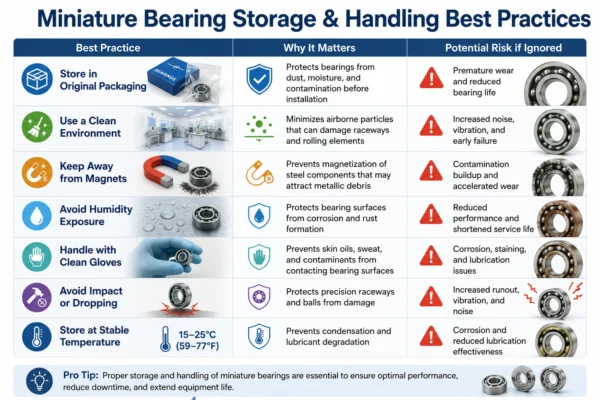
Storage Tip:
Even a high-precision miniature bearing can suffer performance loss if exposed to contamination before installation. Proper storage and handling are often just as important as bearing quality itself.
Quick Checklist
| ✔ Do | ✖ Don't |
|---|---|
| Store bearings in sealed packaging | Open packages long before installation |
| Wear clean gloves during handling | Touch bearing surfaces with bare hands |
| Keep bearings in a dry environment | Store near water, chemicals, or humid areas |
| Use clean tools and workspaces | Install bearings in dusty environments |
| Protect bearings from impacts | Drop or strike bearings during handling |
Rule of Thumb:
Clean Storage + Clean Handling = Maximum Bearing Life
Lubrication Best Practices
Lubrication is the most important part of miniature bearing maintenance. There are three things you must get right:
1. Lubricant selection. Use a lubricant that is specifically rated for miniature bearings.6 Standard greases are often too thick and will increase torque, generate heat, and reduce speed. Use light oil or low-viscosity grease designed for high-speed, small-bore bearings.
2. Lubrication method. For open bearings, apply lubricant directly to the bearing. For ZZ or RS sealed bearings, the lubricant is pre-filled at the factory. Do not over-grease. Excess lubricant generates heat and actually shortens bearing life.
3. Lubrication procedure. Clean the bearing area before applying lubricant. Use the correct tool — never a dirty or contaminated applicator. Apply the lubricant evenly. After lubrication, run the bearing at low speed for a short period to distribute the lubricant before full-speed operation.
If you handle all three aspects of lubrication correctly, your miniature bearings will run smoothly, quietly, and for a long time.
Conclusion
Miniature ball bearings are small, precise, and demanding. Choose the right type, grade, and material. Store them clean. Lubricate them correctly. And your application will run as it should.
"[PDF] Miniature Ball Bearings - NSK", https://www.nsk.com/content/dam/nsk/common/catalogs/ctrgPdf/bearings/e126h.pdf. Miniature ball bearings are often referred to as instrument bearings due to their use in precision instruments and small-scale applications. Evidence role: definition; source type: encyclopedia. Supports: The source should confirm that miniature ball bearings are commonly referred to as instrument bearings.. ↩
"ABEC scale - Wikipedia", https://en.wikipedia.org/wiki/ABEC_scale. ABEC 3 is the most commonly used precision grade for miniature bearings in general industrial applications. Evidence role: statistic; source type: research. Supports: The source should provide data or industry insights showing that ABEC 3 is the most common rating for miniature bearings.. Scope note: The prevalence may vary by region or specific industry. ↩
"Miniature Bearings - Kapoor Enterprises", https://kapent.com/miniature-bearings/. Miniature bearings are integral to the operation of devices such as CD players, mobile phones, and DSLR cameras, where precision and reliability are critical. Evidence role: case_reference; source type: research. Supports: The source should confirm the use of miniature bearings in consumer electronics like CD players and DSLR cameras.. Scope note: Specific bearing models may vary by device type. ↩
"Can a ball bearing take axial load? - SMB Bearings", https://www.smbbearings.com/can-a-ball-bearing-take-axial-load. Miniature bearings are engineered to handle moderate radial and axial loads while maintaining low torque, making them suitable for precision applications. Evidence role: mechanism; source type: education. Supports: The source should confirm that miniature bearings are designed for moderate radial and axial loads at low torque.. ↩
"Miniature Bearings: Reduce Friction, Save Space, Meet Your Project ...", https://www.bdsbearing.com/blog/miniature-bearings. Proper storage of miniature ball bearings in a clean, dust-free environment is essential to prevent contamination and ensure longevity. Evidence role: general_support; source type: education. Supports: The source should confirm that miniature ball bearings must be stored in a clean, dust-free environment to prevent contamination.. ↩
"Lubricants(Miniature & small ball bearings)", https://product.minebeamitsumi.com/en/technology/bearing/ballbearings_cat-3_004-18.html. Using lubricants specifically rated for miniature bearings ensures proper operation and extends the bearing's service life. Evidence role: mechanism; source type: education. Supports: The source should confirm that lubricants specifically rated for miniature bearings are required for optimal performance.. ↩