

Agricultural machinery never stops. When a bearing fails mid-harvest, the entire operation stops with it. The cost is not just a part — it is time, yield, and money.
Selecting the right bearing for agricultural equipment means matching load capacity, sealing performance, corrosion resistance, and temperature range to the specific working conditions of each machine component. The wrong choice leads to early failure. The right choice keeps equipment running through the entire season.

Our factory have worked with bearing applications in agricultural machinery for over thirty years. In that time, I have seen the same mistakes made again and again — engineers choosing bearings based on price alone, or importers sourcing general-purpose bearings for high-contamination environments. This guide covers everything you need to know to make the right call, from understanding the field environment to matching bearing types to specific machines.
What Makes the Agricultural Environment So Harsh for Bearings?
Most people think of farm soil as just dirt. In reality, it is a complex mix of mineral particles, organic matter, water, and air — and almost all of it is hostile to bearings.
Agricultural bearings face four main threats: solid contaminants like sand and clay particles, liquid contaminants like slurry and fertilizer solutions, wide temperature ranges from cold mornings to hot engine compartments, and constant mechanical shock and vibration from uneven terrain.1

Breaking Down Each Threat
The solid contaminants alone come in several forms, and each behaves differently.
| Contaminant Type | Particle Size Range | Primary Damage Mechanism |
|---|---|---|
| Gravel & Stones | > 2 mm | Causes direct mechanical impact on bearing housing and seals, leading to deformation or cracking |
| Sand Particles | 20 µm – 0.2 mm | Penetrate seals and raceways, accelerating abrasive wear and surface fatigue |
| Clay / Fine Dust | < 2 µm | Mixes with grease to form abrasive slurry, significantly increasing friction and wear rate |
| Plant Fibers (straw, rope, etc.) | Variable | Wrap around shafts or bearing units, interfering with seals and causing overheating or blockage |
Sand particles are the most common internal threat. They are small enough to pass through a standard seal but large enough to score the raceway surface. Once inside, they mix with grease and behave like a grinding compound.
Clay particles are an even bigger problem in wet conditions. After rain, clay-heavy soil turns into a fine slurry. This slurry finds its way through even tight seals, combines with the lubricant, and destroys the smooth surface of the rolling elements.
Liquid threats add another layer of difficulty. Slurry and manure carry ammonium salts (NH₄⁺), which corrode steel surfaces quickly. Chemical fertilizer solutions attack rubber seals and cause grease to break down or leak.2 Even clean water is dangerous — if it enters the bearing, it washes out the grease and leaves the rolling elements unprotected.
Temperature adds one more variable. Tractor engines and gearboxes run hot. In northern regions, early-season fieldwork happens at sub-zero temperatures.3 A bearing that performs well at 20°C may fail at -20°C if the grease hardens or the seal material becomes brittle.
What Sealing Technologies Are Used to Protect Agricultural Bearings?
A contaminated bearing is a failed bearing. That is why sealing is the single most important design factor in agricultural bearing selection.
Agricultural bearings use multi-layer sealing systems to block contaminants of different sizes.4 These range from single-lip seals for low-contamination indoor applications to eight-lip seals for extreme outdoor environments. Each seal layer targets a specific threat.

How Multi-Lip Seals Work
The logic of multi-lip seals is simple: each layer handles a different job.
| 🧩 Seal Type | 🧷 Lip Structure | 🌍 Suitable Environment | ⚙️ Key Capability |
|---|---|---|---|
| ◽ Single-lip seal | 1 lip | Low contamination (indoor, clean conditions) | Basic dust and light debris protection with low friction |
| ◽ Triple-lip seal | 3 lips | Medium contamination (general industrial use) | Improved sealing against sand, dust, and fine particles |
| ◽ Eight-lip seal | 8 lips | Extreme contamination (agriculture, mining, field conditions) | Multi-stage sealing system for strong resistance to dust, dirt, and moisture |
In an eight-lip design, the outer lips stop large particles like plant fiber and gravel. The middle lips block fine sand. The inner lips, combined with a grease barrier, stop clay particles from reaching the raceway.
Beyond the seal lips, two other protection layers matter:
Ductile iron housings absorb impact better than standard steel. When a stone hits the bearing housing at speed, ductile iron deforms slightly rather than cracking. This protects the internal components.
External dust caps act as the first physical barrier. They take the direct hit from large debris before it reaches the seal system.
Fluorocarbon rubber (FKM) seals replace standard rubber in high-chemical environments like manure spreaders and fertilizer applicators. FKM holds up against ammonium compounds and acid-based chemicals where standard NBR rubber degrades and hardens.
High-adhesion grease fills the space between seal lips and forms a static barrier. Fine particles that pass through a seal lip get trapped in the grease before they reach the raceway. Grease selection matters — thin grease washes out; grease that is too stiff will not fill the gaps.
Which Bearing Types Are Used in Agricultural Machinery?
Not all bearings are the same. Each type handles loads and conditions differently. Agricultural machinery uses a range of bearing types depending on the application.
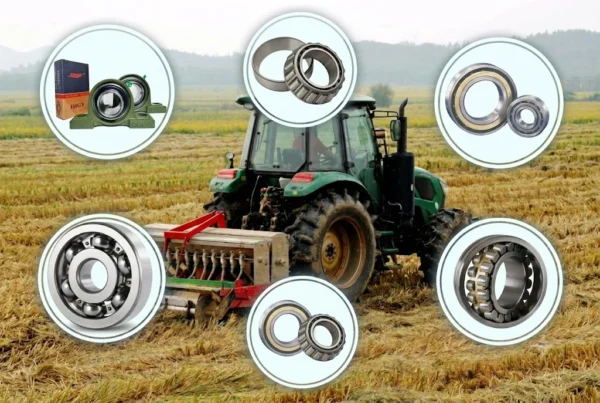
The most common bearing types in agricultural equipment are deep groove ball bearings, tapered roller bearings, angular contact ball bearings, spherical roller bearings, and housed units. The right type depends on load direction, magnitude, speed, and available space in the machine.
Matching Bearing Type to Application
Here is how the main types are matched to agricultural use cases:
| ⚙️ Bearing Type | 📊 Load Capability | 🚜 Typical Agricultural Application |
|---|---|---|
| ◽ Deep groove ball bearing | Moderate radial + limited axial | Gearboxes, electric motors, fans, grain conveyors |
| ◽ Tapered roller bearing | High combined radial + axial load | Tractor wheel hubs, combine harvester drums |
| ◽ Angular contact ball bearing | High axial + radial load capacity | Steering shafts, cutting heads, precision drive systems |
| ◽ Spherical roller bearing | Very high radial + misalignment tolerance | Drive axles, heavy tillage machinery, harsh field equipment |
| ◽ Pillow block bearing unit | Moderate to high load, easy installation | Grain augers, baling machines, conveyor shaft support systems |
Deep groove ball bearings are the most widely used type across all agricultural equipment. Common sizes in grain crushers include 6205RS, 6206RS, 6207RS, 6208RS, and 6309RS. For corn threshers, 6201RS, 6203RS, 6205RS, and 6206RS are standard. In grain conveyor systems, 6203RS through 6308RS cover most shaft sizes. The RS suffix indicates a rubber seal on one or both sides — this is the minimum sealing standard for field use.
Tapered roller bearings handle the combined loads found in tractor wheel hubs and harvester main drums. The 30207 and 30208 series appear frequently in worm gear reducers used across farm equipment.
Pillow block bearings (housed units) like UCP205, UCP206, and UCP207 are used in corn threshers and grain processing equipment. The self-aligning insert inside the housing compensates for shaft misalignment — a common issue in equipment that takes constant vibration and shock.
Self-aligning ball bearings such as 1206, 1207, 1308, 1310, and 1312 are used in rice mills and grain grinding machines where slight shaft deflection under load is expected.
For wheat seeders with hexagonal bores, inner-hexagonal 6204RS bearings are used. For square-bore applications in seeders, square-bore 6205RS bearings fit the specific shaft shape.
What Load and Performance Requirements Must Agricultural Bearings Meet?
Agricultural machinery has gotten larger and more automated.5 That means bearings work harder, run longer, and face more stress than they did twenty years ago.
Agricultural bearings must meet five core performance requirements: high load capacity with shock resistance, effective contamination sealing, wide temperature tolerance, corrosion resistance to water and chemicals, and long service life with minimal maintenance.
Why Each Requirement Matters in Practice
These five requirements are not marketing language. Each one connects directly to a field failure mode.
| 🧩 Requirement | 🌱 Root Cause (Field Condition) | ⚠️ Consequence of Failure |
|---|---|---|
| ◽ High load + shock resistance | Uneven terrain, heavy crop loads, vibration | Raceway fatigue, surface spalling, or full seizure |
| ◽ Sealing performance | Soil, dust, water, manure contamination | Abrasive wear, grease contamination, premature failure |
| ◽ Temperature tolerance | Engine heat + cold morning field operation | Grease degradation (hardening or thinning), seal cracking |
| ◽ Corrosion resistance | Fertilizer, manure, irrigation chemicals | Rust pitting on raceways and rolling elements |
| ◽ Long service life | Remote operation, high replacement cost | Downtime during critical harvesting periods |
Load and shock resistance is the baseline requirement. Tillage equipment hits rocks, roots, and compacted soil. Each impact sends a shock load through the drivetrain to the bearings. Bearings without adequate dynamic load ratings fail early from fatigue spalling.
Sealing performance separates agricultural-grade bearings from general-purpose ones. A standard bearing in a clean factory environment might last for years. The same bearing in a combine harvester will fail in days if it uses only a single lip seal.
Temperature tolerance matters because agricultural work does not stop for weather. In northern China and similar regions, spring planting happens when temperatures are still below zero. The same bearing may operate near a diesel engine where surface temperatures exceed 100°C. The bearing, its grease, and its seal material must all perform across this full range.
Corrosion resistance is often overlooked during bearing selection. Zinc plating and ceramic coatings on the bearing outer surfaces resist the ammonium compounds in manure and the salt-based chemicals in fertilizer sprays. Without this protection, surface rust forms quickly and creates pit points that become stress concentrations for fatigue cracking.
Long service life ties everything together. Farmers do not want to stop a combine during harvest to replace a bearing.6 Distributors and importers who supply agricultural OEMs know that bearing reliability is a direct factor in machine brand reputation. A bearing that fails early in the field creates a customer service problem that is hard to recover from.
How Should You Approach Bearing Selection for a Specific Agricultural Machine?
Knowing the bearing types and requirements is one thing. Applying that knowledge to a real selection decision is another.
Bearing selection for agricultural equipment comes down to two decisions: choosing the right bearing type based on load direction, magnitude, speed, alignment needs, and available space; and choosing the right accuracy grade based on the machine's actual precision requirements.

A Practical Selection Framework
Agricultural machinery does not need the precision grades used in machine tools or spindles. The operating environment makes micron-level precision irrelevant — contamination and shock loads will affect performance far more than a slight variation in geometry. This means cost can be managed without sacrificing reliability, as long as the other selection criteria are met correctly.
| 🎯 Selection Factor | ❓ Key Questions to Answer | ⚙️ Impact on Selection |
|---|---|---|
| ◽ Load direction | Is the load radial only, axial only, or combined? | Determines bearing type (deep groove, angular contact, tapered roller, etc.) |
| ◽ Load magnitude | Is the load light, medium, or heavy? Are there shock loads? | Defines minimum dynamic and static load ratings |
| ◽ Speed | Is the operating speed high, medium, or low? | Influences cage design, lubrication type, and heat generation |
| ◽ Alignment | Is shaft deflection or misalignment expected? | Determines need for self-aligning bearing or pillow block unit |
| ◽ Space constraint | Is installation space compact or flexible? | Sets limits for bearing outer diameter and width |
| ◽ Environment | What contaminants or moisture are present? | Determines sealing system (RS, 2RS, multi-lip, FKM, etc.) |
| ◽ Precision requirement | Is high rotational accuracy required? | Defines tolerance class (P0 for general agriculture applications, higher grades for precision systems) |
I always start with the environment. There is no point selecting a bearing with perfect load ratings if the sealing system cannot handle the application. In agricultural machinery, sealing comes first.
The second step is load analysis. For most agricultural components, tapered roller bearings or deep groove ball bearings will cover the requirement. For shafts that experience misalignment — which is most outdoor equipment after a season of use — a spherical roller bearing or a self-aligning insert in a pillow block is the safer choice.
The third step is confirming the fit. Agricultural machines often use non-standard bore shapes: square bores, hexagonal bores, and tapered bores are all common in seeder and thresher applications. The bearing bore must match the shaft shape exactly, or fretting and wear will start at the fit surface and shorten service life.
Conclusion
Agricultural bearings must handle contamination, shock, corrosion, and wide temperature ranges. Match the bearing type to the load, seal the bearing to the environment, and choose material and grease accordingly — and the machine will run through the season.
"Why do bearings in tractors fail and how can this be prevented? It ...", https://www.facebook.com/bbcrbearings/videos/why-do-bearings-in-tractors-fail-and-how-can-this-be-preventedit-seems-like-a-si/1705618880062010/. Research studies on agricultural machinery often highlight contamination, temperature extremes, and mechanical shock as primary factors affecting bearing performance. Evidence role: expert_consensus; source type: research. Supports: The listed threats are common challenges faced by bearings in agricultural machinery.. ↩
"The Impact of Environmental Factors on Rubber Seal Performance", https://www.sealsdirect.co.uk/blog/news-5/the-impact-of-environmental-factors-on-rubber-seal-performance-85?srsltid=AfmBOoqi4BLPvjwI_xXHxp1HqKvITrY8jJ5g_jjHizoITYTE1r3-2H_Q. Material compatibility studies show that ammonium salts and acidic compounds in fertilizers can weaken rubber seals and alter grease properties. Evidence role: mechanism; source type: education. Supports: Chemical fertilizers can degrade rubber seals and affect grease performance due to their chemical composition.. Scope note: Specific degradation rates depend on fertilizer concentration and exposure duration. ↩
"[PDF] Bearings for Agricultural Machinery - NSK", https://www.nsk.com/content/dam/nsk/common/catalogs/ctrgPdf/bearings/e1269.pdf. Technical guidelines for agricultural machinery confirm that bearings must perform in both sub-zero field conditions and high-temperature engine environments. Evidence role: general_support; source type: institution. Supports: Agricultural machinery bearings are exposed to wide temperature ranges due to environmental and operational conditions.. Scope note: Specific temperature ranges may vary by machine type and region. ↩
"Agricultural Bearings - Ag Bearings - Bearings Direct", https://bearingsdirect.com/ball-bearings/agricultural-ball-bearings/?srsltid=AfmBOoo5h6yEeDx6iOPPJoLaXXwjPBq3dH0KXbFjHXArXLdo-TW2rtng. Engineering textbooks on bearing design describe multi-layer seals as effective solutions for contamination control in harsh environments. Evidence role: mechanism; source type: education. Supports: Multi-layer sealing systems are designed to protect bearings from various contaminants in agricultural environments.. Scope note: Specific seal designs may vary by manufacturer and application. ↩
"Agricultural Machinery Market - Share & Industry Trends", https://www.mordorintelligence.com/industry-reports/agricultural-machinery-market. Historical overviews of agricultural technology document the trend toward larger and more automated machinery. Evidence role: historical_context; source type: encyclopedia. Supports: Agricultural machinery has increased in size and automation over recent decades.. Scope note: Specific growth rates and automation levels may vary by region and crop type. ↩
"Structural Fault Detection and Diagnosis for Combine Harvesters", https://pmc.ncbi.nlm.nih.gov/articles/PMC12251867/. Industry case studies highlight the importance of reliable bearings in minimizing downtime during critical harvest periods. Evidence role: case_reference; source type: institution. Supports: Bearing reliability is crucial during harvest to prevent costly downtime in agricultural operations.. Scope note: Specific downtime costs may vary by crop type and region. ↩