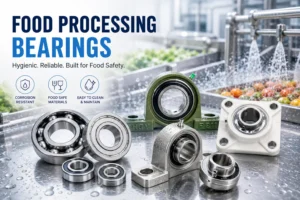
Bearings may seem like one of the least conspicuous components in food processing equipment, but their failure often results in disproportionate consequences. From production downtime to increased waste and sanitation challenges, such issues can quickly escalate. Selecting the right bearings based on working conditions is essential for ensuring seamless operations and managing costs effectively.
In food processing equipment, bearing selection revolves around meeting three key challenges: resistance to frequent washing, tolerance to extreme temperatures, and adherence to hygiene standards that eliminate foreign object risks.
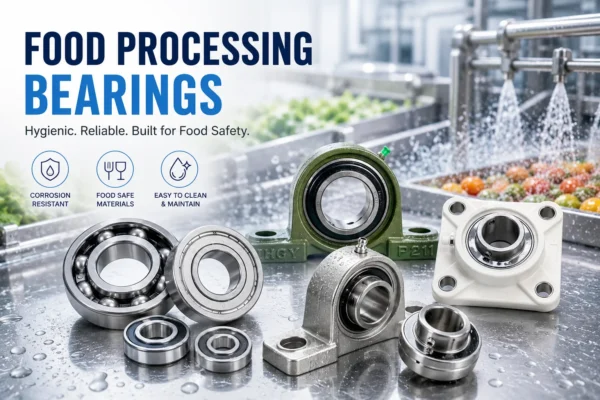
A closer look at various food industry scenarios reveals how different types of bearings fit specific working conditions. Matching the type of bearing to the operating environment is far more effective than simply opting for premium materials across the board.
What makes washdown bearings necessary?
No food processing line escapes frequent cleaning routines mandated by stringent hygiene standards, involving CIP (clean-in-place) and COP (clean-out-of-place) methods1. This results in significant wear due to exposure to hot water, alkaline detergents, acidic neutralizers, and high-pressure jets.
Washdown bearings must be equipped with food-grade lubricants resistant to water washout and seals that withstand high-pressure cleaning, avoiding liquid ingress.
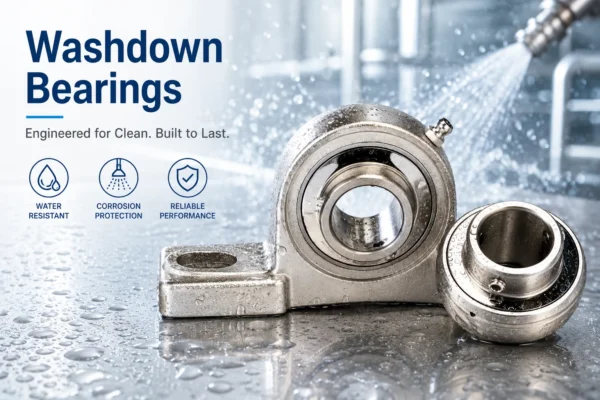
Common industry applications of washdown bearings
Washdown-resistant bearings are indispensable in food processing facilities that face constant cleaning cycles. They’re heavily utilized in areas such as suspended conveyors on slaughter lines, rotary heads on dairy filling units, and drive wheels on bakery conveyor belts.
| Feature | Washdown Bearings Criteria | Benefits |
|---|---|---|
| Material | Stainless steel (440C or similar)2 | Corrosion protection |
| Lubricant | NSF-certified food-grade grease3 | Safe for food contact |
| Seal Type | Contact-type, withstands high-pressure cleaning | Prolongs service life |
How do bearings handle extreme temperature conditions?
Temperature fluctuations are often underestimated in food processing. Operations like frying, drying, and baking frequently put bearings under high heat stress. For example, bearings near frying production lines operate above 150°C, while those around hot air dryers and tunnel ovens see prolonged exposure above 120°C.
High-temperature bearings must incorporate thermal expansion allowances, robust cage materials, and food-grade lubricants resistant to carbonization.
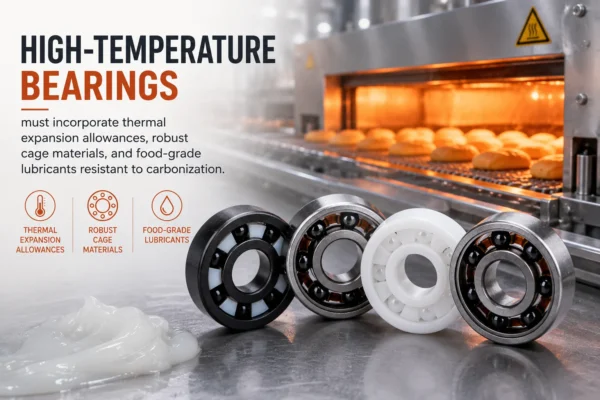
Optimal configurations for high-temperature bearings
In extreme temperature contexts, selecting bearings with expanded radial clearance (C3 or higher)4 and durable cages like PTFE composites or stainless steel ensures sustained performance. Ceramic rolling elements combined with steel rings5 are also increasingly popular for high-speed and high-temperature environments.
| Feature | High-Temperature Bearing Considerations | Benefits |
|---|---|---|
| Radial Clearance | C3 or higher | Compensates for thermal expansion |
| Cage Material | PTFE or stainless steel | Durability under intense heat |
| Lubricant Type | Food-grade, heat-resistant grease | Prevents carbonization |
When should polymer bearings be used?
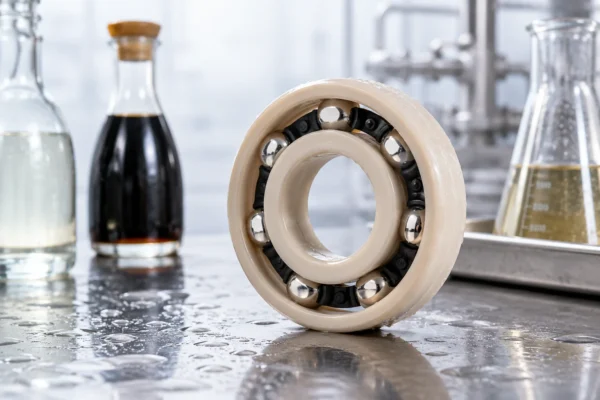
Polymer bearings, made from engineering plastics, hold unique advantages in low-load and chemically corrosive environments. These include areas with frequent exposure to vinegar, soy sauce, or brining liquids. Surprisingly, these locations often see higher bearing costs due to inappropriate use of stainless steel options.
Polymer bearings are self-lubricating6, chemically resistant, and eliminate risks of metallic foreign object contamination7.
Specific use cases for polymer bearings
Polymer bearings are perfect for condiment filling lines, sauce conveyors, vacuum sealing machines, and thawing equipment exposed to saline, acidic, or lactic environments. Such configurations significantly reduce maintenance and prevent operational bottlenecks.
| Feature | Polymer Bearings Characteristics | Advantages |
|---|---|---|
| Material | Engineering plastics (polyethylene or PTFE)8 | Rust resistance |
| Application | Low-speed loads | Prevents deformities |
| Lubricant | None, self-lubricating | No risk of contamination |
Ball bearings vs. sleeve bearings: What's the dividing line?
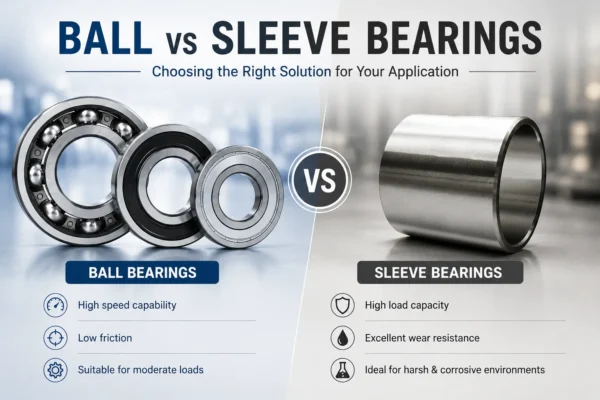
Food processing equipment uses primarily two types of bearings: ball bearings and sleeve bearings (plain bearings). Ball bearings cater to setups requiring combined axial and radial load support9 at high rotational speeds, while sleeve bearings are used for slow-moving operations requiring higher durability.
The selection depends on operational conditions; ball bearings suit transport machinery, while sleeve bearings excel in low-speed swinging assemblies.
Application-specific examples
Ball bearings are common in conveyor drive units, mixer staff supports, and centrifugal separators. Sleeve bearings, often made from PTFE or UHMW polyethylene, are vital in areas like vacuum pump connector rods or packaging machine swinging arms.
| Bearing Type | Application Areas | Benefits |
|---|---|---|
| Ball Bearings | Conveyor drives, mixers, pumps | High speed, dual-load capability |
| Sleeve Bearings | Vacuum pump rods, swing assemblies | Low maintenance, no lubrication |
Why is matching bearings to working conditions more important than material selection?
A common misconception in the industry is that stainless steel bearings, especially those made of 316 steel10, are universally superior. In reality, many dry environments or grain processing lines work perfectly well with traditional steel bearings accompanied by food-safe lubricants. Conversely, frequent cleaning conditions can fail even stainless steel bearings if seals or lubricants are inadequate11.
Bearing selection in food processing depends on wash intensity, temperature range, and load characteristics—not just material composition.
Cost-effective bearing selection for food facilities
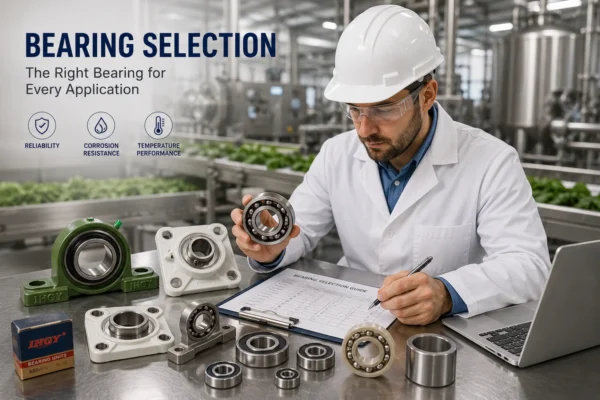
Developing workpiece-specific bearing selection lists, rather than chasing premium materials, provides better reliability and efficiency for food processors. The goal is balancing the upfront cost against long-term functionality in specific operating environments.
| Key Factor | Implication | Cost Impact |
|---|---|---|
| Cleaning Intensity | High pressure affects seal integrity | Prioritize seal robustness |
| Temperature Range | High-heat operations require C3 clearances | Choose heat-resistant materials |
| Load Characteristics | Heavy loads can deform polymer bearings | Match load limits appropriately |
Conclusion
Matching food processing bearing types to specific working conditions ensures durability and operational efficiency. Washdown resistance, temperature tolerance, and understanding load profiles are key for selection and long-term cost management.
"Validation of Cleaning Processes (7/93) - FDA", https://www.fda.gov/inspections-compliance-enforcement-and-criminal-investigations/inspection-guides/validation-cleaning-processes-793. Clean-in-place (CIP) and clean-out-of-place (COP) systems are established sanitation methods in food processing, designed to meet hygiene requirements without equipment disassembly. Evidence role: general_support; source type: government. Supports: CIP and COP are recognized cleaning methodologies in food processing facilities. Scope note: This supports the existence and purpose of these methods but does not directly confirm they are universally mandated by regulation. ↩
"440C - Wikipedia", https://en.wikipedia.org/wiki/440C. AISI 440C is a high-carbon martensitic stainless steel containing approximately 1% carbon and 17% chromium, providing hardness and moderate corrosion resistance suitable for bearing applications in mildly corrosive environments. Evidence role: mechanism; source type: encyclopedia. Supports: Material properties of 440C stainless steel relevant to corrosive environments. ↩
"Nonfood Compounds: ISO 21469 Food-Grade Lubricants - NSF", https://www.nsf.org/food-beverage/commercial-food-equipment/nonfood-compounds-chemical-registration-certification/food-grade-lubricants-iso-21469-certification. NSF International provides certification programs for lubricants used in food processing environments, with H1 registration indicating products formulated for incidental food contact. Evidence role: definition; source type: institution. Supports: NSF certification provides standards for food-grade lubricants. ↩
"Internal clearance | SKF", https://www.skf.com/us/products/rolling-bearings/principles-of-rolling-bearing-selection/general-bearing-knowledge/bearing-basics/internal-clearance. Bearing radial clearance groups (C2, Normal, C3, C4, C5) are standardized under ISO 5753, with C3 providing greater internal clearance than Normal to accommodate thermal expansion of rings and rolling elements during high-temperature operation. Evidence role: mechanism; source type: education. Supports: Radial clearance classifications and their relationship to thermal expansion. ↩
"Advanced Hybrid Bearings for Industrial Use", https://industry.ceramicspeed.com/pages/why-hybrid-bearings. Hybrid bearings with silicon nitride (Si₃N₄) ceramic rolling elements and steel rings exhibit lower thermal expansion, reduced friction, and higher temperature tolerance compared to all-steel bearings, with operational capabilities extending beyond 300°C in some configurations. Evidence role: mechanism; source type: research. Supports: Performance characteristics of ceramic hybrid bearings in demanding conditions. Scope note: This describes general performance characteristics but does not specifically confirm increasing adoption rates in food processing environments. ↩
"How Self-Lubricating Bearings Work | TriStar Plastics - YouTube",
. Self-lubricating polymer bearings function through transfer film formation, where microscopic material transfer from the bearing surface creates a low-friction layer on the mating surface, eliminating the need for external lubricants in many applications. Evidence role: mechanism; source type: education. Supports: Mechanism of self-lubrication in polymer bearings. ↩"Detection and prevention of foreign material in food: A review - PMC", https://pmc.ncbi.nlm.nih.gov/articles/PMC10558841/. Foreign material contamination, including metal fragments from equipment wear, is identified as a physical hazard in food processing requiring preventive controls under FDA regulations, with material selection being one mitigation strategy. Evidence role: general_support; source type: government. Supports: Foreign material control as a food safety concern. Scope note: This confirms foreign material control is a regulatory concern but does not directly verify that polymer bearings eliminate all contamination risks, as polymer fragments could also pose hazards. ↩
"Food Packaging & Other Substances that Come in Contact with Food", https://www.fda.gov/food/food-ingredients-packaging/food-packaging-other-substances-come-contact-food-information-consumers. Polytetrafluoroethylene (PTFE) and certain polyethylene formulations are listed in FDA regulations (21 CFR 177) as acceptable materials for food-contact applications, with PTFE exhibiting exceptional chemical resistance across pH ranges. Evidence role: general_support; source type: government. Supports: Regulatory status of PTFE and polyethylene for food contact. ↩
"Rolling-element bearing - Wikipedia", https://en.wikipedia.org/wiki/Rolling-element_bearing. Ball bearings support combined loads through point contact between spherical rolling elements and raceways, with contact angle determining the ratio of radial to axial load capacity; angular contact designs optimize axial load handling while deep-groove configurations balance both load types. Evidence role: mechanism; source type: education. Supports: Load-handling mechanics of ball bearings. ↩
"Understanding 316 Grade Stainless Steel", https://neelectropolishing.com/understanding-316-grade-stainless-steel/. AISI 316 stainless steel is an austenitic grade containing molybdenum (2-3%), which enhances resistance to chloride corrosion and acidic environments compared to standard 304 steel, though its lower hardness makes it less suitable than martensitic grades for bearing raceways. Evidence role: mechanism; source type: encyclopedia. Supports: Corrosion resistance properties of 316 stainless steel. Scope note: This explains 316 steel's corrosion advantages but notes a limitation for bearing applications, where hardness is typically prioritized. ↩
"[PDF] Technologies and Testing to Prevent Water Ingress in Railroad ...", https://railroads.dot.gov/sites/fra.dot.gov/files/2022-11/Prevent%20Water%20Ingress%20in%20Railroad%20Bearings.pdf. Bearing failures in food processing environments frequently result from seal degradation and lubricant washout rather than raceway corrosion, with water ingress leading to lubricant emulsification, increased friction, and accelerated wear regardless of bearing material composition. Evidence role: mechanism; source type: research. Supports: Failure mechanisms in bearings exposed to washdown conditions. ↩