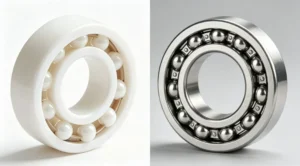
Choosing between ceramic and steel bearings is tough. A wrong choice means high costs and downtime. This guide helps you pick the right bearing for your business needs.
Ceramic bearings excel in harsh conditions like high speeds, corrosion, or extreme temperatures. Steel bearings are the reliable, cost-effective choice for most standard industrial applications. The best choice depends on your specific application needs and total cost of ownership, not just the material.
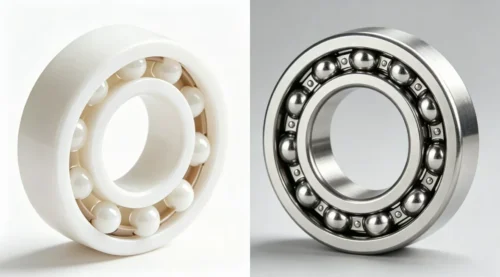
We've been in the bearing business since 1992, right here in Henan. Over the years, I've seen many buyers get lost in technical specifications. But for importers, distributors, and OEMs, the real decision is about business factors. It's about what makes sense for your inventory, your customers, and your bottom line. Let's look beyond the materials and explore what really matters when you're making a purchasing decision.
What Really Matters for B2B Buyers, Not Just Material Differences?
You are focused on profit and reliability. Technical jargon about materials does not always translate to business success. Let's focus on what truly impacts your bottom line.
For B2B buyers, the key factors are Total Cost of Ownership (TCO), failure rates, lead time stability, and application risk. These business metrics are often more important than the physical differences between ceramic and steel materials. They directly impact your profitability and customer satisfaction.
When I talk to fellow business owners, our conversations are not just about RPM ratings or material hardness. We talk about numbers that affect our operations directly. The initial price of a bearing is only one small part of the story. You have to think bigger to protect your margins and reputation.
Total Cost of Ownership (TCO)
TCO is the most important number. It includes the purchase price, but also the cost of installation, maintenance, and potential downtime if the bearing fails. A cheap steel bearing that needs frequent replacement in a tough application can end up costing much more than a pricier ceramic bearing that lasts for years. You must calculate the lifetime cost for your customer's specific use case.
Reliability and Failure Rates
For any distributor or OEM, your reputation is everything. Selling a product that fails prematurely damages your brand. You need to understand the failure rate of a bearing in its intended environment. A low failure rate means happy customers, fewer warranty claims, and more repeat business. This is where matching the right bearing to the right job becomes critical.
Supply Chain and Lead Time
Can you get the bearings when you need them? Unstable lead times can halt your production line or leave you unable to fulfill customer orders. This is a major business risk. It is essential to consider the stability of the supply chain for a particular type of bearing.
Ceramic vs Steel Bearings — A Quick Comparison for Procurement?
You need to make purchasing decisions quickly. Wading through dense technical sheets is slow. You need a clear, side-by-side comparison to help you decide fast.
Here is a quick comparison for procurement teams. Ceramic bearings offer superior performance in speed, temperature, and corrosion resistance but at a higher price. Steel bearings provide excellent load capacity and durability at a lower cost for general-purpose applications. Your choice depends on balancing performance against budget.
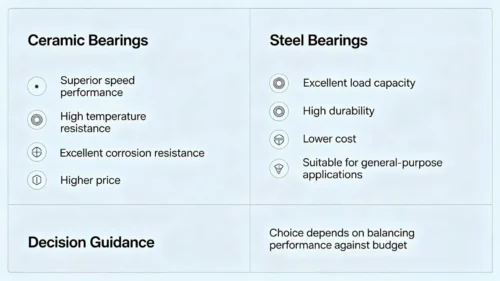
To make this even simpler, I've put the most common procurement questions into a table. I use a similar thought process when advising my own clients. This helps cut through the noise and get to a decision faster. Every purchasing manager needs a clear overview that they can rely on. This table is designed to be that tool for you.
| Feature | Full Ceramic Bearings | Standard Steel Bearings |
|---|---|---|
| Initial Cost | High | Low |
| Speed Rating (RPM) | Very High | High |
| Temperature Tolerance | Excellent (up to 1000°C) | Good (with proper grease) |
| Corrosion Resistance | Excellent | Poor (requires seals/coatings) |
| Load Capacity | Moderate | Very High |
| Electrical Insulation | Excellent (insulator) | Poor (conductive) |
| Lubrication Needs | Low (can run dry in some cases) | Essential |
| Typical Lifespan | Very Long (in correct application) | Long (in standard conditions) |
| Supply Chain | Specialized, less stable | Robust, highly stable |
As you can see, the choice is a trade-off. For a food processing plant where equipment is washed down with harsh chemicals daily, the excellent corrosion resistance of a ceramic bearing might justify its high cost. But for a standard piece of agricultural machinery, a tough, high-load capacity steel bearing is the clear winner. The key is to not over-engineer the solution. Use this table as your starting point to guide your purchasing strategy.
When Should Distributors Choose Ceramic Bearings?
You see competitors offering high-tech ceramic bearings. You wonder if you are missing out on a profitable niche market. Let's identify the exact scenarios where stocking ceramic pays off.
Distributors should choose ceramic bearings when serving niche markets with extreme conditions. These include aerospace, medical equipment, semiconductor manufacturing, and high-performance electric motors. The high profit margins in these specialized applications can justify the higher inventory cost and sales effort required.
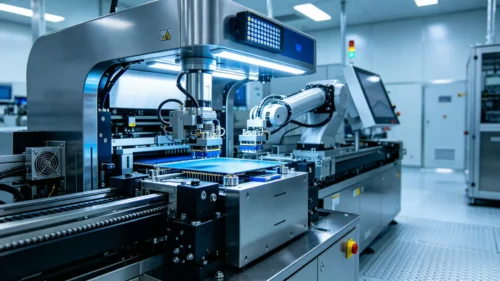
Stocking ceramic bearings is a strategic decision. You are not just adding another product to your catalog; you are entering a high-value, specialized market. This move requires investment in knowledge and inventory, but the rewards can be significant. It positions your business as a provider of advanced solutions.
High-Speed Applications
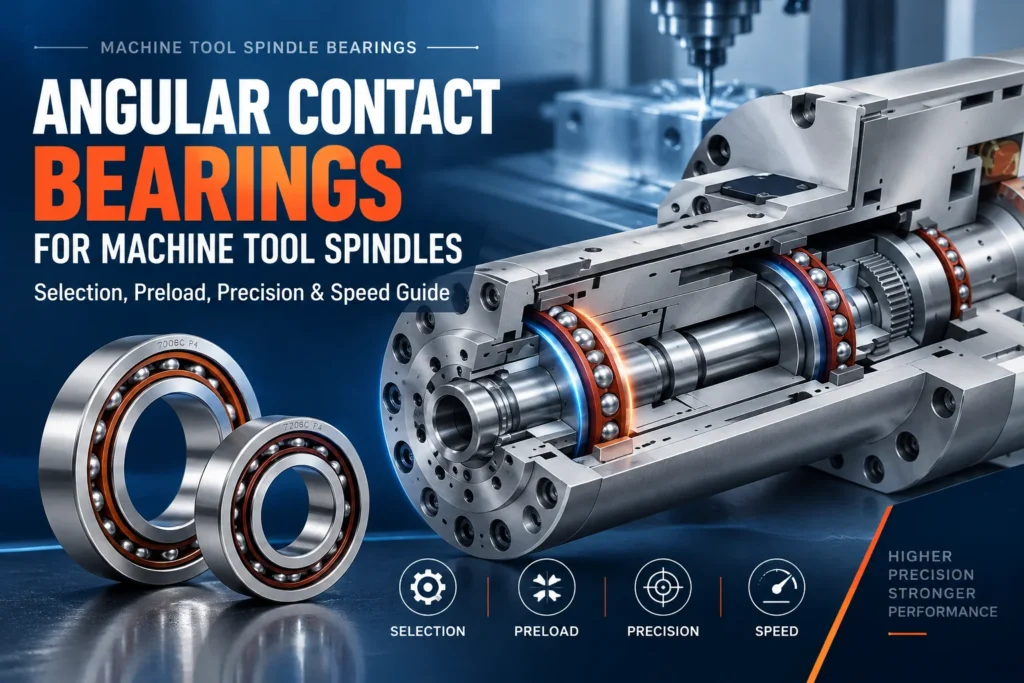
Think about machines that run incredibly fast, like CNC machine spindles or laboratory centrifuges. At very high RPMs, traditional steel bearings generate a lot of heat and wear. Full ceramic or hybrid ceramic bearings are much lighter and generate less friction, allowing them to run faster, cooler, and longer. If you have customers in precision manufacturing, this is a key market.
Corrosive Environments
Many industries, such as chemical processing, marine applications, or food and beverage, expose machinery to corrosive substances. Steel bearings will rust and fail quickly in these environments. Ceramic materials like silicon nitride or zirconia are chemically inert. They do not corrode. For customers in these industries, ceramic bearings are not a luxury; they are a necessity for reliable operation.
High-Temperature and Non-Conductive Needs
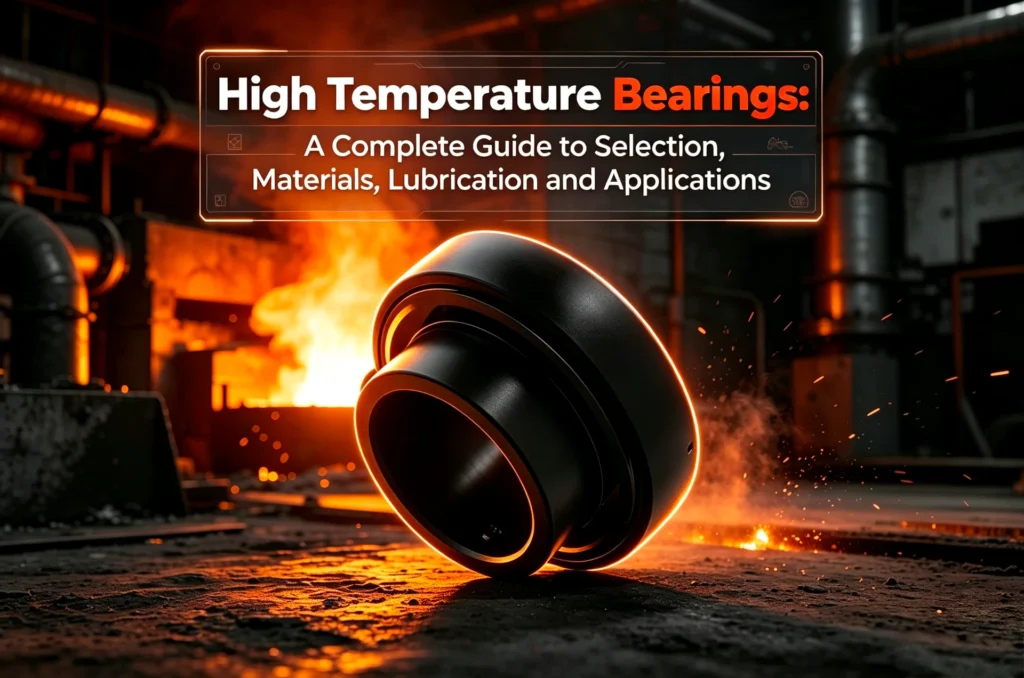
Imagine an oven in a factory or equipment inside a vacuum chamber. Standard steel bearings and their lubricants would break down at these temperatures. Ceramic bearings can operate reliably in extreme heat. Furthermore, because ceramic is an electrical insulator, it prevents electrical arcing through the bearing, which can destroy both the bearing and the lubricant. This is a critical feature for applications like electric vehicle motors.
When Are Steel Bearings the Better Business Choice?
Your core business relies on volume and reliability. You cannot afford to stock expensive, slow-moving parts. You need to know when sticking with traditional steel bearings is the smartest move.
Steel bearings are the better choice for the vast majority of industrial and commercial applications. Their combination of high load capacity, durability, and low cost makes them ideal for machinery, agriculture, and general manufacturing where extreme conditions are not a factor. They are your reliable workhorse.
While ceramic bearings are impressive, let's be realistic. The foundation of the bearing industry is built on steel. For most applications my customers deal with every day, steel is the most practical and profitable choice. It's the engine of global industry for good reason.
High Load and Impact Applications
Think about construction equipment, mining machinery, or large gearboxes. These applications involve heavy loads and sudden shocks. Steel is tough and ductile, meaning it can handle these forces without fracturing. Ceramic is very hard, but it's also more brittle and can crack under severe impact loads. In these heavy-duty situations, steel's toughness is a clear advantage.
Cost-Sensitive Projects
For OEMs producing standard equipment or for large-scale industrial projects, budget is a primary concern. Steel bearings offer proven, reliable performance at a fraction of the cost of ceramic bearings. This allows you to be competitive in your pricing while still providing a durable product. The massive scale of steel production ensures that prices remain low and stable.
Established and Predictable Markets
The demand for standard-sized steel bearings, like the pillow block housings and self-aligning ball bearings we produce, is enormous and consistent. This makes inventory management simple for distributors. You know what sizes to stock and you know they will sell. This predictability is the bedrock of a stable and profitable distribution business. It is a lower-risk, higher-volume game.
Are Hybrid Ceramic Bearings the Best Balance for OEM Buyers?
You need better performance than steel, but full ceramic is too expensive. You feel stuck between a rock and a hard place. There is a third option that offers a perfect compromise.
Hybrid ceramic bearings, which use steel rings and ceramic balls, often provide the best balance for OEMs. They offer higher speeds, lower friction, and longer life than all-steel bearings, but at a more manageable cost than full ceramic bearings. This makes them ideal for performance upgrades.
For many of my OEM clients, the choice isn't just about ceramic or steel. They are often looking for a competitive edge without a complete product redesign. This is where hybrid bearings come in. They offer a significant performance boost for a moderate increase in cost.
How Hybrid Bearings Work
A hybrid bearing combines the best of both worlds. It uses standard steel for the inner and outer rings, which provides the strength and familiar dimensions of a steel bearing. But the rolling elements—the balls—are made of a ceramic material like silicon nitride. These ceramic balls are over 60% lighter than steel balls. This reduction in mass means less centrifugal force at high speeds, which leads to less friction, less heat, and higher possible RPMs.
Key Advantages for OEMs
For an Original Equipment Manufacturer, hybrid bearings are a fantastic upgrade path. You can offer a "high-performance" version of your product, such as an electric motor or a pump, by simply swapping the standard steel bearings for hybrids. This allows you to enter a premium market segment and command a higher price for your product with minimal engineering changes. It's an efficient way to enhance your product line.
Common Applications
You will find hybrid bearings in applications where speed and reliability are critical, but full ceramic is not required. High-speed machine tool spindles, electric motors in performance vehicles, and turbochargers are perfect examples. In these cases, the hybrid bearing's ability to run faster and longer directly translates to better performance and value for the end-user.
What Is the Supply Chain Reality Most Articles Won’t Tell You?
Technical articles praise ceramic bearings. But they do not mention sourcing headaches and unstable lead times. This can kill your profit margins and damage your reputation with customers.
The supply chain for ceramic bearings is less mature and more complex than for steel. Raw material sourcing is limited, and manufacturing is specialized, leading to longer lead times and higher price volatility. Steel bearings have a robust, global supply chain, ensuring stable availability and pricing.
This is a topic that is very important to me as a manufacturer. A great product is useless if you cannot get it reliably. As an importer or distributor, your business depends on a predictable supply chain. The difference between the steel and ceramic bearing supply chains is night and day.
Raw Material Sourcing
High-purity bearing steel is produced in massive quantities all over the world. The supply is stable and predictable. The specialized powders needed for high-performance ceramic bearings, like silicon nitride, come from a much smaller number of suppliers. Any disruption in this niche supply chain can lead to long delays and sharp price increases.
Manufacturing Complexity
Grinding and finishing hardened steel is a process we have perfected over decades. The machinery is common and the expertise is widespread. Grinding and finishing ceramic, which is much harder than steel, requires specialized diamond tooling and different machinery. There are far fewer factories in the world with this capability. This manufacturing bottleneck can also contribute to longer lead times.
What This Means for Importers
For you, the importer, this means you must be extra careful when sourcing ceramic bearings. You need to thoroughly vet your supplier's capabilities and their own raw material supply chain. For steel bearings, the market is much more stable. At Yuanguang Bearing, having our own foundry and processing plants gives us direct control over our production of cast iron and steel bearing housings. This vertical integration is how we guarantee reliable quality and lead times for our partners.
How Do You Choose the Right Supplier, a Critical Step for Importers & OEMs?
You have decided on the right bearing type. But choosing the wrong supplier can be a disaster. Late shipments, poor quality, and no support can ruin your business.
Choosing the right supplier is as important as choosing the right bearing. Look for a manufacturer with direct control over their production process, from raw materials to final assembly. Verify their certifications, ask for references, and prioritize partners who offer OEM/ODM flexibility and transparent communication.
Over our 30 years in this business, We've learned that a partnership is more valuable than a transaction. Your supplier should be a partner who helps your business succeed. Finding that partner requires looking beyond the price list and evaluating their entire operation.
Vertical Integration
Does the supplier control their own production? A company that has its own foundry, machining workshops, and assembly lines, like we do at Yuanguang Bearing, has far more control over quality and delivery schedules. They are not dependent on multiple other subcontractors. This significantly reduces your risk of unexpected delays and quality issues. Always ask a potential supplier about their manufacturing process.
Quality Certifications and Traceability
Ask for quality certifications like ISO 9001. This shows they have a documented, repeatable process for maintaining quality. Also, ask how they ensure traceability. Can they trace a specific batch of bearings back to the raw materials used? This is crucial if a quality problem ever arises. A serious manufacturer will be able to provide this information.
OEM/ODM Capabilities
As an OEM or a distributor serving specialized customers, you may need customized products. A good partner should have strong OEM (Original Equipment Manufacturer) and ODM (Original Design Manufacturer) capabilities. Can they modify a housing, use a special grease, or add your branding? This flexibility allows you to offer unique solutions to your customers. We have built our business by providing these services to our partners worldwide.
Conclusion
The choice between ceramic and steel is not just technical; it's a business decision. Balance performance needs with cost, supply chain reliability, and your specific market to maximize profitability.
Ready to find a reliable bearing partner for your business? At Yuanguang Bearing, we've been manufacturing quality bearing housings and bearings since 1992. With our own foundry and complete production control, we offer stable lead times and flexible OEM/ODM services to help your business grow. Visit our website at www.ihgybearing.com or contact us today to discuss your needs.