Many bearings die early. Noise, heat, and seizure stop machines. The painful part is this: many teams repair the machine but miss the bearing quality problem.
Bearing failure is often caused by poor material, weak heat treatment, bad sealing, wrong clearance, poor machining, or wrong working condition matching.1 A buyer can reduce most failures by checking appearance, rotation feel, sound, weight, sealing quality, and supplier traceability before installation.2
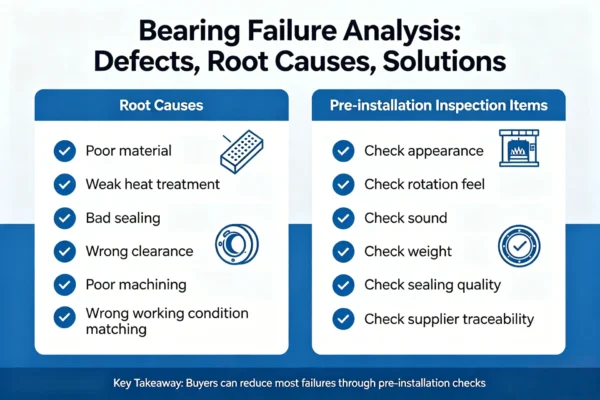
A bearing should not fail after three months if the load, speed, lubrication, and installation are normal.3 In my daily work with bearing housings and self-aligning bearings, I see one hidden truth again and again. Many failures start before the bearing reaches the machine. The problem is already inside the steel, raceway, cage, seal, or grease. If the buyer only compares price, the later cost will move to downtime, labor, spare parts, and customer complaints. I will break the problem down from market traps to field diagnosis, so the next bad bearing is easier to stop before it enters your warehouse.
Why Do Most Bearings Fail Prematurely in Real Industry?
A bearing is small, but it can stop a full production line. The problem hurts more when the same failure comes back after every repair.
Most premature bearing failures come from low-quality bearings, wrong working condition matching, poor lubrication, poor installation, contamination, or overload.4 In many cases, the first root cause is not maintenance. It is a bad bearing with weak material, poor heat treatment, loose tolerance, or weak sealing.
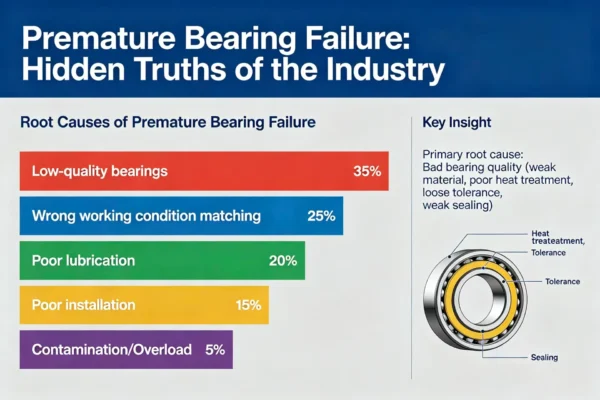
In many factories, people first blame installation, grease, or equipment alignment. These factors matter. I never ignore them. But I also know a simple fact from bearing production and after-sales cases. A good bearing can forgive small field errors better than a weak bearing. A low-quality bearing cannot survive even a normal working condition.
The same model number can have a very different internal quality.5 The outside size may be the same. The drawing may look the same. The bearing may fit the shaft and housing. But the steel purity, hardness depth, grinding precision, cage strength, sealing pressure, and grease quality can be completely different.
| Failure sign | Common first guess | Often missed root cause | Better action |
|---|---|---|---|
| Early noise | Bad installation | Rough raceway or reused bearing | Inspect rotation and source |
| Fast heating | Grease problem | Wrong clearance or poor heat treatment | Check clearance grade and supplier |
| Short life under load | Wrong model | Reduced steel or thin ring | Compare weight and section thickness |
| Rust after storage | Warehouse issue | Poor anti-rust oil or weak packaging | Check packing before purchase |
A bearing price can be double for the same model. Some buyers think this is only a brand issue. I do not see it that way. A stable bearing needs clean steel, correct forging, proper heat treatment, precision grinding, controlled assembly, and final inspection.6 Every step has cost. When the price is far below normal market level, one step is often reduced.
A bearing importer or wholesaler should treat bearing cost as a full cost. The purchase price is only the first line. The real cost includes claims, replacement, freight, lost trust, and machine stop time.
What 4 Types of Low-Quality Bearings in the Market Must Be Avoided?
A bad bearing often looks normal on the table. The real danger appears after load, speed, heat, and vibration start to work together.
The four bearing types to avoid are refurbished bearings, non-standard reduced bearings, reworked rejected bearings, and unbranded fake bearings. They may look similar to standard bearings, but their steel, tolerance, raceway, cage, seal, and life are not reliable for industrial use.
1. Refurbished and polished bearings
Refurbished bearings are among the most hidden products in the market. Old bearings are collected, cleaned, polished, painted, marked again, and packed as new.7 The outside may look fresh. The inside may already have fatigue damage. The raceway may have micro cracks. The steel structure may be aged. The rolling elements may have hidden wear.
I always pay attention to smell, surface finish, and rotation feel when I check suspicious bearings. A strong paint smell, kerosene smell, or rust smell is a warning. A new bearing should mainly have a light anti-rust oil smell.
2. Non-standard reduced bearings
A non-standard reduced bearing is more difficult for a beginner to notice. The outside size follows the standard. It can be installed. But the ball size may be smaller. The ring wall may be thinner.8 The steel grade may be lower. The heat treatment time may be shorter.
| Low-quality type | How it is made | Main risk | Simple check |
|---|---|---|---|
| Refurbished bearing | Old bearing polished and repacked | Fast peeling and noise | Smell and rotation feel |
| Non-standard reduced bearing | Less steel and smaller parts | Low load capacity | Weight comparison |
| Reworked rejected bearing | Failed factory inspection item | Crack, high clearance, seizure | Visual and clearance check |
| Fake unbranded bearing | No stable process control | Random failure | Supplier traceability |
3. Reworked rejected bearings
Some bearings fail factory inspection because of cracks, large clearance, poor accuracy, rough raceways, or bad appearance. These products should not enter industrial use. But some of them move into low-price channels. They may work for light hand rotation. They may fail under speed or vibration.
4. Fake or no-name bearings
No-name bearings often have no stable quality system. The material can change from batch to batch. The grease can be cheap. The seals may not press correctly. These products may be acceptable for a simple one-time device. They should not be used for industrial motors, conveyors, agricultural machines, mining machines, or heavy equipment.
What Are the 8 Common Bearing Quality Failures and Root Causes?
A failed bearing always leaves marks. The key is to read the marks correctly and connect them to material, process, sealing, clearance, or working condition.
The 8 common bearing quality failures are fatigue spalling, high-temperature burning, seal failure, cage damage, ring cracks, rust corrosion, tolerance error, and electrical pitting. Each defect has visible signs, technical causes, and a direct solution that can prevent repeat failure.
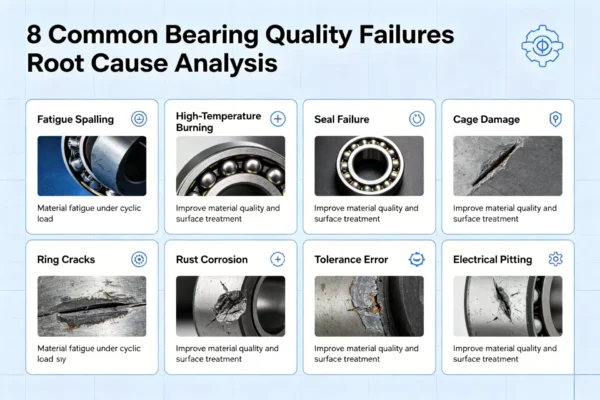
Failure map for quick root cause analysis
Bearing failure analysis should not be guesswork. I prefer to check the failed part, the working condition, and the bearing source together. GB/T 24611-2020 gives a useful direction for bearing damage judgment.9 Field experience then helps connect the sign to the real purchase or use problem.
| No. | Defect | Visible sign | Likely root cause | Permanent solution |
|---|---|---|---|---|
| 1 | Fatigue spalling | Fish-scale pits, dense pitting | Poor steel purity, weak hardening layer | Use certified heat-treated bearings |
| 2 | High-temperature burning | Blue, brown, black marks | Wrong clearance, poor assembly, weak steel | Use proper clearance and high-temp grease |
| 3 | Seal failure | Black grease, dust, water inside | Thin seal, recycled rubber, bad contact | Use real 2RS seals for dust and water |
| 4 | Cage damage | Clicking sound, ball displacement | Thin cage, brittle material | Use reinforced or solid cage design |
| 5 | Ring crack or edge break | Sudden noise and seizure | Internal sand hole, stress, bad heat treatment | Inspect before mounting and avoid rejects |
| 6 | Rust and peeling | Rust points, dry rotation | Poor anti-rust process, weak packaging | Buy sealed anti-rust packing |
| 7 | Tolerance error | Too tight or too loose fit | Poor machining accuracy | Use standard tolerance products |
| 8 | Electrical pitting | Striped or dotted pits | Current passing through raceway | Use insulated bearings for motors10 |
How each defect usually develops
Fatigue spalling often starts as small pits on the raceway or balls. The machine may first show dull noise and stronger vibration. As the pits grow, the contact surface becomes rough. Wear then grows faster. This problem is often linked to steel cleanliness, heat treatment hardness, or a hardening layer that is too thin.
High-temperature burning shows blue, brown, or black color.11 The bearing can heat quickly. The rotation can feel rough. This may come from small internal clearance, poor lubrication, or steel that cannot hold stable performance under heat. In high-speed use, C3 clearance is often needed, but it must match the machine.
Seal failure is common in dust, water, and mud. Cheap seals may be thin, loose, or made from poor rubber. Dust enters. Grease turns black. Rust starts.
Cage failure is dangerous. A broken cage can make balls move out of position. The bearing can lock suddenly. For shock load and vibration, I always prefer a stronger cage and correct bearing series, not only the cheapest model.
How Can Bearing Noise Diagnosis Identify Problems by Sound?
A machine sound is like a warning language. If the sound changes, the bearing is already telling the maintenance team where to look.
Bearing noise can identify many problems. A sharp scream often means small clearance, dry lubrication, or rough raceway.12 A clicking sound may mean cage damage. A dull hum often points to spalling. A sandy sound usually means dust, water, or internal contamination.
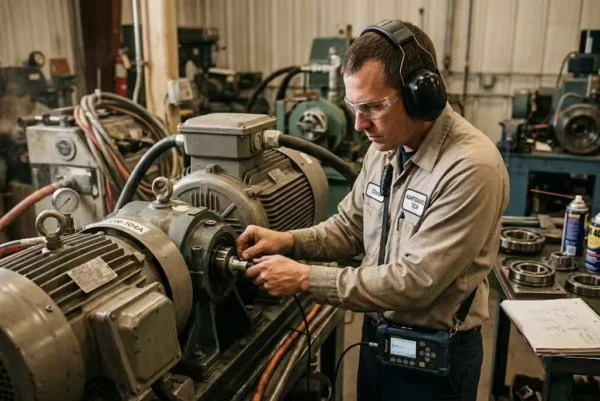
Common bearing sounds and what they mean
Noise diagnosis is useful because it is fast. A trained worker can hear a problem before full failure. I do not suggest replacing full inspection with sound alone. But sound can help choose the first inspection direction.
| Sound | Possible defect | Risk level | First check |
|---|---|---|---|
| Sharp high-frequency scream | Too small clearance, poor grease, rough raceway | Medium to high | Temperature and lubrication |
| Intermittent clicking | Cage crack, ball shift, broken part | Very high | Stop machine and inspect |
| Dull humming | Raceway spalling or pitting | High | Vibration and raceway surface |
| Fine sandy noise | Dust, water, bad seal | Medium | Seal and grease color |
| Rhythmic knock | Loose fit or tolerance error | High | Shaft, housing, and bearing size |
How I use sound without overguessing
Sound must be matched with temperature, vibration, grease color, and mounting condition. A sharp scream during the first running test may be caused by dry grease distribution. But if the temperature rises fast and the sound stays high, I check clearance and raceway quality. A repeated clicking sound is more serious. I treat it as a cage or rolling element warning. I do not let the machine continue for long.
A dull hum is common when fatigue spalling starts. The surface becomes uneven. The rolling element hits the small pits again and again. The sound becomes deeper as damage expands.
A sandy sound is often easy to understand. It feels like small particles are inside the bearing. In many field cases, the seal is the weak point. The seal lip is thin. The contact is poor. Dust enters early. In wet places, water enters first, then rust and grease failure follow.
A simple listening process
I use a simple order in field checks. First, I listen at no load. Then I listen under normal load. Then I compare the same position with another machine if possible. A new bearing that sounds worse than an old bearing should not be accepted without inspection.
How Can a 5-Second Visual Inspection Detect Fake Bearings?
A fake bearing wants to pass quickly through receiving inspection. A buyer can stop many risks with eyes, hands, rotation, smell, and weight.
A 5-second bearing inspection checks appearance, touch, free rotation, smell, and weight. Clear laser marking, smooth edges, stable rotation, light anti-rust oil smell, and normal weight usually show better quality. Blurry letters, rough edges, dry noise, paint smell, and light weight are warning signs.
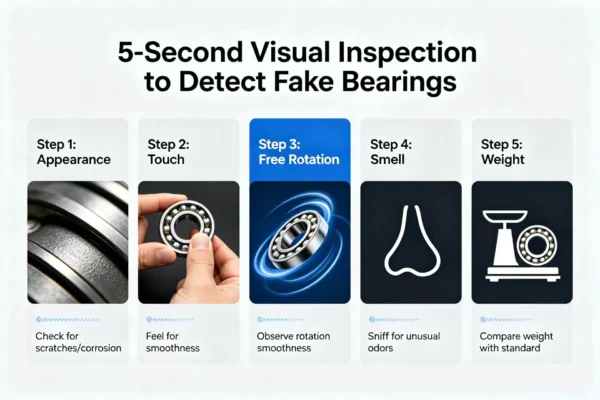
The five checks I use first
A full bearing test needs equipment. But warehouse inspection does not always have instruments. So I use a fast filter method before deeper sampling. It does not replace lab testing. It helps remove obvious risk items before they enter stock.
| Check | Good bearing | Risk bearing |
|---|---|---|
| Look | Clear marking, smooth surface, even color | Blurry marking, paint marks, scratches |
| Touch | Smooth edge, flat end face, no burr | Rough edge, cutting feel, uneven face |
| Rotate | Smooth, stable, no noise, slow stop | Dry feel, small noise, shaking, fast stop |
| Smell | Light anti-rust oil smell | Strong paint, kerosene, rust smell |
| Weigh | Close to standard weight | Clearly lighter than normal sample |
Why these checks work
Marking tells a lot about process control. A good bearing usually has clear and even laser marking. The depth and spacing look stable. A refurbished bearing may have re-marking, unclear text, or strange paint cover. A fake bearing may use poor printing that rubs off easily.
Touch shows machining quality. A standard bearing should not cut the hand. The edge should be clean. The end face should feel flat. Burrs show poor grinding, poor handling, or low-level production.
Rotation feel is one of the fastest checks. A good bearing has a tight but smooth feeling. It should not feel empty, dry, or sandy. If it shakes, stops too fast, or makes fine noise by hand, I mark it as high risk.
Smell is useful for refurbished products. New bearings should not smell like fresh paint. A strong chemical smell can mean polishing, repainting, or heavy cleaning.
Weight comparison is simple and powerful. A reduced bearing often uses less steel. If the same model is clearly lighter than a known good sample, I do not accept it without further measurement.
What Field Maintenance and Selection Guide Prevents Bearing Failure?
A correct bearing still needs correct use. A good supplier, correct selection, clean installation, and regular inspection work together to prevent repeat failure.
To prevent bearing failure, match the bearing to load, speed, temperature, dust, water, vibration, and electrical risk. Then use clean installation, correct grease, proper fit, no mixing of old and new bearings, and strict incoming inspection for every batch.
Match the bearing to the working condition
I do not choose a bearing only by model number. I first ask where it will work. A dusty conveyor needs sealing strength. A high-speed motor needs clearance and low-noise quality. A heavy agricultural machine needs load capacity and impact resistance. A wet environment needs better anti-rust packaging and better seals.
| Working condition | Key risk | Better selection |
|---|---|---|
| Dust and powder | Contamination | 2RS sealed bearing or protected housing |
| Wet or outdoor use | Rust and grease washout | Better seal and anti-rust grease |
| High speed | Heat and clearance problem | Correct clearance such as C3 when needed |
| Heavy load | Spalling and deformation | Standard steel, proper ring thickness |
| Shock and vibration | Cage damage | Reinforced cage or stronger structure |
| Motor with inverter | Electrical pitting | Insulated bearing where needed |
Maintenance rules that reduce repeat failure
Low price is often high cost. This is not a slogan. It is what many maintenance records prove. A cheap bearing can save a small amount at purchase. Then it can create repeated downtime, labor cost, shaft wear, housing damage, and customer claims.
A new bearing with immediate noise should not always be blamed on installation. I check authenticity and quality first. If the bearing is bad, repeated mounting will not solve the problem.
New and old bearings should not be mixed in one matched position. Their wear level and accuracy are different. The old bearing can force uneven load onto the new bearing. Then the new bearing fails early.
Stock bearings also need inspection. Long storage can cause rust, dry grease, or damaged packaging. Incoming stock should be sampled. Long-term stock should be rotated and checked.
A practical purchasing rule for importers and wholesalers
A bearing importer or wholesaler should build a stable quality gate. I suggest three steps. First, confirm the supplier has real production and inspection ability. Second, keep a standard sample for weight, marking, rotation, and packaging comparison. Third, record failure feedback by batch number.
At Yuanguang Bearing, our advantage comes from integrated production. We have casting, machining, bearing housing production, and bearing assembly support. This structure helps control quality from bearing housing fit to final assembly. For OEM and ODM customers, stable batch control is more important than a one-time low price.
Conclusion
Bearing failure prevention starts with quality judgment. Check the bearing before installation, match it to the working condition, and choose stable suppliers over risky low prices.
"Why Bearings Fail (Part 1) | TriStar Plastics - YouTube",
. Reference articles and standards on rolling‑element bearings (e.g., encyclopedia summaries and ISO 15243) enumerate common failure mechanisms such as material or heat‑treatment defects, lubrication and contamination/sealing problems, incorrect internal clearance and mounting, and operating‑condition mismatch; such sources classify accepted causes but do not quantify their prevalence in every industry setting. Evidence role: expert_consensus; source type: encyclopedia. Supports: That recognized bearing failure mechanisms include material and heat-treatment issues, contamination/sealing problems, incorrect internal clearance, machining errors, and operating-condition mismatch.. ↩"Bearing Inspection | NSK Global", https://www.nsk.com/tools-resources/mantenance/bearing-inspection/. Industry association advisories on anti‑counterfeiting (e.g., from the World Bearing Association) recommend verifying markings, packaging, and batch traceability and performing basic visual/functional checks to reduce the risk of installing counterfeit or substandard bearings; such guidance is preventive and does not guarantee detection of every defect. Evidence role: general_support; source type: institution. Supports: That industry bodies recommend visual/functional checks and traceability verification to intercept counterfeit or substandard bearings prior to installation.. ↩
"Bearing (mechanical) - Wikipedia", https://en.wikipedia.org/wiki/Bearing_(mechanical). Bearing life references describing the ISO 281 L10 methodology explain that, when operated within rated load, speed, lubrication, and mounting, the calculated statistical life typically corresponds to many millions of revolutions—often translating to years rather than months in common machinery; this is a statistical expectation and actual field life varies with conditions. Evidence role: mechanism; source type: encyclopedia. Supports: That standardized life-rating methods (e.g., L10 per ISO 281) predict service lives well beyond a few months under rated conditions.. ↩
"Bearing (mechanical) - Wikipedia", https://en.wikipedia.org/wiki/Bearing_(mechanical). Reference treatments of bearing failures summarize major root causes such as inadequate lubrication, contamination, improper mounting or clearance, overload or misalignment, and material‑related defects; such sources support the categories but do not substantiate that any single category is the majority cause in all industries. Evidence role: expert_consensus; source type: encyclopedia. Supports: That widely cited causes of premature bearing failure include poor lubrication, contamination, improper mounting/clearance, overload/misalignment, and material/quality defects.. ↩
"Rolling-element bearing - Wikipedia", https://en.wikipedia.org/wiki/Rolling-element_bearing. Standards for rolling bearings standardize boundary dimensions and tolerances to enable interchangeability, while internal design features, materials, heat treatment, and lubricants can legitimately differ among manufacturers; this contextualizes why identical designations do not guarantee identical internal quality. Evidence role: historical_context; source type: encyclopedia. Supports: That standards harmonize boundary dimensions for interchangeability while allowing manufacturers to vary internal design, materials, and lubrication.. ↩
"[PDF] Rolling Bearing Life Prediction, Theory, and Application", https://ntrs.nasa.gov/api/citations/20160013905/downloads/20160013905.pdf. Materials and tribology studies report that reduced non‑metallic inclusions (cleaner steel) and appropriate heat treatment and finishing processes increase rolling contact fatigue life of bearings, linking process control to reliability; these findings address mechanisms rather than any particular manufacturer. Evidence role: mechanism; source type: paper. Supports: That higher steel cleanliness and proper heat treatment and manufacturing processes improve rolling contact fatigue performance and reliability.. ↩
"Stop fake bearings: WBA", https://www.stopfakebearings.com/. Anti‑counterfeiting guidance from industry associations documents instances where reconditioned or counterfeit bearings were presented as new and provides indicators to identify such products; such materials are case‑based and do not imply all markets are equally affected. Evidence role: case_reference; source type: institution. Supports: That industry associations have documented cases of used/reconditioned and counterfeit bearings being sold as new and advise vigilance.. ↩
"Ball bearing - Wikipedia", https://en.wikipedia.org/wiki/Ball_bearing. Explanations of bearing rating methods indicate that the basic dynamic load rating is a function of the number and size of the rolling elements and geometry, implying that smaller balls or reduced ring cross‑section decrease load capacity; this is a formula‑based principle and not an evaluation of a specific product. Evidence role: mechanism; source type: encyclopedia. Supports: That basic dynamic load rating (and thus life) depends on the number and size of rolling elements and geometry, so smaller balls or reduced cross‑section lower capacity.. ↩
"[PDF] BEARING DAMAGE AND FAILURE ANALYSIS - SKF", https://cdn.skfmediahub.skf.com/api/public/093168a92d25cc46/pdf_preview_medium/093168a92d25cc46_pdf_preview_medium.pdf. National and international standards on rolling bearings (e.g., GB/T 24611 and ISO 15243) provide taxonomies and guidance for identifying and assessing bearing damage modes; access to the full texts may be restricted or language‑specific. Evidence role: definition; source type: institution. Supports: That standards such as GB/T 24611 and ISO 15243 classify bearing damage modes and provide guidance for failure assessment.. ↩
"A Review of Modeling and Mitigation Techniques for Bearing ...", https://ieeexplore.ieee.org/iel7/6287639/9668973/09964144.pdf. Professional guidance (e.g., IEEE/EASA publications) reports that inverter‑driven motors can develop shaft voltages and bearing currents causing electrical erosion, and that insulated bearings or shaft grounding are accepted mitigation measures; applicability depends on the specific drive, grounding, and operating conditions. Evidence role: expert_consensus; source type: institution. Supports: That professional guidance identifies insulated bearings as a mitigation for electrically induced bearing damage in motors, especially with inverter drives.. ↩
"[PDF] Rate of oxidation of steels as determined from interference colors of ...", https://nvlpubs.nist.gov/nistpubs/jres/23/jresv23n1p63_A1b.pdf. Metallurgical references on temper/oxide colors note that steel surfaces develop brown, blue, or darker oxide hues as temperature increases, a phenomenon often used as an indicator of overheating on components; observed colors can vary with surface condition and lighting. Evidence role: mechanism; source type: encyclopedia. Supports: That steel exhibits characteristic temper/oxide colors (brown to blue/black) when exposed to elevated temperatures.. ↩
"University of Ottawa constant load and speed rolling-element ... - PMC", https://pmc.ncbi.nlm.nih.gov/articles/PMC10331275/. Condition‑monitoring studies report that bearing defects and operating issues (e.g., inadequate lubrication, clearance anomalies, or surface roughness) can manifest as characteristic high‑frequency noise or tonal signatures detectable by acoustic/vibration methods; qualitative associations depend on machine configuration and measurement setup. Evidence role: general_support; source type: research. Supports: That condition‑monitoring research links certain audible or high‑frequency noise signatures to lubrication deficiency, clearance issues, or surface roughness in bearings.. ↩