
Choosing the wrong bearing type can shut down your entire production line. The cost is not just a replacement part — it is unplanned downtime, damaged equipment, and lost revenue.
Ball bearings use point contact between the rolling elements and the raceway.1 Roller bearings use line contact. This single difference controls everything: load capacity, speed limits, heat generation, and service life. Choose based on your load type and speed first, then factor in environment and cost.

I have worked with bearing selection long enough to know that most people oversimplify this choice. They pick by size or price, and they pay for it later. The real decision requires you to understand what is happening inside the bearing under load. Once you see that, the right choice becomes clear. Let me walk you through each factor one by one.
What Is the Core Mechanical Difference Between Ball and Roller Bearings?
Most people know the two types look different. But very few understand why that shape difference matters so much in real applications.
Ball bearings make point contact with the raceway — a tiny circular area under load. Roller bearings make line contact — the full length of the roller touches the raceway. This means roller bearings spread the same load over a much larger area, which dramatically reduces contact stress and increases radial load capacity by 2 to 4 times compared to the same-size ball bearing.
This is not a small difference. It defines the entire performance profile of each bearing type. Think of it this way: pressing your finger on a table creates a small point of pressure. Pressing your whole hand on the same table spreads the pressure across a much larger surface. Roller bearings work like the open hand. Ball bearings work like the finger.
Why Contact Type Controls Load Capacity
Because ball bearings concentrate stress on a small point, they are very sensitive to overload. When the contact stress exceeds the material's limit, the raceway develops small pits — a failure mode called spalling. Once spalling starts, the bearing fails quickly.
Roller bearings spread the same load across the entire roller length. The contact stress stays much lower. This is why heavy industries choose roller bearings by default.
Here is a direct comparison by contact type:
Ball Bearings vs Roller Bearings: Key Performance Comparison
| Criteria | Ball Bearings | Roller Bearings |
|---|---|---|
| 🔹 Contact Type | Point Contact | Line Contact |
| 🔹 Contact Area | Smaller | Larger |
| 🔹 Radial Load Capacity | ★★★☆☆ | ★★★★★ |
| 🔹 Shock Load Resistance | ★★☆☆☆ | ★★★★★ |
| 🔹 Operating Speed | ★★★★★ | ★★★☆☆ |
| 🔹 Friction | Lower | Higher |
| 🔹 Overload Resistance | Moderate | Excellent |
| 🔹 Service Life Under Heavy Load | Shorter | Longer |
| 🔹 Precision Performance | Excellent | Good |
| 🔹 Typical Industries | Motors, Pumps, Fans, Medical Devices | Mining, Steel, Construction, Agricultural Equipment |
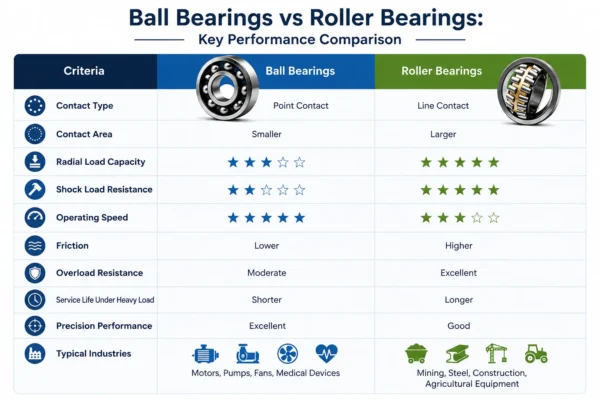
The lesson here is simple. If your load is heavy or includes shock loads, point contact is not enough. Line contact is what you need. Applications like steel rolling mills, large electric motors, mining machinery, and construction equipment all run roller bearings for exactly this reason.2
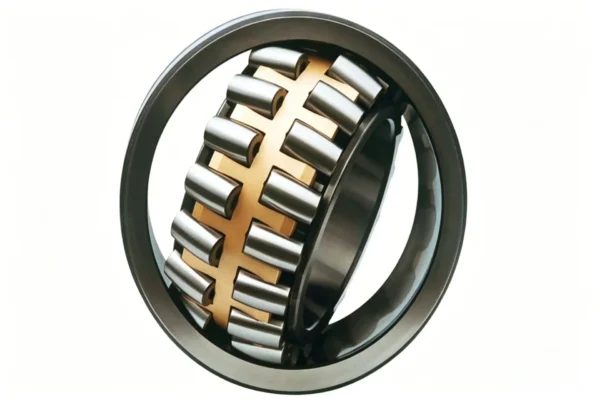
There is one more point worth knowing. The type of roller also matters. Cylindrical rollers handle pure radial loads best. Tapered rollers handle combined radial and axial loads. Spherical rollers handle misalignment. Each roller geometry solves a specific problem, and each gives you a different performance profile within the broad category of "roller bearings."
Which Bearing Type Handles Higher Speeds?
Speed is where ball bearings take a clear and significant advantage. This is not a matter of opinion — it follows directly from the physics of rotating mass and friction.
Ball bearings run at higher speeds than roller bearings of the same size.3 Because the rolling elements are smaller and lighter, centrifugal force is lower, heat generation is lower, and the limiting speed is higher. For applications above 10,000 rpm — such as spindles, high-speed motors, and turbomachinery — ball bearings are the standard choice.
When a roller bearing runs at high speed, the ends of the rollers press against the guide flanges of the inner or outer ring. This sliding contact generates heat. At some point, the lubricant breaks down, the temperature spikes, and the bearing seizes. This is called smearing or adhesive wear, and it is one of the most common high-speed roller bearing failures.4
Speed, Friction, and Energy Efficiency
Ball bearings do not just run faster — they also run with lower starting torque and lower running torque. This matters in systems that start and stop frequently, or in any application where energy consumption is a concern.
Consider servo motors in industrial automation. These motors start, stop, and reverse direction hundreds of times per minute. Every start requires overcoming the bearing's starting friction. Lower starting torque means less energy per cycle, less heat generated, and better dynamic response. This is why precision servo motors almost always use ball bearings.
Here is a speed and friction comparison:
Ball Bearings vs Roller Bearings: Speed & Friction Performance
| Performance Factor | ⚪ Ball Bearings | 🔵 Roller Bearings |
|---|---|---|
| Limiting Speed | High | Lower (for the same bearing size) |
| Starting Torque | Low | Higher |
| Running Friction | Low | Higher |
| Heat Generation at High Speed | Low | Higher |
| Frequent Start/Stop Operation | Excellent | Limited |
| High-Speed Lubrication Requirement | Moderate | High |
| Energy Efficiency | Higher | Lower |
| Noise Level | Lower | Higher |
| Precision at High Speed | Excellent | Moderate |
| Best Suited For | Motors, Fans, Pumps, Machine Tool Spindles | Gearboxes, Conveyors, Crushers, Heavy-Duty Equipment |
One practical note from my own experience: I have seen customers try to run cylindrical roller bearings at speeds well above the manufacturer's rating because the load requirement forced them to use a larger bearing. The result was always the same — rapid temperature rise, lubricant degradation, and early failure. Do not fight the physics. If speed is the constraint, design around it from the start.
For applications that need both high speed and moderate load capacity, angular contact ball bearings are often the right compromise. They can handle combined axial and radial loads, run at high speeds, and are available in precision grades (P4, P2) for spindle applications where rotation accuracy is critical.
How Do You Match Bearing Type to Load Direction?
Load direction is one of the most important — and most misunderstood — factors in bearing selection. Not all bearings handle all load directions equally well.
Ball bearings can handle radial loads, axial loads in both directions, and combined loads — depending on the design. Roller bearings are generally stronger in radial load capacity, but most types need specific configurations to handle axial loads. Matching the bearing type to the actual load direction in your application prevents premature failure.5
This is where people make mistakes. They select a bearing based on size alone, without checking whether the bearing can actually handle the direction of the forces in their system. A cylindrical roller bearing, for example, has extremely high radial load capacity — but it cannot support axial loads at all in standard configurations. If your shaft has axial forces, you need a different bearing or a secondary thrust bearing.
Load Direction Decision Guide
Different bearing types handle load directions in very different ways. Here is a structured overview:
Bearing Load Capability Comparison
| Bearing Type | Radial Load | Axial Load (One Direction) | Axial Load (Both Directions) | Combined Load Capability |
|---|---|---|---|---|
| Deep Groove Ball Bearing | ★★★☆☆ Medium | ✅ Yes | ✅ Yes | ✅ Excellent |
| Angular Contact Ball Bearing | ★★★☆☆ Medium | ✅ Excellent | ⚠️ Paired Arrangement Required | ✅ Excellent |
| Cylindrical Roller Bearing | ★★★★★ Very High | ❌ No (Standard Design) | ❌ No | ❌ Not Suitable |
| Tapered Roller Bearing | ★★★★☆ High | ✅ Excellent | ⚠️ Paired Arrangement Required | ✅ Excellent |
| Spherical Roller Bearing | ★★★★★ Very High | ⚠️ Limited | ❌ No | ✅ Excellent |
| Thrust Ball Bearing | ❌ None | ✅ Excellent | ❌ No | ❌ Not Suitable |
For pure radial heavy loads, cylindrical roller bearings are the clear winner. For combined heavy radial and axial loads — as found in gearboxes, wheel hubs, and conveyor drives — tapered roller bearings are the standard solution, but they must be used in pairs to balance the axial forces they generate internally.
Angular contact ball bearings are a strong choice when you need both speed and the ability to handle axial loads. Machine tool spindles commonly use them in back-to-back or face-to-face pairs to handle bidirectional axial forces with high precision.
One more important consideration is misalignment. When a shaft deflects under load, or when installation alignment is imperfect, the bearing must tolerate some angular error between the inner and outer rings. Standard cylindrical and tapered roller bearings have zero tolerance for this. If misalignment is present and uncorrected, edge loading occurs on the rollers — and the bearing fails very quickly. In these cases, self-aligning ball bearings or spherical roller bearings are the right choice. Spherical roller bearings offer high radial load capacity plus misalignment tolerance, making them the standard choice for heavy equipment like cranes and tunnel boring machines.
Can You Replace a Roller Bearing with a Ball Bearing (or Vice Versa)?
This question comes up regularly in maintenance situations. A machine is down, the original roller bearing is not in stock, and someone wants to know if a ball bearing of the same bore size will work as a temporary replacement.
In most cases, you should not substitute one type for the other without a full engineering review. Replacing a roller bearing with a ball bearing risks overloading the ball bearing's contact zone, leading to rapid fatigue failure.6 Replacing a ball bearing with a roller bearing risks overheating at operating speed. Any substitution must be backed by load and life calculations.
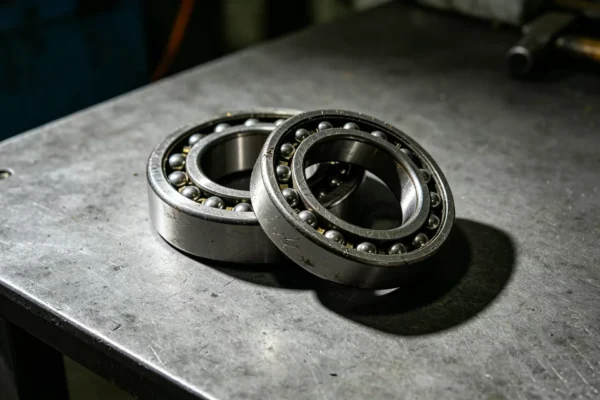
I want to be direct here: I have seen this go wrong many times. The shaft fits, the housing fits, and the machine runs — for a few weeks. Then the substituted bearing fails, often in a way that damages the shaft or housing, turning a small problem into a large and expensive one.
How to Evaluate a Substitution Safely
If a substitution is unavoidable, you must check three things before installing the replacement bearing.
Load capacity check. Calculate the actual radial and axial loads on the bearing position. Compare these to the dynamic load rating (C) of the proposed replacement. If the actual load exceeds 50% of the ball bearing's C value, the substitution is not safe for continuous operation.
Speed check. Confirm that the proposed replacement bearing's limiting speed is above your operating speed. If you are replacing a ball bearing with a roller bearing, this is often the critical constraint.
L10 life recalculation. Recalculate the basic rating life using the formula L10 = (C/P)^3 for ball bearings and L10 = (C/P)^(10/3) for roller bearings. If the original bearing was designed for 20,000 hours and your recalculation shows 2,000 hours, you have a serious problem. That is not a temporary fix — it is a scheduled failure.
Bearing Substitution Risk Assessment
| Criteria | Ball Bearing Replacing Roller Bearing | Roller Bearing Replacing Ball Bearing |
|---|---|---|
| Load Capacity | 🔴 High Risk | 🟢 Low Risk |
| Speed Capability | 🟢 Low Risk | 🔴 High Risk |
| Heat Generation | 🟢 Low Risk | 🔴 High Risk |
| Shock Load Resistance | 🔴 High Risk | 🟢 Low Risk |
| Expected Service Life | 🔴 Likely Reduced | 🟡 Application Dependent |
| Engineering Approval Needed | ✅ Yes | ✅ Yes |
| Overall Recommendation | ❌ Avoid Whenever Possible | ⚠️ Verify Load, Speed, and Lubrication Conditions |
Structural compatibility is another issue. Tapered roller bearings generate internal axial forces that must be reacted by a second bearing. If you replace a tapered roller bearing pair with a single ball bearing, the axial force management changes completely. The shaft positioning system may also need to change. This is not a bolt-in substitution.
What Is the Total Cost of Ownership for Each Bearing Type?
Purchase price is only one part of the cost equation. The real question is what each bearing type costs you over its entire service life — including lubrication, maintenance labor, downtime, and replacement frequency.
Ball bearings cost less to purchase, require simpler lubrication, and are available with lifetime seals that eliminate relubrication entirely.7 Roller bearings cost more upfront and require more careful lubrication management, but they last longer under heavy loads and reduce unplanned downtime in critical equipment — making them the lower-cost choice over the full service life in many heavy-duty applications.
This is a conversation I have with customers regularly. They look at the unit price difference and choose ball bearings to save money. Then they replace them three times in two years under heavy loads, while a roller bearing solution would have run continuously for five years. The math is not complicated once you lay it out.
Full Cost Comparison by Application Type
The right cost framework depends entirely on the application. Here is how the economics break down across common scenarios:
Cost, Maintenance & Lifecycle Comparison: Ball Bearings vs Roller Bearings
| Cost Factor | ⚪ Ball Bearings | 🔵 Roller Bearings |
|---|---|---|
| Unit Purchase Price | Lower | Higher |
| Lubrication Requirement | Lower — sealed options widely available | Higher — lubricant viscosity & cleanliness are critical |
| Relubrication Interval | Long or maintenance-free (sealed types) | Shorter and more frequent |
| Service Life Under Heavy Load | Shorter | Longer |
| Noise Level | Lower | Higher (especially under load) |
| Failure Mode | Usually gradual wear | Can be sudden under overload or shock |
| Maintenance Cost | Low | Higher |
| Best Cost Efficiency Scenario | High-speed, light to medium load, mass production equipment | Heavy-duty, continuous load, long service life applications |
Noise is a factor that often gets overlooked in the cost discussion. Ball bearings run quieter. In consumer appliances, office equipment, medical devices, and HVAC fans, noise is a product quality metric. A roller bearing that produces structural noise under load would be unacceptable in these applications regardless of its load capacity. Ball bearings dominate these markets for good reason.
On the other end, consider a wind turbine main shaft bearing. The bearing sees enormous combined loads, constant vibration, and operates in a location that is expensive and difficult to access for maintenance. A spherical roller bearing with a 5-year relubrication interval makes economic sense here, even at a much higher unit cost. The alternative — more frequent replacement of lower-cost bearings — generates far higher total cost when you factor in the crane rental, labor, and production loss from each maintenance event.
The lubrication point deserves extra attention. Roller bearings require lubricants with higher viscosity ratings and better cleanliness levels than most ball bearing applications. Contamination reduces roller bearing life dramatically — much more so than for ball bearings.8 If your operating environment has dust, water ingress, or chemical exposure, the additional investment in proper sealing and filtration must be part of your total cost calculation.
Conclusion
Choose roller bearings for heavy loads and shock. Choose ball bearings for high speed and low friction. Match load direction, speed, and environment before you decide, and always calculate life before substituting one type for the other.
"[PDF] Rolling Element Bearings", https://www.engineering.iastate.edu/~gkstarns/me325/lecture34.pdf. Ball bearings use point contact, while roller bearings use line contact, which affects load distribution and stress. This distinction is widely recognized in mechanical engineering literature. Evidence role: definition; source type: education. Supports: The source should confirm the mechanical difference between point contact in ball bearings and line contact in roller bearings.. ↩
"[PDF] timken", https://www.lib.uchicago.edu/ead/pdf/century0460.pdf. Roller bearings are widely used in heavy industries such as steel rolling mills and mining machinery due to their ability to handle high radial and shock loads. Evidence role: case_reference; source type: institution. Supports: The source should confirm that industries like steel rolling mills and mining machinery use roller bearings for their high load capacity.. Scope note: Specific usage may depend on the exact machinery and operational conditions. ↩
"Bearings - Industrial Solutions Lab - UNC Charlotte", https://isl.charlotte.edu/bearings/. Ball bearings operate at higher speeds than roller bearings of the same size due to their lower centrifugal force and reduced heat generation, as explained in mechanical engineering principles. Evidence role: mechanism; source type: education. Supports: The source should explain why ball bearings can operate at higher speeds than roller bearings of the same size.. ↩
"(PDF) Wear-Resistant Bearings - Academia.edu", https://www.academia.edu/143239420/Wear_Resistant_Bearings. Smearing, also known as adhesive wear, is a prevalent failure mode in high-speed roller bearings, often caused by sliding contact and insufficient lubrication. Evidence role: mechanism; source type: research. Supports: The source should confirm that smearing or adhesive wear is a common failure mode in high-speed roller bearings.. Scope note: The frequency of this failure mode may vary depending on operating conditions and maintenance practices. ↩
"(PDF) Selection of bearing type and configuration - Academia.edu", https://www.academia.edu/41923906/Selection_of_bearing_type_and_configuration. Properly matching bearing type to load direction is essential to avoid premature failure, as supported by engineering best practices. Evidence role: expert_consensus; source type: education. Supports: The source should confirm that matching bearing type to load direction is critical to preventing premature failure.. ↩
"[PDF] Rolling Bearing Life Prediction, Theory, and Application", https://web.mit.edu/2.70/Reading%20Materials/Nasa%20rolling%20bearing%20life%20prediction.pdf. Substituting a roller bearing with a ball bearing can result in rapid fatigue failure, as ball bearings are not designed to handle the same load distribution. Evidence role: mechanism; source type: education. Supports: The source should confirm that substituting a roller bearing with a ball bearing can lead to rapid fatigue failure due to overloading.. ↩
"Bearings - Industrial Solutions Lab - UNC Charlotte", https://isl.charlotte.edu/bearings/. Ball bearings are generally less expensive, require simpler lubrication, and are available with lifetime seals, reducing maintenance needs. Evidence role: general_support; source type: education. Supports: The source should confirm that ball bearings are less expensive, require simpler lubrication, and are available with lifetime seals.. ↩
"[PDF] Bearing Maintenance Practices to Ensure Maximum Bearing Life", https://oaktrust.library.tamu.edu/bitstreams/5d06f5b2-30cf-4ec2-a730-05f81cdcb850/download. Contamination has a more pronounced effect on reducing the service life of roller bearings due to their higher sensitivity to debris and lubricant cleanliness. Evidence role: mechanism; source type: research. Supports: The source should confirm that contamination significantly reduces the service life of roller bearings compared to ball bearings.. ↩