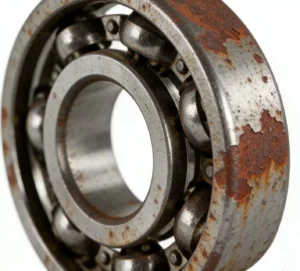
You paid extra for stainless steel bearings1, thinking they were invincible. But now you see ugly red spots. You feel cheated and wonder if you were sold fakes.
The truth is, stainless steel bearings can and do rust. This usually happens when their protective chromium layer is damaged by salt, chemicals, or scratches. The most common reason, however, is choosing a material like 440C for an environment that requires the superior protection of 304/316 steel.
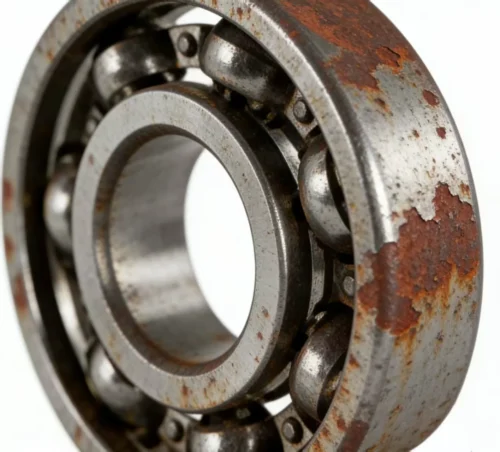
It all started with an angry call from a long-time client in Malaysia the other day. "You sold me stainless steel bearings," he said, "Why are they covered in 'red spots' after only two weeks? Are these fake?" He sent over a photo, and sure enough, the bearing surface was dotted with rust, a classic case of saltwater air corrosion. I asked him, "Did you choose the 440C2 material because you needed high hardness3?" He went quiet. This is a huge misunderstanding I see all the time. Today, I'm going to tell you the honest truth my competitors might not: stainless steel rusts. Let's break down why and how to make sure it doesn't happen to you.
What Makes Stainless Steel "Stainless" Anyway?
You hear "stainless steel" and think it's a superman metal. But when it fails, you are left confused. What is the real secret behind its name and its limits?
Stainless steel isn't rust-proof; it's rust-resistant. It contains an element called chromium, which forms a thin, invisible protective film on the surface. This layer blocks oxygen and prevents rust. But this protective shield can be broken.
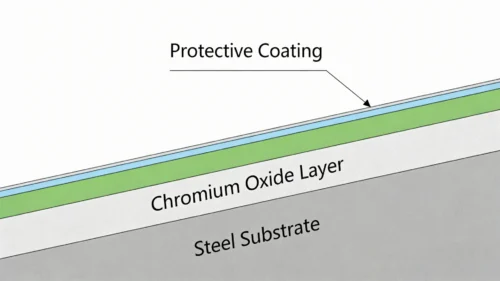
Think of this protective layer, called a passivation film, as a self-healing skin. If it gets a minor scratch, as long as there's oxygen around, the chromium will react and instantly repair the shield. It’s a brilliant piece of chemistry. But this shield isn't invincible. It has enemies that can overwhelm its healing ability. Understanding these enemies is the key to preventing rust.
The Enemies of the Protective Film
There are three main ways this film can be defeated, leading to the rust you see on your bearings.
- Chemical Attack: The number one villain here is chloride ions4. You find these everywhere in coastal areas (sea salt spray), de-icing salts, and many industrial chemicals. These ions are like tiny bullets that aggressively penetrate the passive layer, creating small pits where rust can begin to form and spread.
- Physical Damage: Any deep scratch or gouge can break through the protective film. A common cause is improper installation, like hitting the bearing with a hammer. This exposes the raw steel underneath. If the damage is too severe or the environment is too harsh, it won't be able to "heal" itself in time.
- The Wrong Material: This is the most common reason I see in practice. Not all stainless steels are created equal. Some are designed for hardness, while others are designed for maximum corrosion resistance5. Choosing the wrong type for your job is like sending a soldier into the water without scuba gear.
| Threat Type | Example | How it Causes Rust |
|---|---|---|
| Chemical | Saltwater air, cleaning agents | Chloride ions pierce the protective chromium layer. |
| Physical | Hammering during installation | Scratches expose the unprotected steel beneath. |
| Material | Using 440C in a marine environment | The material isn't designed for that level of corrosion. |
440C vs. 304: Is It a Battle Between Hardness and Rust Resistance?
Choosing the right bearing feels like a gamble. You need it to be strong and handle a heavy load, but you also need it to survive in a damp place. How do you pick a winner?
Yes, it's a direct trade-off. 440C stainless steel is very hard, making it great for high loads and speeds, but its rust resistance is only moderate. 304/316 stainless steel offers superior rust protection but is much softer and can't handle the same performance demands.
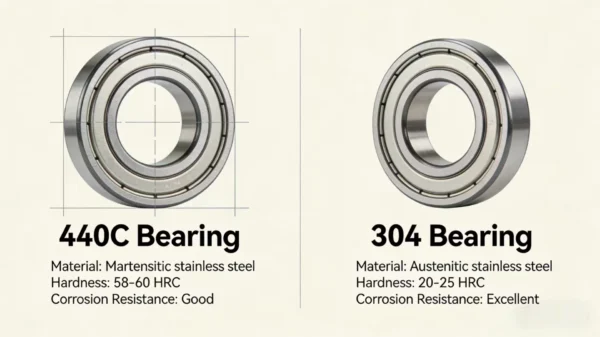
In the bearing world, we basically have two different schools of stainless steel, each with a distinct personality. Think of it as choosing a team member for a specific mission. You have the "Hard Guy" and the "Diver," and you can't ask one to do the other's job. The "Hard Guy" is 440C steel. It has a high carbon content, which makes it extremely hard after heat treatment. This is why it can handle high loads and high speeds. It's also magnetic, which is a simple way to identify it. But that same carbon that gives it strength makes it more vulnerable to rust. The "Diver" is 304 or 316 steel. This type has much better corrosion resistance5 because of its chemical makeup. It can handle being submerged in water or exposed to chemicals for a long time. But, it is much softer and can't take the same punishment as 440C. You have to accept lower speeds and loads. You simply can't have it all in one material.
| Feature | 440C Stainless Steel ("The Hard Guy") | 304/316 Stainless Steel ("The Diver") |
|---|---|---|
| Primary Trait | Hardness & Load Capacity | Corrosion Resistance |
| Material Type | Martensitic (High Carbon) | Austenitic (Low Carbon) |
| Hardness | Very Hard (~58 HRC) | Soft (~25 HRC) |
| Magnetism | Magnetic | Non-Magnetic or Weakly Magnetic |
| Best For | High speed, high load, moderate moisture | Food processing, marine, chemical environments |
| Weakness | Will rust in salty or acidic conditions | Lower load and speed limits |
How Do I Choose the Right Stainless Steel Bearing for My Machine?
You know the options, but making the final decision is stressful. A wrong choice means wasted money, angry customers, and frustrating downtime. How can you be sure you're picking the right one?
First, honestly analyze your operating environment. For general industrial use6 with some humidity, a well-greased 440C bearing is fine. For direct exposure to salt, chemicals, or food products, you must choose 304 or 316 stainless steel.
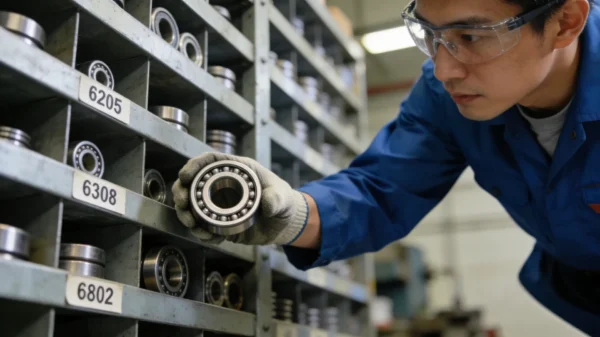
Making the right choice is a simple, logical process. You just have to ask the right questions about your specific situation. Don't just order "stainless steel"; get specific to save yourself a headache later.
Step 1: Assess Your Environment
This is the most important question. Be honest about where this bearing will live.
- Mild Dampness: Is it for a machine like a fan or motor in a factory with general air humidity? A good quality 440C bearing will work perfectly here.
- Coastal or Salty Air: Is your equipment near the ocean? That salt in the air is highly corrosive. You should strongly lean towards 304/316.
- Washdown/Chemicals: Will the bearing be in food processing or chemical plants where it gets washed down frequently? Don't even think about it. You need 304/316 to prevent contamination and failure.
Step 2: Consider Your Performance Needs
Next, what do you need the bearing to do?
- Load & Speed: Is it a high-speed application or under a heavy load? If yes, you need the hardness of 440C. 304 is too soft and will wear out quickly under these conditions. If it's a slow-moving, low-load application like a conveyor, 304/316 is a great choice.
Step 3: The Ultimate Solution
What if you need both? What if you have a high-load, high-speed machine that's also in a corrosive environment? For this, there's a premium option: hybrid ceramic bearings7. These typically use the hard 440C stainless steel rings but replace the steel balls with ceramic ones (like Silicon Nitride). The ceramic balls are immune to rust, harder than steel, and lighter. This gives you the best of both worlds, but it does come at a higher price.
Conclusion
Choosing the right stainless bearing isn't about finding one that never rusts. It's about understanding the trade-off between hardness and corrosion resistance5 to match the material to your specific job.
Explore this resource to learn how to properly care for stainless steel bearings and prevent rust. ↩
Discover the unique characteristics of 440C stainless steel and its applications in various industries. ↩
Explore the advantages of high hardness in stainless steel and its applications in demanding environments. ↩
Learn about the impact of chloride ions on stainless steel and how to mitigate their effects. ↩
Understand the key factors that affect corrosion resistance in stainless steel to make better material choices. ↩
Explore best practices for utilizing stainless steel in industrial settings to maximize durability and performance. ↩
Discover the benefits of hybrid ceramic bearings and how they combine the best features of different materials. ↩