
Struggling to find new growth areas? The traditional bearing market is crowded. We need to find where the real opportunities are, the new "gold mines" for our business.
Buyers are increasing orders in key growth sectors. These include electric vehicles, wind energy, aerospace, medical equipment, and high-precision machine tools. These markets demand specialized, high-performance bearings and offer huge potential for growth.
Today, I'm not going to talk about the usual bearing applications. Instead, I want to take you on a "mining" expedition. Let's dig deep into the most promising bearing markets of the future. Let's see where the brightest "gold" is and which fields are worth our focus.
Why is the Electric Vehicle Bearing Market a Goldmine for High-Speed Solutions?
EVs need to go further on a single charge. Every bit of friction matters. Standard bearings just can't keep up with the high speeds and efficiency demands of modern electric motors.
The EV market is a goldmine because its rapid growth creates massive demand for specialized bearings. These bearings must handle higher speeds, reduce noise, and increase efficiency to extend battery life, creating a new standard for performance and a huge opportunity for advanced manufacturers.

The EV boom is a game-changer for us. Sales are skyrocketing, and so is the need for the bearings that are the heart of the drive system. We're not just talking about a simple swap from an internal combustion engine to an electric motor. The demands on bearings, from the motor to the wheel hubs, are completely different and much more extreme. They need to be high-precision1, long-lasting, and incredibly quiet. You can't have a silent motor and a noisy bearing. But it's not just about replacing old parts. The future of EV bearings is all about innovation. Lightweight materials are key to reducing overall vehicle weight and increasing range. Integrated designs, where the bearing is part of a larger component like the housing, save space and improve performance. And intelligent bearings2 with built-in sensors will soon provide real-time data on temperature and vibration. This is a huge leap forward for safety and maintenance. This is where we can really show our strength and our ability to innovate beyond the standard.
| Feature | Traditional Car Bearings | Electric Vehicle Bearings |
|---|---|---|
| Speed | Moderate | Very High (over 20,000 RPM) |
| Noise | Tolerable (masked by engine) | Must be extremely low (no engine noise) |
| Efficiency | Important | Critical for battery range |
| Trend | Mature Technology | Lightweight, Integrated, Intelligent |
How are Wind Energy Bearings Powering the Future with Heavy-Duty Solutions?
Wind turbines are massive and operate in harsh conditions. A bearing failure can be catastrophic and incredibly expensive to fix. Reliability is not just a goal; it is an absolute necessity.
Wind energy bearings power the future by providing extreme durability and reliability for critical components. These giant bearings for main shafts, yaw, and pitch systems must withstand immense forces and operate for over 20 years, making them a high-stakes, high-reward market.
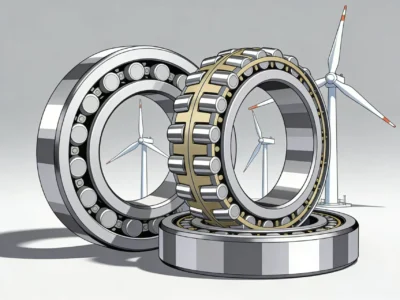
Wind power is a major focus for clean energy development around the world. Just look at those giant wind turbines. Inside them are some of the most impressive bearings you'll ever see. The main shaft bearings, yaw bearings, and pitch bearings are all "giants." They face incredibly tough demands for reliability and durability. Just think about it for a moment. A single wind turbine is expected to run smoothly for 20 years, often in remote locations offshore or on mountains. The pressure and stress on its bearings during that time are enormous. This isn't just a test of a product; it's a test of our technical strength and manufacturing capability. It's a stage where we can truly prove what we are capable of. Since we have our own casting foundry and processing plants, we can control the entire production process from start to finish. This ensures the material integrity and structural strength needed to meet these extreme demands. This market is a perfect match for our expertise in producing robust and long-lasting bearing solutions.
| Bearing Type | Location in Turbine | Key Requirement |
|---|---|---|
| Main Shaft Bearings | Connects rotor to gearbox | Handle massive radial and axial loads |
| Yaw Bearings | Rotates the nacelle into the wind | Slow rotation, high static load capacity |
| Pitch Bearings | Adjusts blade angle for speed control | Withstand high-frequency oscillations |
What Makes Aerospace Bearings the Pinnacle of Ultra-Precision Engineering?
In aerospace3, there is zero room for error. A single component failure can have unimaginable consequences. This means every bearing must perform perfectly, every single time, under extreme conditions.
Aerospace bearings are the pinnacle of precision because they are mission-critical components where failure is not an option. From aircraft landing gear to satellite control systems, they require the highest levels of quality, reliability, and performance, representing a market of ultimate challenges and rewards.
The aerospace3 market has a high barrier to entry, and for good reason. The demands here are simple: you either do it perfectly, or you don't do it at all. Every single bearing, from the ones in an airplane's landing gear to the tiny ones controlling a satellite's position, carries a huge responsibility for safety4 and mission success. This is a market where challenges and opportunities go hand in hand. It forces us to push our research, development, and manufacturing capabilities to a world-class level. There is no room for compromise on materials, heat treatment, or geometric precision. But if you succeed and get into this market, the payoff is huge. It's a win for both your technical reputation and your brand name. It proves you are among the best in the world, capable of meeting the most difficult standards imaginable. This is the kind of challenge that excites us and pushes our entire team to be better.
| Application | Key Bearing Demands | Material Focus |
|---|---|---|
| Jet Engine Mainshaft | Extreme speed, high temperature | Advanced steel alloys, ceramics |
| Landing Gear | High impact loads, corrosion resistance | Specialty steels, robust sealing |
| Satellite Systems | Ultra-high precision, vacuum compatibility | Lightweight materials, solid lubricants |
Why are Clean and Quiet Bearings Critical for Medical Equipment?
In a hospital, a noisy or unreliable piece of equipment can cause distress and misdiagnosis. Bearings in medical devices must be silent, perfectly smooth, and absolutely dependable to protect patient well-being.
Clean, quiet, and reliable bearings are critical for medical devices because they directly impact patient safety and diagnostic accuracy. In equipment like CT scanners and surgical robots, any vibration, noise, or failure can compromise a procedure, making precision and dependability essential.
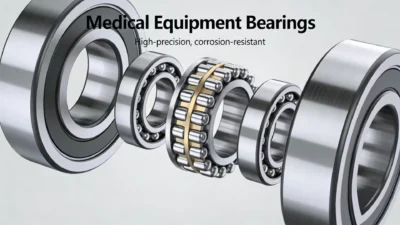
Let's talk about medical equipment, especially high-end diagnostic tools. These machines have almost impossibly strict standards for bearing precision1, cleanliness, and reliability5. Think about surgical robots, CT scanners, or MRI machines. The bearings inside them have to be perfect. Here's a little secret for you: a lot of the time, when you see those advanced machines in a hospital, our high-performance bearings6 are working silently inside them, doing their job flawlessly. This is a field that demands the most extreme attention to detail. "Good enough" is never an option. Every single bearing has to be manufactured with the utmost care because it plays a role in protecting and saving lives. This means using special materials that are non-magnetic or corrosion-resistant, and lubricants that are safe for a clinical environment. It’s a market that truly values the "zero defect" philosophy that we have built our company on for decades.
| Medical Device | Bearing Requirement | Why It's Critical |
|---|---|---|
| Surgical Robots | Zero backlash, high stiffness | Ensures precise, steady movements |
| CT Scanners / MRI | Low noise, non-magnetic materials | Prevents image artifacts, ensures patient comfort |
| Blood Pumps | High cleanliness, smooth operation | Avoids contamination and damage to blood cells |
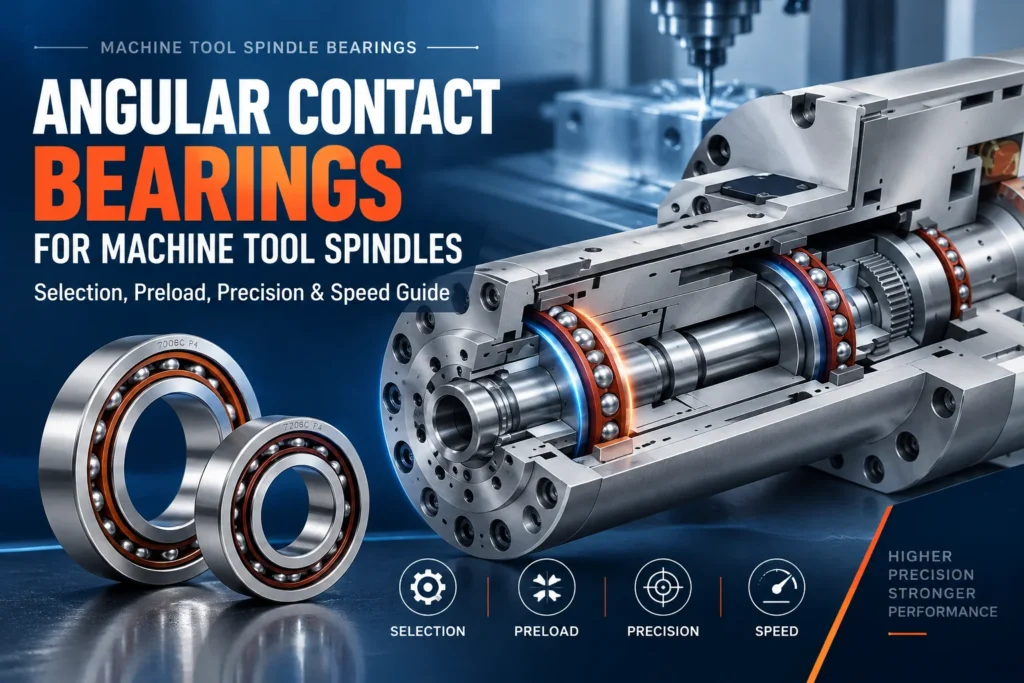
How Do High-Precision Spindle Bearings Define Modern Machine Tools?
A machine tool is only as good as its spindle. If the spindle bearing has even a tiny flaw, the parts it makes will be inaccurate, leading to waste and poor quality.
High-precision spindle bearings define modern machine tools because their performance directly determines the machine's accuracy and "ceiling." The higher the precision and rigidity of the bearing, the more accurate the parts the machine can produce, making these bearings fundamental to advanced manufacturing.
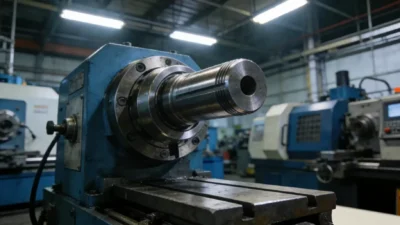
High-end machine tools7 are the foundation of all modern industry. They are the "master machines" that make all other parts. And what drives them? High-precision1, high-rigidity spindle bearings. The quality of the final product, whether it's a car engine part or a smartphone case, depends directly on the accuracy of the machine tool. And the accuracy of the machine tool depends directly on the quality of its spindle bearings. The trend in this industry is clear: everything is moving towards more intelligence and automation. This means the performance of the bearings is more critical than ever before. They set the "ceiling" for what a machine tool can achieve. A better bearing allows for faster cutting speeds, heavier cuts, and a smoother surface finish on the final part. This is a market where technical excellence is rewarded, and our focus on precision manufacturing gives us a strong advantage.
| Bearing Characteristic | Impact on Machining | Industry Trend |
|---|---|---|
| High Precision | Determines final part accuracy | Tighter tolerances, sub-micron precision |
| High Rigidity | Resists cutting forces, reduces vibration | Enables heavy-duty cutting, better surface finish |
| High Speed | Increases productivity and efficiency | Higher RPMs for faster material removal |
Conclusion
These five markets—EVs, wind, aerospace3, medical, and machine tools7—are not just trends. They are the future, offering massive growth opportunities for forward-thinking bearing manufacturers like us.
Discover the techniques and technologies that ensure precision in manufacturing. ↩
Explore the benefits of intelligent bearings with built-in sensors for real-time monitoring. ↩
Understand the complexities and demands of aerospace engineering and its impact on technology. ↩
Explore the rigorous safety standards that govern aerospace and medical device manufacturing. ↩
Understand the importance of reliability in engineering and its impact on safety and performance. ↩
Learn about the characteristics that make bearings high-performance and their importance in technology. ↩
Discover the trends and technologies shaping the future of machine tools in industry. ↩