
Choosing the wrong bearing type can lead to customer complaints and lost profits. This guide makes the decision simple, protecting your reputation and your bottom line.
The best bearing choice depends entirely on the application. Sealed bearings offer built-in protection and are maintenance-free, perfect for dirty environments. Open bearings are ideal for high-speed or high-temperature situations where custom, regular lubrication is possible. Understanding this difference is key to profitability.
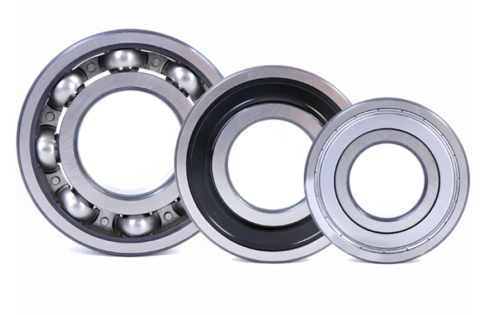
As a bearing manufacturer for over 30 years, We've seen this question come up thousands of times. It's not just a technical detail; it's a strategic business decision for any importer or distributor. The choice you recommend to your customer directly impacts their machine's performance and your company's reputation. Getting it right builds trust and repeat business. Getting it wrong creates problems that could have been easily avoided. Let's dig deeper into how you can make the smart choice every time.
Why This Choice Matters for Your Business (Not Just Performance)?
A simple bearing choice can feel small, but a mistake can cause big business headaches. These issues directly impact your profits and your relationship with customers.
Choosing the wrong bearing leads to direct financial losses. You will face increased after-sales costs from customer complaints, get stuck with inventory that doesn't sell, and suffer damage to your brand's reputation. Getting it right protects your profits and builds lasting customer trust.
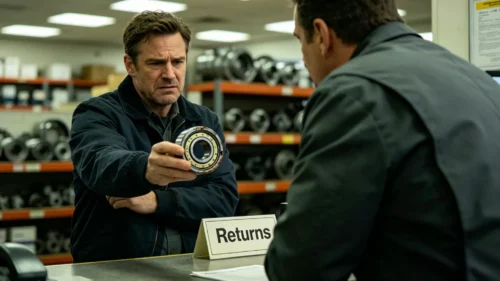
The consequences of a mismatch between the bearing and its application are very real. We remember one of our distributor partners telling me about a large order they sold to a quarry. They sold standard open bearings to save the customer a little money upfront. But the extreme dust caused those bearings to fail in just a few weeks. The distributor had to cover the cost of the replacement parts—this time, the correct sealed bearings—and the labor to install them. The entire profit from the original sale was wiped out, and the relationship with the quarry was damaged. This is not just about one sale. These mistakes create three major business problems:
- Customer Complaints and After-Sales Costs: When a bearing fails prematurely because it was the wrong type, the customer doesn't blame the environment; they blame you, the supplier. This leads to costly service calls, free replacements, and sometimes even paying for the customer's downtime. These costs come directly from your profit margin.
- Dead Stock and Tied-Up Capital: If you misjudge your market's needs and stock thousands of open bearings when most of your customers work in agriculture, that inventory will sit on your shelves. It becomes dead stock, tying up cash that you could be using to invest in products that actually sell.
- Damaged Brand Reputation: As a distributor, your customers see you as the expert. Recommending or selling the wrong part makes you look unreliable. Word travels fast, and a reputation for selling parts that don't last is incredibly difficult to repair. Every sale is a reflection of your brand.
Sealed Bearings vs Open Bearings — Quick Comparison for Buyers?
The technical differences between these two types can seem confusing. This confusion can easily lead to ordering the wrong part, creating problems for your customers and your business.
Sealed bearings come pre-lubricated with seals (rubber 2RS) or shields (metal ZZ) for protection from contaminants. Open bearings have no seals, allowing for custom lubrication and better heat dissipation at high speeds. Sealed is for protection; open is for performance and maintenance access.
Thinking about these bearings as "all-in-one" versus "customizable" can help. A sealed bearing is a complete, self-contained unit ready to be installed. It's designed for convenience and reliability in tough conditions. An open bearing is a component that is part of a larger system, relying on external lubrication and a clean environment to perform at its peak. To make it even clearer for you and your sales team, I've broken down the key differences in a simple table. This is the kind of chart you can print out and keep at your sales counter to help customers make an informed choice on the spot. It turns a technical conversation into a simple, value-based decision.
| Feature | Sealed Bearings (e.g., 2RS, ZZ) | Open Bearings |
|---|---|---|
| Protection | Excellent against dust, moisture, and dirt. | Poor. Relies entirely on external housing seals. |
| Maintenance | Low. Pre-lubricated for the life of the bearing. | High. Requires a strict re-lubrication schedule. |
| Speed Limit | Lower, as the seals create slight friction. | Higher, due to less friction and better heat flow. |
| Temperature | Limited by the grease and seal material. | Can handle higher temperatures with special grease. |
| Best For... | Dirty environments, hard-to-reach places, agriculture. | Clean environments, high-speed machines, electric motors. |
How to Choose Based on Your Market (Key for Distributors)?
Every market has completely different needs and challenges. Using a one-size-fits-all purchasing strategy is a sure way to end up with unsold stock and unhappy customers.
For agricultural or outdoor equipment markets, always recommend sealed bearings due to dust and moisture. For industrial maintenance clients, open bearings are often acceptable. For highly price-sensitive markets, open bearings typically sell in higher volumes. And for OEM clients, offer both as options.
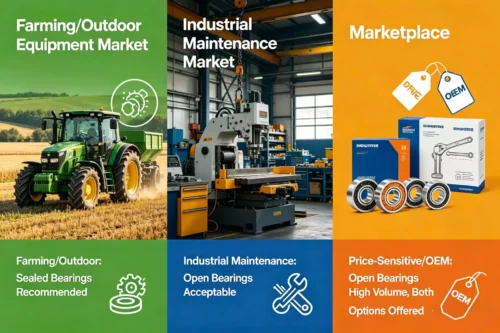
Understanding your end-user is the most important part of being a successful distributor. The person buying bearings for a tractor has completely different priorities than an engineer maintaining a high-speed production line. By segmenting your market, you can create a smarter inventory and provide better advice, making you a more valuable partner to your customers. We've worked with distributors across dozens of industries, and we've seen clear patterns emerge. Here is a breakdown of how to approach the most common market segments. This is your key to aligning your stock with what your customers actually need, which is the foundation of a profitable distribution business.
If Your Customers Are in Agriculture / Outdoor Equipment
In these applications, bearings are constantly exposed to dust, dirt, mud, and water. Maintenance is often infrequent and performed in the field. For this market, sealed bearings, especially the 2RS type with two rubber seals, are not just a recommendation—they are a necessity. An open bearing would fail incredibly quickly. Your customers in this segment value reliability and long life above all else. A "fit and forget" solution is exactly what they need, and a sealed bearing provides that.
If You Sell to Industrial Maintenance Buyers
Buyers in this segment, often called MRO (Maintenance, Repair, and Operations), work in factories and plants. They often have well-established maintenance procedures and sometimes even centralized automatic lubrication systems. For them, open bearings are perfectly acceptable and often preferred, as they can use their own specialized grease and integrate the bearing into their maintenance schedule. When you talk to these buyers, asking about their lubrication practices shows your expertise and helps them get the right product.
If Your Market Is Price-Sensitive
In some markets, particularly in developing regions like Southeast Asia or Africa, the upfront purchase price is the most important factor. For general-purpose applications that are not in harsh environments or running at high speeds, open bearings are a great choice. They are less expensive to manufacture, so you can offer them at a more competitive price point. This is a volume game. Stocking common sizes of open bearings allows you to win business where the decision is based purely on cost.
If You Target OEM Clients
Original Equipment Manufacturers (OEMs) who build new machinery need flexibility. The best strategy here is to offer both options. You can present the open bearing as the standard, cost-effective component and the sealed bearing as a premium upgrade for "heavy-duty" or "low-maintenance" versions of their product. This allows your OEM client to offer different tiers of their own product to their customers, and it positions you as a flexible, strategic supplier who understands their business needs.
Inventory Strategy: Stock Sealed or Open Bearings?
As a distributor, you can't afford to stock every possible bearing variation. Bad inventory decisions tie up your cash and warehouse space, directly hurting your business's health.
For your fastest-moving, high-turnover products, stock sealed bearings (like the 6200 2RS series) because they are more versatile. Focus on sealed types for higher-margin sales. Keep open bearings in stock specifically for price-driven, competitive situations where cost is the only factor.
A smart inventory strategy is not about having everything; it's about having the right things. It's about applying the 80/20 rule—focusing on the 20% of products that will generate 80% of your sales and profit. When it comes to sealed versus open, you need a balanced approach that matches your market and business goals. Instead of guessing, you can build a strategy based on product turnover, profit margin, and competitive positioning. Over the years, we've helped our most successful distributors refine their approach, and it usually comes down to a few core principles that you can apply to your own business starting today.
- High-Turnover Products: Look at your sales data. Identify your top 10 or 20 best-selling bearing sizes. For these core products, it is almost always safer and more profitable to stock the sealed version, specifically the 2RS (double rubber seal) type. It is the most versatile option. A customer who needs a sealed bearing cannot use an open one. But a customer in a clean environment could, in theory, use a sealed bearing. This makes the sealed type the most flexible choice to hold in stock.
- Profit-Oriented Products: Sealed bearings offer clear value-added benefits: protection from contaminants, zero maintenance, and long life. These are benefits you can sell and charge a premium for. When you are focused on maximizing your profit margin, sealed bearings are the better product. You can frame the conversation around total cost of ownership, not just the initial purchase price. The small extra cost for a sealed bearing saves the customer much more in avoided downtime and labor.
- Price-Competitive Products: There will always be situations, like competitive bids or large-volume contracts, where the lowest price wins. For these cases, having the lower-cost open bearing option available is essential. These are the products that get your foot in the door with a new customer or help you win a large tender. Think of them as your competitive tool.
Common Mistakes Importers Make (And How to Avoid Them)?
In my decades in this business, I've seen importers make the same simple mistakes over and over. These seemingly small errors can cost you thousands of dollars in returns, lost sales, and a damaged reputation.
The biggest mistakes are buying only on price, not knowing the difference between ZZ and 2RS seals, failing to advise customers on proper selection, and not tailoring inventory to specific market segments. Avoiding these common traps is crucial for long-term success.
Learning from the mistakes of others is the fastest way to improve your own business. The bearing industry has its own unique set of traps for the unwary. The good news is that they are all avoidable if you know what to look for. By being aware of these common pitfalls, you can set yourself apart from less-informed competitors and build a more resilient, profitable business. Let's go through the four most common errors we see importers and distributors make, so you can make sure you're not one of them.
- Buying on Price Alone: This is the number one mistake. An importer gets a quote for an open bearing that is 10 cents cheaper than a sealed one and buys ten thousand of them. They then sell it to a customer who uses it in a cement mixer. The bearing fails in a week. The customer is angry, your reputation is hurt, and you have to replace the part for free. The 10 cents you saved cost you dollars in the end. The application environment must be the first consideration, always.
- Confusing ZZ and 2RS Seals: Not all sealed bearings are the same. A 'ZZ' bearing has two metal shields. A '2RS' bearing has two rubber seals. Metal shields (ZZ) are non-contact, meaning they have less friction and are better for higher speeds, but they only protect against larger debris. Rubber seals (2RS) make contact with the inner ring, providing a much better seal against fine dust and moisture, but they have a lower speed limit. Selling a ZZ bearing for a wet application is a guaranteed failure. You must know the difference.
- Not Providing Selection Advice: Your job is not just to take an order. It's to solve a problem. When a customer asks for a "6205 bearing," the right response is, "Great, what are you using it for?" That one simple question can prevent a costly mistake. It positions you as an expert and builds trust. The most successful distributors are consultants, not just box-movers.
- A One-Size-Fits-All Inventory: We've discussed this before, but it's a mistake so common it's worth repeating. Stocking only the cheapest open bearings will leave you unable to serve customers in agriculture, construction, or food processing. Stocking only premium sealed bearings might make you uncompetitive in the general repair market. You need a smart mix based on your specific local market.
How We Help Distributors Reduce Risk?
We know that sourcing from any manufacturer, especially one overseas, can feel like a risk. You worry about product quality, consistent supply, and whether you'll get the support you need.
We control our entire production chain, from casting the raw iron for our bearing housings to the final bearing assembly. This vertical integration guarantees stable quality and a massive capacity. We also offer custom packaging and expert technical support to help your clients succeed.
At Yuanguang Bearing, we have structured our entire company to eliminate these risks for our distributor partners. We started in 1992, and from the beginning, our goal was to control quality at every single step. We are not just an assembly plant that buys components from other suppliers. We are a true manufacturing enterprise, and this gives our partners a significant advantage. This control and capacity mean you can trust us to be a reliable foundation for your business growth. When you partner with us, you are not just buying a product; you are gaining a manufacturing backbone that you can depend on.
- Full Production Chain Control: We have our own foundry where we cast the iron, our own state-of-the-art machining facility, and our own bearing assembly lines. This means we control the quality of the raw materials and the precision of every single process. If there is ever an issue, we can trace it and fix it instantly. This total control is your best guarantee of consistent quality, shipment after shipment.
- Stable, High Capacity: Our scale is your security. We produce 40 tons of castings per day, 12 million bearing housings per year, and 15 million fully assembled bearings per year. This massive capacity means we can handle large, time-sensitive orders without the delays you might experience with smaller factories. You can be confident that we can grow with your business.
- A True Partnership: We succeed when you succeed. We offer services that go beyond manufacturing, like creating custom packaging with your brand logo and part numbers. This helps you build your own brand in your market. Furthermore, our engineering team is available to you. If your customer has a challenging application and you're not sure what to recommend, we will work with you to provide the right technical advice. We help you win more business.
Quick Selection Checklist?
When a customer is at your counter or on the phone, you need a fast way to make the right choice. Remembering all the details under pressure can be difficult for any salesperson.
To choose quickly, ask these key questions. Is the environment dirty or wet? Choose Sealed. Is the speed very high? Choose Open. Is maintenance difficult or impossible? Choose Sealed. Is the lowest possible initial cost the top priority? Choose Open.
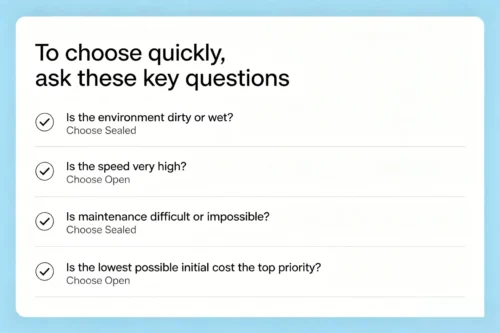
To make things as simple as possible for you and your team, I've created a quick checklist. These are the five questions you should ask for every order. Walking through these questions will lead you to the correct bearing type nearly every time. It's a simple tool that prevents complex problems. This process not only ensures the customer gets the right part but also reinforces your position as a knowledgeable and trustworthy supplier. It's a professional approach that builds customer loyalty and reduces the risk of returns and complaints, protecting your profitability on every single sale.
The 5-Question Bearing Selection Checklist:
- What is the operating environment like?
- If it's dusty, dirty, or exposed to moisture (like on a farm, construction site, or food processing line): The answer is Sealed (2RS is best).
- If it's a clean, dry, controlled indoor environment (like in an electric motor): The answer is Open.
- What is the operating speed (RPM)?
- If it's low to moderate speed: The answer is Sealed.
- If it's high or very high speed: The answer is Open to prevent overheating.
- Can the bearing be easily maintained and re-lubricated?
- If no, the location is hard to access or there is no maintenance plan: The answer is Sealed.
- If yes, there is a regular lubrication schedule: The answer is Open.
- What is the customer's main priority?
- If it's maximum reliability and long life with no fuss: The answer is Sealed.
- If it's the absolute lowest upfront purchase price: The answer is Open.
- Are there extreme temperatures involved?
- For standard operating temperatures: Both are fine.
- For very high-temperature applications: The answer is Open, so a special high-temperature grease can be used.
Conclusion
Choosing between sealed and open bearings is a critical business decision, not just a technical one. Use this guide to match the right product to your market, reduce your risks, and grow your profits.