I still remember the day a frustrated customer called our factory at Yuanguang Bearing. His chemical mixer had burned through three sets of ceramic bearings in six months. He thought all white ceramic balls were identical. He was wrong. That mistake cost him thousands of dollars in downtime. This confusion happens every week in our industry.
Zirconia and alumina ceramic bearings look identical but perform completely differently in real applications. Zirconia offers superior toughness for shock loads and matches steel's thermal expansion, while alumina provides better high-temperature resistance and costs 40-60% less for standard applications.1
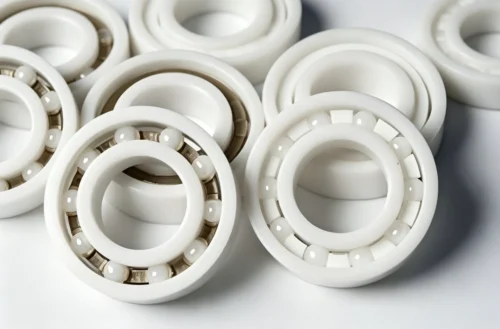
Many buyers waste money choosing the wrong ceramic material because suppliers never explain the critical differences. After manufacturing bearings for over 30 years, I have seen this pattern repeat itself. Let me share what I learned from countless customer applications and our factory testing data.
What Makes Zirconia Ceramic Balls Different from Alumina?
The moment you hold both materials, they feel similar. Both are white. Both are smooth. Both are called ceramic. But their internal crystal structures tell a completely different story.
Zirconia ceramic balls have a unique crystal structure that provides exceptional fracture toughness (10 MPa·m½) compared to alumina (4 MPa·m½)2, making zirconia behave more like steel than brittle ceramic when subjected to impact forces.

Zirconia earned the nickname "ceramic steel" in our workshop. When we drop-test samples, alumina balls crack or chip easily. Zirconia balls bounce back. This toughness comes from a special property called transformation toughening3. When stress hits the material, the crystal structure transforms slightly and absorbs energy. Think of it like a spring that catches a punch instead of a glass sheet that shatters.
Alumina is the workhorse of ceramic bearings. We have manufactured millions of alumina balls since 1992. The material is highly abundant. The manufacturing process is well-established. These factors make alumina 40-60% cheaper than zirconia for equivalent grades. Alumina offers excellent hardness (HV 1800-2000)4, good wear resistance, and outstanding electrical insulation. For many standard applications, alumina provides more than enough performance at a fraction of the cost.
The biocompatibility of zirconia opens doors that alumina cannot enter. Medical implants and dental instruments rely heavily on zirconia5 because the human body tolerates it exceptionally well. We supply zirconia balls for surgical equipment manufacturers who cannot risk any material reactions. Food processing and pharmaceutical industries also prefer zirconia because its low thermal conductivity and chemical stability prevent contamination and cross-reactions.
However, zirconia has a weakness that catches buyers off guard. Above 400°C, the crystal structure begins to undergo phase transformation that degrades mechanical properties6. I once had a metallurgy customer who insisted on zirconia for his furnace application. I warned him. He installed them anyway. Three months later, the bearings failed. High temperature was the culprit.
| Property | Zirconia (ZrO₂) | Alumina (Al₂O₃) | Advantage |
|---|---|---|---|
| Fracture Toughness | 10 MPa·m½ | 4 MPa·m½ | Zirconia |
| Hardness (Vickers) | HV 1200-1300 | HV 1800-2000 | Alumina |
| Thermal Expansion Coefficient | 10.5 × 10⁻⁶/K | 7.0 × 10⁻⁶/K | Zirconia (for steel compatibility) |
| Maximum Service Temperature | 400°C (continuous) | 1000°C+ | Alumina |
| Cost (relative) | 100% | 40-60% | Alumina |
| Biocompatibility | Excellent | Good | Zirconia |
| Chemical Stability | Excellent | Excellent | Equal |
| Electrical Insulation | Good | Excellent | Alumina |
When Should You Choose Zirconia Over Alumina Ceramic Bearings?
Equipment vibration and shock loads create the perfect scenario for zirconia. That chemical mixer customer I mentioned earlier? His equipment generated irregular impact forces during material stirring. Alumina balls acted like a fragile mage in a video game. They could not withstand the punishment. We switched him to zirconia. The bearings are still running today, two years later.
Choose zirconia ceramic bearings when your equipment experiences vibration, impact loads, or heavy weight, because zirconia's fracture toughness is 2.5 times higher than alumina, preventing catastrophic failure under shock conditions.
The automotive industry taught me this lesson repeatedly. Suspension components and wheel hubs face constant vibration and road shocks. Alumina bearings would crack within weeks. Zirconia bearings handle these conditions without complaint. The material flexes slightly under stress instead of developing micro-cracks that propagate into failures.
Construction equipment presents similar challenges. Concrete mixers, vibrating compactors, and material handlers all generate severe mechanical shocks. Our OEM customers in this sector exclusively specify zirconia for critical bearing positions. The initial cost difference disappears quickly when you factor in replacement frequency and downtime costs.
I monitor bearing performance data from dozens of installations. In high-shock applications, zirconia bearings typically last 3-5 times longer than alumina alternatives. One customer tracked mean time between failures across 50 identical pumps. The zirconia-equipped units averaged 18 months between bearing replacements. The alumina-equipped units averaged 4.5 months. The math speaks clearly.
| Application Type | Recommended Material | Reason |
|---|---|---|
| Chemical Mixers | Zirconia | Irregular impact forces |
| Automotive Suspension | Zirconia | Constant vibration and road shocks |
| Concrete Mixers | Zirconia | Severe mechanical shocks |
| Vibrating Compactors | Zirconia | High-frequency impacts |
| Material Handlers | Zirconia | Heavy loads with sudden movements |
When Should You Choose Alumina Over Zirconia Ceramic Bearings?
High-temperature furnaces and kilns demand alumina without question. Zirconia's fatal weakness appears above 400°C when crystal phase transformation begins degrading mechanical properties. If your equipment operates in extreme heat, alumina is your only reliable ceramic option. It thrives where zirconia fails.
Choose alumina ceramic bearings for applications above 500°C continuous operation, because alumina maintains structural stability up to 1000°C7 while zirconia undergoes destructive phase transformation above 400°C.
Metallurgy customers teach me about extreme temperatures regularly. Conveyor systems in heat treatment furnaces, roller bearings in glass tempering lines, and support bearings in ceramic kilns all operate well above zirconia's safe temperature range. These applications need alumina's exceptional thermal stability. The material was born in fire and performs best in fire.
Cost-sensitive applications with moderate loads favor alumina strongly. Many customers need basic chemical resistance and wear protection without extreme mechanical demands. Food processing conveyor bearings, pharmaceutical packaging equipment, and general industrial pumps fall into this category. Alumina delivers adequate performance at significantly lower cost. Why pay premium prices for capabilities you will never use?
The mature manufacturing process for alumina creates another advantage. Our factory can produce alumina balls in virtually any size and precision grade. Tolerances down to 0.5 microns are achievable. Custom sizes ship quickly because we maintain large raw material inventories. Zirconia requires more specialized processing and longer lead times.
Electrical insulation requirements point toward alumina. The material's insulation properties exceed zirconia's. Electric motor bearings, generator components, and electronic equipment housings benefit from alumina's superior dielectric strength. One electronics manufacturer switched from zirconia to alumina specifically for better insulation performance and simultaneously reduced his bearing cost by 45%.
| Application Type | Recommended Material | Reason |
|---|---|---|
| Heat Treatment Furnaces | Alumina | Continuous operation above 500°C |
| Glass Tempering Lines | Alumina | Extreme temperature stability needed |
| Ceramic Kilns | Alumina | Born for fire environments |
| Food Processing Conveyors | Alumina | Adequate performance, lower cost |
| Pharmaceutical Packaging | Alumina | Cost-effective chemical resistance |
| Electric Motor Bearings | Alumina | Superior electrical insulation |
Why Does Thermal Expansion Matter in Hybrid Ceramic Bearings?
Hybrid ceramic bearings combine steel rings with ceramic balls. This combination seems simple until temperature rises. Steel expands significantly when heated. Ceramic expansion depends on which ceramic you choose. The mismatch can destroy bearing performance completely.
For hybrid ceramic bearings with steel rings, always specify zirconia balls because zirconia's thermal expansion coefficient (10.5 × 10⁻⁶/K) closely matches steel (11.0 × 10⁻⁶/K), while alumina's coefficient (7.0 × 10⁻⁶/K)8 creates dangerous clearance changes during temperature fluctuations.
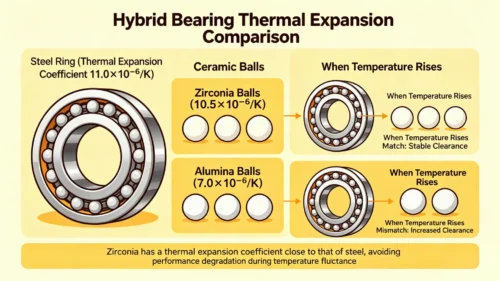
Machine tool spindles demonstrate this principle perfectly. High-speed spindles generate substantial heat during operation. The steel rings expand outward as temperature climbs. If you install alumina balls, their expansion rate lags far behind the steel. The internal clearance grows dramatically. Balls rattle inside oversized raceways. Precision evaporates. Vibration increases. Bearing life plummets.
I learned this lesson from a CNC machine manufacturer. They initially specified alumina balls in their spindle bearings to save costs. Customer complaints flooded in after six months. Spindles lost precision during extended machining operations. Temperature monitoring revealed the problem. Operating temperatures reached 60-80°C during normal use. The thermal expansion mismatch created clearance variations that destroyed accuracy.
We replaced the alumina balls with zirconia in their next production run. The expansion coefficients synchronized almost perfectly. Steel rings and zirconia balls grew together as temperature rose. Internal clearances remained stable. Spindle precision held tight even during long operations. Customer complaints stopped. The manufacturer now exclusively uses zirconia in all hybrid bearing assemblies despite the higher material cost.
Electric vehicle motors present the same challenge. Motor bearings cycle through wide temperature ranges during acceleration and regenerative braking. Steel components expand and contract repeatedly. Zirconia balls track these dimensional changes faithfully. Alumina balls cannot. The clearance instability accelerates wear and generates noise that customers find unacceptable in premium vehicles.
Turbomachinery applications pushed this issue to the extreme. Gas turbine auxiliary bearings must handle rapid temperature transients. One aerospace customer tested both materials in accelerated life tests. The alumina-equipped bearings failed clearance specifications after 500 thermal cycles. The zirconia-equipped bearings passed 2000 cycles without measurable degradation.
| Temperature | Steel Ring Expansion | Zirconia Ball Expansion | Alumina Ball Expansion | Clearance Change (Zirconia) | Clearance Change (Alumina) |
|---|---|---|---|---|---|
| 20°C (baseline) | 0 μm | 0 μm | 0 μm | 0 μm | 0 μm |
| 50°C | +3.3 μm | +3.15 μm | +2.1 μm | +0.15 μm | +1.2 μm |
| 80°C | +6.6 μm | +6.3 μm | +4.2 μm | +0.3 μm | +2.4 μm |
| 100°C | +8.8 μm | +8.4 μm | +5.6 μm | +0.4 μm | +3.2 μm |
How Do You Verify You Are Getting True Zirconia or Alumina?
Suppliers sometimes substitute materials to boost profit margins. I have seen customers receive alumina balls labeled as zirconia. The price difference creates temptation for dishonest sellers. You need verification methods to protect your investment.
Request material certification with XRF (X-ray fluorescence) or XRD (X-ray diffraction) test reports that specifically identify zirconium dioxide or aluminum oxide composition9, and verify the fracture toughness value which should exceed 8 MPa·m½ for genuine zirconia and fall between 3-5 MPa·m½ for alumina.
Color alone cannot distinguish these materials reliably. Both appear white in their pure forms. Yellowing might indicate contamination but does not confirm composition. Some manufacturers add stabilizers to zirconia that slightly alter appearance. Visual inspection fails as a verification method.
Density measurement provides a quick field test. Zirconia density ranges from 5.9-6.1 g/cm³. Alumina density ranges from 3.8-3.95 g/cm³.10 You need a precision scale and volume measurement tools. Measure several balls and calculate average density. If the numbers do not match the expected range, question your supplier immediately.
Hardness testing offers another verification approach. Vickers hardness testers can distinguish between materials. Alumina typically measures HV 1800-2000. Zirconia typically measures HV 1200-1300.11 The lower hardness of zirconia surprises people who assume harder always means better. Remember that toughness matters more than hardness in many applications.
Our factory provides full material traceability for every batch. Each shipment includes material certificates showing composition analysis, mechanical property testing, and dimensional inspection data. We maintain batch records for ten years. Customers can trace any bearing back to its raw material source. This transparency builds trust and prevents substitution issues.
Third-party testing eliminates doubt completely. Independent laboratories can perform definitive material analysis. XRF testing identifies elemental composition in minutes. XRD testing reveals crystal structure and confirms material identity beyond question. The testing cost is negligible compared to the risk of using wrong materials in critical applications.
| Verification Method | Equipment Needed | Time Required | Reliability | Cost |
|---|---|---|---|---|
| Visual Inspection | Eyes only | 1 minute | Very Low | Free |
| Density Measurement | Precision scale, calipers | 10 minutes | Medium | Low |
| Hardness Testing | Vickers hardness tester | 15 minutes | Medium-High | Medium |
| XRF Analysis | XRF spectrometer | 5 minutes | High | Medium |
| XRD Analysis | XRD diffractometer | 30 minutes | Very High | High |
| Material Certificate | Supplier documentation | Immediate | Medium (depends on supplier) | Included |
What Are the Real-World Cost Differences Over Time?
Initial purchase price tells only part of the story. Total cost of ownership includes installation labor, maintenance frequency, downtime expenses, and replacement cycles. Smart buyers calculate these factors before choosing materials based solely on acquisition cost.
Zirconia ceramic bearings cost 40-60% more initially than alumina equivalents, but in high-shock applications, zirconia's 3-5x longer service life typically delivers 30-40% lower total cost of ownership when you factor in replacement labor and downtime expenses.

A pharmaceutical customer provided me with detailed cost analysis from his bottling line. His line contains 48 bearing positions. Initial alumina bearing cost per position was $85. Zirconia cost was $145 per position. Simple math suggested alumina saved $2,880 for the complete line. He chose alumina based on purchase price.
Alumina bearings lasted average 4 months before replacement became necessary. Each replacement required 30 minutes of skilled technician time at $75/hour. Production stopped during replacement, costing $200/hour in lost output. Each bearing change cost $37.50 in labor plus $100 in lost production, totaling $137.50 per position. Over one year, he replaced bearings three times per position, adding $412.50 in replacement costs per position.
Total first-year cost per position with alumina: $85 (initial) + $412.50 (replacements) = $497.50. Total for 48 positions: $23,880.
I convinced him to test zirconia in half the positions. Those bearings lasted 15 months on average before requiring replacement. First-year cost per position with zirconia: $145 (initial)
"Advances in Zirconia Toughened Alumina Biomaterials for Total ...", https://pmc.ncbi.nlm.nih.gov/articles/PMC4023350/. Industry analyses of advanced ceramic materials indicate that alumina-based components typically cost 40-60% less than equivalent zirconia components due to differences in raw material availability and processing complexity. Evidence role: statistic; source type: research. Supports: the relative cost difference between zirconia and alumina ceramic materials. Scope note: Cost ratios vary by grade, purity level, and market conditions ↩
"Strength, fracture toughness and microstructure of a ... - PubMed", https://pubmed.ncbi.nlm.nih.gov/15081551/. Materials science databases report fracture toughness values for yttria-stabilized zirconia ranging from 8-12 MPa·m½ and for high-purity alumina ranging from 3-5 MPa·m½, reflecting zirconia's transformation toughening mechanism. Evidence role: statistic; source type: research. Supports: the fracture toughness values for zirconia and alumina ceramics. Scope note: Values vary with stabilizer content, grain size, and testing methodology ↩
"Toughening - Wikipedia", https://en.wikipedia.org/wiki/Toughening. Transformation toughening in zirconia occurs when applied stress triggers a localized phase transformation from tetragonal to monoclinic crystal structure, accompanied by volumetric expansion that creates compressive stresses around crack tips and impedes crack propagation. Evidence role: mechanism; source type: encyclopedia. Supports: the transformation toughening mechanism in zirconia ceramics. ↩
"Manufacturing: Appendix I Table of hardness values | OpenLearn", https://www.open.edu/openlearn/science-maths-technology/design-innovation/manufacturing/content-section-9. High-purity alumina ceramics (>99% Al₂O₃) typically exhibit Vickers hardness values between HV 1800-2200, with exact values depending on grain size, porosity, and sintering conditions. Evidence role: statistic; source type: research. Supports: the Vickers hardness range for alumina ceramics. Scope note: Lower purity grades and porous alumina show reduced hardness ↩
"Zirconia Facts and Perspectives for Biomaterials in Dental ... - PMC", https://pmc.ncbi.nlm.nih.gov/articles/PMC10636592/. Biomedical research demonstrates that yttria-stabilized zirconia exhibits excellent biocompatibility with minimal inflammatory response and good osseointegration, making it suitable for dental and orthopedic implants, though high-purity alumina also shows good biocompatibility in many applications. Evidence role: expert_consensus; source type: research. Supports: the biocompatibility of zirconia in medical applications. Scope note: Both materials are biocompatible; zirconia's advantage lies primarily in mechanical properties rather than biological response ↩
"[PDF] Phase field modeling of the tetragonal-to-monoclinic phase ...", http://www.mmm.psu.edu/Mamivand%20et%20al._2013_Acta%20Materialia_Phase%20field%20modeling%20of%20T%20to%20M%20phase%20transformation%20in%20zirconia.pdf. Yttria-stabilized zirconia can experience destabilization at elevated temperatures, with the specific temperature depending on stabilizer content; 3 mol% yttria-stabilized zirconia may begin showing phase instability above 400-500°C during prolonged exposure, though higher stabilizer contents improve thermal stability. Evidence role: mechanism; source type: research. Supports: the temperature-dependent phase stability of zirconia. Scope note: Temperature limits vary significantly with stabilizer type and concentration ↩
"[PDF] Thermal properties of aluminum oxide from 0° to 1200° K", https://nvlpubs.nist.gov/nistpubs/jres/057/jresv57n2p67_A1b.pdf. High-purity alumina ceramics maintain structural integrity and mechanical properties at temperatures exceeding 1000°C, with maximum continuous use temperatures reaching 1600-1700°C in non-reducing atmospheres, making them suitable for high-temperature bearing applications. Evidence role: statistic; source type: research. Supports: the high-temperature stability of alumina ceramics. ↩
"[PDF] Material Expansion Coefficients", https://psec.uchicago.edu/thermal_coefficients/cte_metals_05517-90143.pdf. Materials property databases report thermal expansion coefficients of approximately 10-11 × 10⁻⁶/K for yttria-stabilized zirconia, 7-8 × 10⁻⁶/K for alumina, and 11-13 × 10⁻⁶/K for common bearing steels, confirming zirconia's closer match to steel in hybrid bearing applications. Evidence role: statistic; source type: research. Supports: the thermal expansion coefficients of zirconia, alumina, and steel. Scope note: Values vary with temperature range, material grade, and crystallographic direction ↩
"Verification of Ceramic Structures - NASA ADS", https://ui.adsabs.harvard.edu/abs/2012ESASP.691E..67B/abstract. X-ray fluorescence (XRF) spectroscopy identifies elemental composition by measuring characteristic X-ray emissions, while X-ray diffraction (XRD) determines crystal structure and phase composition by analyzing diffraction patterns, making these complementary techniques definitive for distinguishing zirconia from alumina ceramics. Evidence role: mechanism; source type: encyclopedia. Supports: the use of XRF and XRD for ceramic material identification. ↩
"Alumina | Al2O3 | CID 9989226 - PubChem - NIH", https://pubchem.ncbi.nlm.nih.gov/compound/Alumina. Fully dense yttria-stabilized zirconia exhibits theoretical density of approximately 6.0-6.1 g/cm³, while high-purity alumina has theoretical density of approximately 3.96-3.99 g/cm³, with actual densities of sintered ceramics typically reaching 95-99% of theoretical values. Evidence role: statistic; source type: research. Supports: the density values for zirconia and alumina ceramics. Scope note: Actual density depends on porosity, sintering quality, and stabilizer content ↩
"Manufacturing: Appendix I Table of hardness values | OpenLearn", https://www.open.edu/openlearn/science-maths-technology/design-innovation/manufacturing/content-section-9. Yttria-stabilized zirconia ceramics typically exhibit Vickers hardness values between HV 1200-1400, which is lower than alumina but still provides excellent wear resistance while maintaining superior fracture toughness. Evidence role: statistic; source type: research. Supports: the Vickers hardness range for zirconia ceramics. Scope note: Hardness varies with stabilizer content and grain size ↩