Are you tired of unexpected bearing failures causing costly downtime? Faulty bearings can halt production, but I know how to keep your operations running smoothly with smart maintenance.
Effective industrial bearing maintenance significantly extends service life and reduces failure rates by addressing common issues like contamination, improper lubrication, and incorrect installation, ensuring consistent performance and preventing costly downtime.
From my perspective, after decades in the bearing manufacturing industry at Yuanguang Bearing Co., Ltd., I have seen firsthand how proper care can transform a bearing's lifespan. I often tell our customers that understanding and implementing robust maintenance practices is not just an option; it is essential for operational excellence.
Why Bearing Maintenance Matters in Industrial Applications?
Are your seemingly identical bearings failing at wildly different times? This common problem causes frustration and unexpected costs, but I have a solution that ensures more consistent performance.
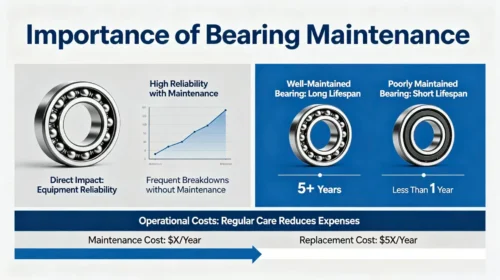
Bearing maintenance matters because it directly impacts equipment reliability and operational costs; even visually similar bearings can have vastly different lifespans based on how they are maintained, making regular care crucial.
The Unseen Impact of Neglect
From my experience at Yuanguang Bearing, I have observed that two bearings, manufactured to the same specifications and operating under similar visible conditions, can have vastly different service lives. This difference often comes down to the quality of maintenance. While a bearing might theoretically last anywhere from 20,000 to 80,000 hours1, its actual lifespan depends heavily on factors like wear, operational intensity, and especially, diligent maintenance. I believe that ignoring maintenance is like gambling with your production schedule. When a bearing fails prematurely, the cost is not just the replacement part; it includes lost production time, repair labor, and potential damage to other components. My team and I understand that every minute of downtime costs money. This is why I advocate for a proactive approach. Regular inspections and timely care are not expenses; they are investments that pay off by extending the bearing’s life and maintaining consistent productivity. We know that proper maintenance allows bearings to perform at their best, and critically, to maintain that performance for as long as possible. Without it, you are simply leaving performance and profit on the table.
What Are the Common Causes of Premature Bearing Failure?
Are your bearings failing before their time, costing you money and delaying production? Unexplained breakdowns can be frustrating, but I can help you identify and fix the root causes.
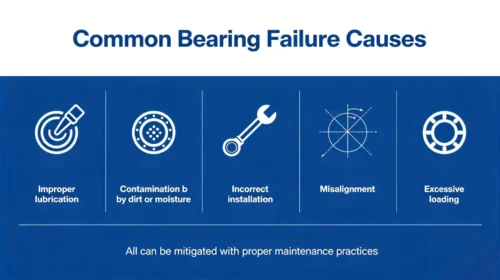
Premature bearing failure commonly results from improper lubrication, contamination by dirt or moisture, incorrect installation, misalignment, and excessive loading, all of which can be mitigated with proper maintenance practices.
Identifying the Root of the Problem
In my work helping clients maximize bearing performance, I have seen many failures, and a few common culprits consistently emerge. The first is improper lubrication. Bearings need the right type and amount of lubricant to reduce friction and heat. Too little, too much, or the wrong kind can cause rapid wear. Second, contamination is a huge issue. Dust, dirt, moisture, or even tiny metal particles can enter the bearing, acting like sandpaper on the precision surfaces. This quickly degrades the bearing's integrity. Third, incorrect installation is a frequent cause. If a bearing is forced onto a shaft or into a housing without proper tools, or if it is misaligned, internal stresses can lead to early failure. Fourth, excessive loading, whether from an overloaded machine or unexpected shocks, can exceed the bearing's design limits. Finally, poor storage before installation can damage a bearing before it even starts working. For example, if a bearing is stored where it can rust or collect dust, its life is compromised from day one. At Yuanguang, we stress that understanding these common issues helps our customers avoid them. Identifying these causes lets you implement targeted preventive measures, safeguarding your investment and ensuring smooth operations.
How Can I Create an Essential Bearing Inspection Checklist?
Do you worry about missing crucial signs of bearing trouble, leading to costly unexpected breakdowns? Without a clear inspection plan, small issues can become big problems, but I know how to help you stay ahead.
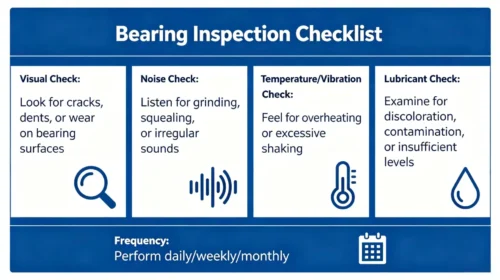
An essential bearing inspection checklist should include visual checks for damage, listening for unusual noises, feeling for excessive heat or vibration, and examining lubricant condition, all performed regularly to detect issues early.
Proactive Checks for Optimal Performance
Developing a thorough inspection checklist is a cornerstone of effective maintenance, something I emphasize to all our partners. When I inspect a bearing, I focus on several critical areas. First, I always look at the bearing's physical condition. I check for any visible signs of damage, like cracks, dents, rust, or discoloration on the outer surfaces. Second, I listen. Unusual noises, such as grinding, squealing, or clicking, are often early indicators of internal wear or lubrication issues. Third, I feel for temperature. Overheating is a clear sign of excessive friction2, which can point to lubrication problems, overloading, or misalignment. Fourth, I check for vibration. Excessive vibration can damage the bearing and surrounding components3. Finally, I examine the lubricant. Is there enough? Does it look clean, or is it discolored or contaminated with particles?
Inspection Checklist Example:
| Inspection Point | What to Look For | Frequency |
|---|---|---|
| Visual Inspection | Rust, cracks, discoloration, dents, seal damage | Daily/Weekly |
| Auditory Check | Grinding, squealing, clicking, unusual noises | Daily |
| Temperature Check | Excessive heat (using touch or infrared thermometer) | Daily |
| Vibration Analysis | Abnormal vibration levels | Weekly/Monthly |
| Lubricant Condition | Discoloration, contamination, proper level, leakage | Weekly/Monthly |
| Mounting Integrity | Loose bolts, signs of movement, shaft alignment | Monthly |
For bearings that have been removed, I perform a more detailed check of dimensions, rotational accuracy, internal clearance, and the condition of contact surfaces, cages, and seals. If I find any component fractured, or if there is spalling (flaking) on the rolling surfaces4, that bearing must be replaced immediately. This systematic approach, honed over years, allows us at Yuanguang to prevent minor issues from escalating into major failures.
What Are the Best Practices for Bearing Lubrication?
Are you unsure if your lubrication practices are truly protecting your bearings and extending their life? Improper lubrication is a leading cause of early failure, but I have straightforward steps to ensure your bearings stay optimally lubricated.
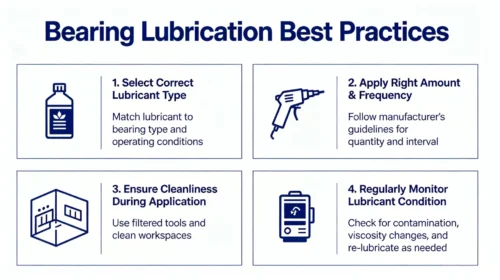
Best practices for bearing lubrication involve selecting the correct lubricant type, applying the right amount at the right frequency, ensuring cleanliness during application, and regularly monitoring lubricant condition to prevent friction and wear.
The Lifeblood of Your Bearings
Proper lubrication is, in my opinion, the single most critical factor in extending bearing life. It reduces friction, dissipates heat, and prevents corrosion. First, selecting the right lubricant is key. Different bearings and operating conditions demand specific grease or oil types. Always follow the manufacturer's recommendations. Second, applying the correct amount is crucial. Too little leads to metal-to-metal contact and rapid wear. Too much can cause churning, increased temperature, and seal damage. I always advise filling the bearing housing to about 1/2 to 2/3 of its capacity5, adjusting for higher pole count motors. Third, cleanliness during lubrication cannot be overstated. Dust and dirt are enemies of bearings. Always use clean tools and ensure the surrounding area is dust-free when adding lubricant. Fourth, regular replenishment is vital. Lubricants degrade over time due to heat, contamination, and mechanical shear. Establish a schedule for adding or replacing lubricant based on operating hours and environmental conditions. Finally, never mix different types of lubricants. They might be incompatible, leading to performance degradation or even accelerated wear. My experience at Yuanguang tells me that a consistent, clean, and correct lubrication regimen is the most effective way to prevent premature bearing failure and significantly extend the service life of your equipment.
What Are Proper Bearing Installation and Storage Tips?
Are you unknowingly shortening your bearings' lifespan even before they start working? Incorrect installation or storage can damage new bearings, but I can guide you on best practices to ensure they perform from day one.
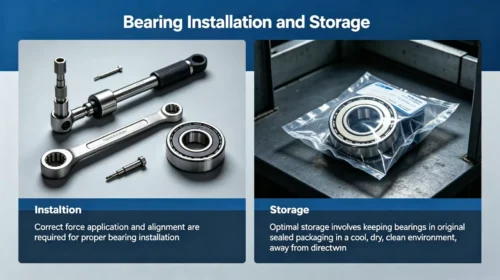
Proper bearing installation requires correct force application and alignment, while optimal storage involves keeping bearings in their original, sealed packaging in a cool, dry, and clean environment, away from direct sunlight or moisture.
Safeguarding Bearings from Start to Finish
From the moment a bearing arrives at your facility until it is fully operational, its handling directly affects its future performance. This is something we at Yuanguang understand deeply. First, let's talk about storage. When bearings leave our factory, they are coated with rust-preventive oil and packaged in anti-rust paper. As long as this packaging remains intact, the bearing's quality is preserved. For long-term storage, I recommend keeping them in a place where humidity is below 65% and the temperature is around 20°C6. Store them on shelves at least 30cm off the ground7. Avoid direct sunlight or contact with cold, damp walls. This prevents rust and contamination. Second, proper installation is just as critical. Many bearings are damaged during installation due to incorrect force. Always ensure that force is applied to the correct ring (inner ring for shaft, outer ring for housing) and that it is applied evenly. I prefer press-fitting for smaller bearings and the hot-fitting method for larger bearings or those with a high interference fit. When hot-fitting, control the temperature between 80°C and 100°C for no more than 10 minutes8. Use non-corrosive, thermally stable mineral oil, ensuring both the oil and container are clean. Before installation, lightly coat contact surfaces with grease to aid assembly and prevent fretting corrosion. After installation, always check for proper seating and ensure there's no axial or radial play that shouldn't be there. These steps, while seemingly small, make a huge difference in the life and reliability of your bearings.
How Can I Extend Bearing Life and Reduce Downtime?
Are you looking for concrete ways to make your industrial bearings last longer and minimize costly interruptions? Extending bearing life and reducing downtime are achievable goals, and I have effective strategies to share.
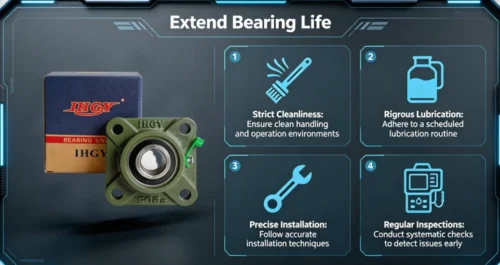
To extend bearing life and reduce downtime, focus on strict cleanliness during handling and operation, adhere to a rigorous lubrication schedule, implement precise installation techniques, and perform regular, systematic inspections to catch issues early.
A Holistic Approach to Bearing Longevity
Extending bearing life and reducing downtime is a comprehensive process that goes beyond just routine checks. My insights, gained from decades in the industry, point to a holistic approach. One critical aspect is maintaining exceptional cleanliness. The provided insights clearly state that bearing cleanliness significantly impacts life; cleaner bearings last longer9. Even lubricant with contamination particles above 10 micrometers can drastically shorten life10. This means regular filtering of cleaning agents and keeping the environment dust-free during lubrication. Another key is proactive replacement. Establish a sensible replacement cycle based on operational conditions, rather than waiting for failure. Always check new bearings for proper packaging, clear identification, and absence of damage before use. When cleaning, remember the distinction between coarse and fine cleaning, and always use clean diesel, kerosene, or gasoline, followed by immediate rust-preventive application. After cleaning, carefully inspect dimensions, rotation, and surfaces. I also emphasize the proper cleaning of bearing caps and oil passages during lubricant changes to ensure unobstructed flow. Finally, never overlook rust prevention. Beyond proper storage, employ methods like surface cleaning, drying, immersion in rust-preventive oil, brushing, or spraying. For rust removal, absolutely avoid strong acids like sulfuric or hydrochloric acid, which damage good metal. Instead, opt for safer alternatives like dilute oxalic acid (3:1 water ratio)11 or specialized gun oil. By integrating these practices—cleanliness, proactive replacement, thorough cleaning, proper rust prevention, and careful installation—you build a robust system that maximizes bearing longevity and minimizes unexpected downtime, ensuring your operations run smoothly and efficiently.
Conclusion
Following best practices for maintenance, lubrication, installation, and cleanliness extends bearing life, reduces failures, and significantly enhances operational efficiency.
"[PDF] Bearing Life The total number of revolutions, or the number or hours ...", https://www.engineering.iastate.edu/~gkstarns/me325/bearing_life.pdf. Industrial bearing lifespan estimates vary by type and application, with rated life (L10) calculations providing theoretical operational hours under specified load and speed conditions, though actual service life depends on maintenance and operating environment. Evidence role: statistic; source type: research. Supports: typical operational lifespan ranges for industrial bearings under standard conditions. Scope note: The cited range may reflect specific bearing types or operating conditions rather than universal applicability across all industrial bearings ↩
"[PDF] Friction and temperature as criteria for safe operation of journal ...", https://nvlpubs.nist.gov/nistpubs/jres/24/jresv24n5p491_A1b.pdf. Bearing temperature rise reflects the balance between frictional heat generation and heat dissipation, with elevated temperatures indicating increased friction from inadequate lubrication, misalignment, or excessive loading. Evidence role: mechanism; source type: research. Supports: the thermal consequences of increased friction in bearing systems. ↩
"[PDF] BEARING DAMAGE AND FAILURE ANALYSIS - SKF", https://cdn.skfmediahub.skf.com/api/public/093168a92d25cc46/pdf_preview_medium/093168a92d25cc46_pdf_preview_medium.pdf. Elevated vibration levels can induce false brinelling, accelerate fatigue crack propagation, and cause fretting wear at bearing interfaces, with damage severity correlating to vibration amplitude and frequency characteristics. Evidence role: mechanism; source type: research. Supports: the pathways by which abnormal vibration accelerates bearing degradation. ↩
"[PDF] INVESTIGATIONS OF SURFACE AND SUBSURFACE INITIATED ...", https://hammer.purdue.edu/articles/INVESTIGATIONS_OF_SURFACE_AND_SUBSURFACE_INITIATED_FAILURES_OF_ROLLING_CONTACT_FATIGUE/11743833/files/21399786.pdf. Spalling refers to the progressive removal of surface material through subsurface fatigue crack propagation in rolling contact, typically indicating that a bearing has exceeded its fatigue life or experienced abnormal loading conditions. Evidence role: definition; source type: encyclopedia. Supports: the nature and formation mechanism of spalling in rolling element bearings. ↩
"Determining grease quantities for initial fill and relubrication - SKF", https://www.skf.com/group/products/rolling-bearings/principles-of-rolling-bearing-selection/bearing-selection-process/lubrication/determining-grease-quantities. Bearing lubrication guidelines typically recommend partial housing fill to balance adequate lubrication with heat dissipation, with specific percentages varying by bearing type, speed, and operating temperature. Evidence role: general_support; source type: research. Supports: recommended grease fill levels for bearing housings. Scope note: Optimal fill ratios depend on specific bearing design, operating speed, and application requirements rather than being universally applicable ↩
"Proper Bearing Storage Guide: Preventing Failure Before Installation", https://tflbearing.com/blog/proper-bearing-storage-guide-prevent-failure.html. Industry storage guidelines recommend controlled humidity and moderate temperatures to minimize corrosion risk during bearing storage, with specific thresholds varying by bearing material and protective coating. Evidence role: general_support; source type: research. Supports: recommended environmental conditions for bearing storage to prevent corrosion. ↩
"1926.250 - General requirements for storage. - OSHA", http://www.osha.gov/laws-regs/regulations/standardnumber/1926/1926.250. Warehouse storage guidelines for precision components recommend elevation above floor level to minimize moisture exposure, contamination risk, and potential water damage from cleaning or flooding. Evidence role: general_support; source type: institution. Supports: elevation requirements for precision component storage. ↩
"Temperature limits - Ball bearings - SKF", https://www.skf.com/us/products/rolling-bearings/ball-bearings/deep-groove-ball-bearings/temperature-limits. Thermal installation methods recommend controlled heating to achieve sufficient thermal expansion while avoiding metallurgical changes or lubricant degradation, with temperature limits typically below 120°C to preserve bearing material properties. Evidence role: general_support; source type: research. Supports: safe temperature ranges for thermal bearing installation methods. Scope note: Specific temperature and duration recommendations vary by bearing size, material, and interference fit requirements ↩
"[PDF] Effect of Bearing Cleaning on Long Term Bearing Life", https://ntrs.nasa.gov/api/citations/19990075848/downloads/19990075848.pdf. Studies on bearing reliability demonstrate that contamination control can extend bearing life by factors of 2-10 times, with the effect magnitude depending on particle size distribution, concentration, and bearing operating conditions. Evidence role: statistic; source type: research. Supports: the quantitative relationship between contamination levels and bearing life reduction. ↩
"[PDF] Effect of filtration on rolling-element-bearing life in a contaminated ...", https://ntrs.nasa.gov/api/citations/19780020514/downloads/19780020514.pdf. Research on bearing contamination demonstrates that particles approaching or exceeding the lubricant film thickness can cause surface damage and accelerated wear, with sensitivity varying by bearing type and operating clearances. Evidence role: mechanism; source type: research. Supports: the relationship between particle size contamination and bearing wear rates. Scope note: The critical particle size threshold depends on bearing design, lubricant film thickness, and operating conditions rather than being a universal 10-micrometer limit ↩
"[PDF] Cleaning Products - University of Idaho", https://objects.lib.uidaho.edu/uiext/uiext30933.pdf. Oxalic acid solutions are employed for rust removal due to their chelating properties and relatively mild action on base metals compared to strong mineral acids, though concentration and exposure time must be controlled to prevent surface etching. Evidence role: mechanism; source type: research. Supports: the use of mild organic acids for rust removal from steel components. Scope note: Optimal concentration and application method depend on rust severity, bearing material composition, and required surface finish ↩