Seeing rust on your bearings can be a shock. It means trouble for your machines. Rust causes major damage.
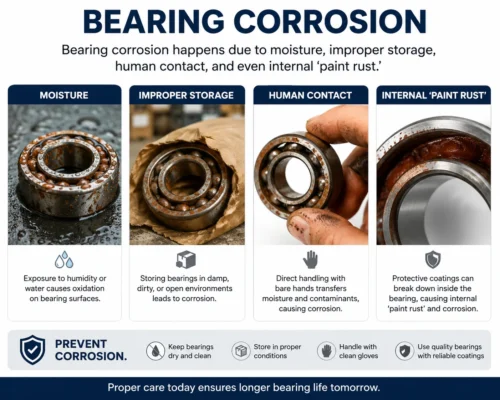
Bearing corrosion happens due to moisture, improper storage, human contact, and even internal 'paint rust.' You can prevent it by controlling the environment, using good seals, and proper lubrication. Always replace bearings with significant rust for critical applications.
Here at Yuanguang Bearing, we have seen rust destroy many bearings since 1992. It is like a cancer for your machines. I want to share what we know about how to fight it. We will look at what causes it, how bad it can get, and what you can do.
Why Do Bearings Rust? Common Causes of Bearing Corrosion?
Are you seeing rust on your bearings? This problem can lead to big costs. It happens for a few key reasons.
The first paragraph, which uses the PAS strategy to grab the reader's attention (max 30 words).
Bearings rust because of high humidity, water getting in, bad storage, sweat from hands, and even special gases from motor insulation.1 These factors all help corrosion start and spread.
From our many years at Yuanguang Bearing, I have learned that rust on bearings is not just bad luck. It has clear causes. We often find four main culprits behind this "cancer" for bearings. Knowing these helps us fight the problem better.
What are the main reasons bearings rust?
- Environmental Attack: This is the most common reason we see. Bearings face high humidity in the air. Water can get inside if seals fail. Also, industrial areas often have harmful gases like sulfur dioxide (SO₂) or hydrogen sulfide (H₂S). These gases make bearings rust much faster.2 They act like tiny, hidden enemies, always attacking the metal.
- Bad Storage: How you store bearings matters a lot. If your warehouse is too hot or too humid (over 60% relative humidity), rust can start even before you use the bearings.3 Also, if the bearing's packaging gets broken or it cannot breathe, moisture can get trapped. This means the bearing might be rusting while it just sits on the shelf, waiting.
- Human Mistakes: Sometimes, we cause the rust ourselves. When people install or maintain bearings, their hands can touch the metal. Sweat on our hands has salt and acid. These chemicals react fast with the metal surface. This causes corrosion to start right away.4 That is why I always tell our teams to wear gloves.
- Internal 'Paint Rust': This one is often missed. It happens a lot in electric motors. The insulating paint on motor windings can release acid gases. The grease inside the bearing then absorbs these gases. This makes the grease go bad and turn acidic.5 Then, the acid from the grease corrodes the bearing from the inside. We see this as unique stripe-like rust patterns. It is a hidden danger.
These four points show us that rust comes from many directions. We must look at all of them to keep bearings safe.
Different Types of Bearing Corrosion You Should Know?
Do you think all rust is the same? For bearings, it is not. Different types mean different issues.
Bearing corrosion can appear as general surface rust, pitting, or even 'paint rust' stripes.6 Each type shows a different way the metal is being attacked and how deeply it might be damaged.
When I talk about bearing rust at Yuanguang Bearing, it is not just one thing. Rust on a bearing is often called "cancer" because it destroys the precision surfaces. Once rust starts, the bearing's perfect surface is gone forever. Its performance drops quickly. Under a microscope, rusted bearing raceways and rolling elements show tiny pits and lines. These damages cause three critical problems.
How Different Rust Types Harm Bearings
We can categorize the damage rust causes:
| Type of Corrosion | Appearance | Primary Impact | Secondary Effects |
|---|---|---|---|
| Surface Rust | Reddish-brown film | Breaks down the oil film | Leads to metal-on-metal contact, friction, heat |
| Pitting Corrosion | Small, deep holes | Causes direct metal loss | Creates stress points, accelerates fatigue |
| Fretting Corrosion | Reddish-brown debris at contact points | Leads to material transfer, surface wear | Damages tight fits, increases looseness |
| 'Paint Rust' (Acidic Corrosion) | Stripe-like patterns, internal | Degrades lubricant, attacks metal from inside | Reduces bearing life, early failure |
Let me explain these impacts more clearly.
- Destroys the oil film: Rust spots break through the protective film that grease or oil forms. This means metal parts rub directly against each other.7 This causes friction and heat. It is like trying to drive a car without engine oil.
- Speeds up wear: The small rust particles that break off act like sandpaper inside the bearing. They become an abrasive.8 This causes even more wear inside the bearing. The damage gets worse and worse.
- Creates fatigue points: Every rust spot is a place where stress builds up. This leads to metal fatigue. The surface starts to peel off too early. This makes the bearing fail much sooner than it should. We see bearings failing long before their design life because of rust.
Understanding these different ways rust attacks helps us to know what kind of damage we are dealing with. It also guides us in deciding if we can fix it or if we need to replace the bearing right away.
How Rust Affects Bearing Performance and Equipment Life?
Do you know how badly rust hurts your equipment? It is more than just an ugly stain. Rust damages performance in big ways.
Rust on bearings greatly reduces their lifespan, increases friction, creates noise, and causes costly equipment downtime. It makes machines work harder and often leads to early failure, impacting your whole operation.
Rust on bearings is not just a surface problem. It is a deep issue that cuts into the very heart of a machine's efficiency. At Yuanguang Bearing, I have seen firsthand how minor rust spots turn into major breakdowns. The cost is not just a new bearing; it is lost production, repair time, and even damage to other parts of the machine.
The Chain Reaction of Rust Damage
Rust creates a chain reaction of negative effects:
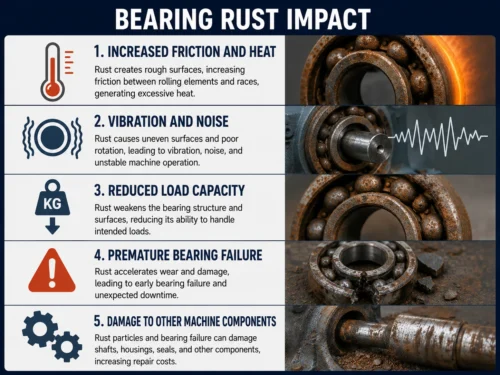
- Increased Friction and Heat: When rust damages the smooth surfaces of the raceways and rolling elements, it creates roughness. This roughness makes parts rub together more, leading to higher friction. More friction means more heat. Excessive heat can then break down the lubricant faster, which only makes the rust problem worse. It also puts more stress on the bearing itself.
- Vibration and Noise: A rusted bearing cannot run smoothly. The pits and uneven surfaces cause the rolling elements to vibrate as they pass over them. This vibration creates extra noise. If you hear a grinding or rough sound from your equipment, rust could be a major cause. This noise and vibration also put stress on other machine parts.
- Reduced Load Capacity: A bearing is designed to handle a certain amount of weight or force. Rust reduces the effective contact area between the rolling elements and the raceway. This means the bearing cannot carry as much load as it should. It becomes weaker. If you try to run it at its normal load, it will fail even faster.
- Premature Failure: All the points above lead to one main outcome: early failure. Rust acts as a stress concentrator. This means it creates weak points where cracks can start.9 These cracks spread quickly, leading to fatigue and then total failure. The bearing dies long before its expected life. This can lead to sudden machine stoppages, which are very expensive for businesses.
- Damage to Other Components: A failing bearing does not just die alone. The increased vibration can loosen bolts, damage shafts, or even hurt other adjacent bearings. The small rust particles or metal fragments from a failing bearing can spread to other parts, causing more problems. So, rust in one bearing can lead to a domino effect of damage throughout your equipment.
From our long experience, I can tell you that the cost of preventing rust is always much lower than the cost of dealing with its damage. We should always try to stop rust before it starts.
How to Prevent Bearings from Rusting?
Do you want to stop rust before it starts? Prevention is always better than repair. It saves you money and trouble.
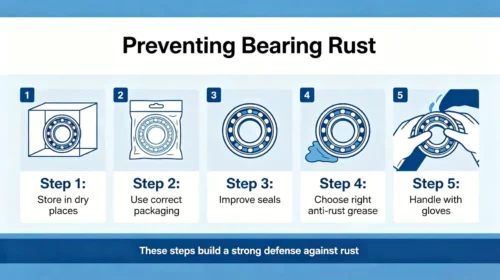
To prevent bearings from rusting, you should store them properly in dry places, use correct packaging, improve seals, choose the right anti-rust grease, and handle them with gloves. These steps build a strong defense.
At Yuanguang Bearing, we always say that "prevention is better than cure." The cost of stopping rust is much less than replacing bearings and dealing with machine downtime. We have built a full anti-rust plan for our customers over the years. It is like building a strong "anti-rust wall" around your bearings. Here are the key steps I recommend.
Building Your Anti-Rust Wall
We follow a few important steps to keep rust away:
- Make Storage Better: Bearings need to be kept in a clean, dry place. The temperature should be between 10-25°C. The air humidity must be lower than 60%. This controlled environment stops moisture from attacking the metal surfaces. It is crucial for long-term storage.
- Use Good Packaging: Unused bearings should stay in their original, sealed packaging. If you open a bearing or need to store it for a long time, wrap it in Vapor Corrosion Inhibitor (VCI) paper. Then, put it in a sealed plastic bag. VCI paper releases special chemicals that stop rust from forming.10 This protects the bearing even when it is not being used.
- Improve Seals: For wet or dusty conditions, you need better seals. Upgrade your bearing's seal structure. For example, use double-lip seals or add deflector rings. These extra seals block water and dirt from getting into the bearing. This is very important in places where water spray or high humidity is common.
- Use the Right Lubricant: Not all greases are the same. Choose lubricants that have excellent anti-rust properties. Also, make sure to add or change the grease regularly, based on how the machine is used. If your motor has a risk of 'paint rust,' use special grease that can neutralize acids. This kind of grease actively fights the internal corrosion problem.
- Correct Handling: When you pick up a bearing, always wear gloves. This stops sweat from your hands from touching the bearing. As I mentioned, sweat has salt and acid that can quickly start rust. This simple step can save a lot of trouble. Make it a rule for everyone who handles bearings.
- Regular Checks: Even with all these steps, regular checks are important. Look for any signs of rust early. Early detection means you can fix the problem before it gets too bad. This proactive approach saves your bearings and your machines in the long run.
By following these methods, you can greatly extend the life of your bearings. You can also make your equipment run more reliably. It is a small effort for a big reward.
Can Rusted Bearings Be Repaired or Should They Be Replaced?
Do you have a rusted bearing? You might wonder if you can save it. This is a common question, and the answer depends.
For slightly rusted, non-critical bearings, mechanical cleaning or chemical rust removal might help. However, for precision, high-speed, or critical equipment, if you see any significant pitting, it is always safer and more cost-effective to replace the bearing.
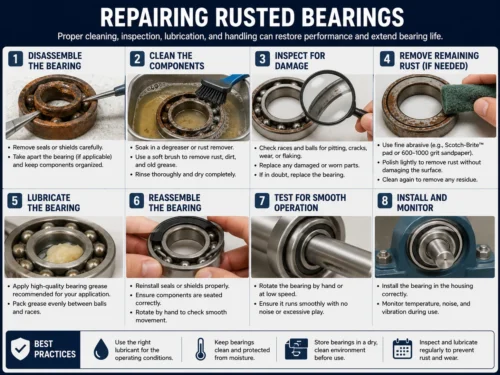
When a bearing has rust, I often hear people ask, "Can I fix it?" My answer at Yuanguang Bearing is always, "It depends." Repairing rust is like a "fix," not a "return to new." The goal is to bring back basic function, not to make it perfect again. For me, repairing a rusted bearing is the last step before replacement.
Repair Methods: When and How?
We usually look at two ways to remove rust:
Mechanical Rust Removal: For Light Surface Rust
- How it works: This is for very light surface rust, like a thin film. You use a very fine abrasive cloth (like 600-grit or 000-grade sandpaper) or a fine grinding paste. Gently rub the rusted area until it feels smooth to touch.
- Important warnings:
- Only use this method for light surface rust on parts that are not the main working surfaces.
- Never rub hard on the precise raceways or rolling elements. You will ruin their exact size and smooth finish. This will cause more harm than good.
- After cleaning, wash the bearing completely with pure alcohol. Then, put anti-rust oil on it right away.
Chemical Rust Removal: A Deeper Clean, But More Complex
- How it works: This is a more complete process, but it is also much harder. You must follow steps carefully. It uses special chemical liquids (often with phosphoric acid) that react with the rust (metal oxides). These liquids dissolve the rust and wash it away. Then, another chemical helps create a protective film on the clean metal surface.
- Standard Steps:
- Clean and remove oil: First, use a solvent to clean all grease and oil from the bearing surface. If you do not, the rust-removing liquid will not touch the rust.
- Chemical rust removal: Dip the bearing into the special liquid. How long it stays depends on how bad the rust is.
- Rinse with water: Wash off all the rust-removing liquid and rust pieces with running water.
- Neutralize: Put the bearing in a neutralizing liquid. This makes sure all the acid from the rust remover is gone. This stops new rust from starting.
- Passivation: Dip the bearing in a passivation liquid. This creates a thin, strong protective layer on the metal. It helps prevent rust for a short time.
- Dry and seal with oil: Dry the bearing fully with hot air or in an oven. Then, immediately dip it in anti-rust oil to store it safely.
- Very Important Warnings:
- Chemical rust removers often contain acids. Always wear protective gear when using them.
- Never use strong acids like sulfuric acid or hydrochloric acid. They will seriously damage the bearing metal.
- You cannot use this method on sealed bearings. The chemicals will get trapped inside or damage the seals.
Ultimately, rust removal is a last resort. For precision machines, high-speed use, or critical parts, if you see clear rust (especially pitting on raceways), the safest and most economical choice is always to replace the bearing immediately. We believe in caution here at Yuanguang Bearing.
Best Bearings for Humid, Washdown, and Corrosive Environments?
Are your bearings failing in tough conditions? If you work in wet or corrosive places, standard bearings might not be enough.
For humid, washdown, or corrosive environments, you need special bearings like those made from stainless steel or ceramics. These materials offer superior resistance to rust and chemicals, extending bearing life in harsh settings.
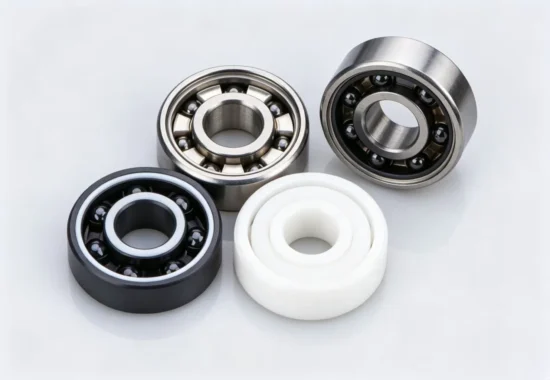
Here at Yuanguang Bearing, we understand that not all work environments are the same. Many of our customers operate in places where humidity is high, equipment needs regular washdowns, or corrosive chemicals are present. In these tough conditions, standard carbon steel bearings just will not last. They will quickly fall victim to rust. That is why we offer specialized solutions.
What are Your Best Options?
When you face these difficult environments, we recommend specific bearing types. These are designed to fight against corrosion and last longer:
1. Stainless Steel Bearings
- Why they are good: Stainless steel has chromium in it. This creates a protective layer that resists rust and many chemicals.11 We use high-quality stainless steel for our pillow block bearing housings and other types of bearings. They are much better than regular steel in wet conditions.
- Typical Uses:
- Food and beverage processing plants (where washdowns are common)
- Medical equipment
- Marine applications
- Areas with high humidity
- Our Products: You can find more details about our stainless steel pillow block bearings on our website: https://ihgybearing.com/stainless-steel-pillow-block-bearing/ These are designed to resist rust and last longer in wet places.
2. Ceramic Bearings
- Why they are good: Ceramic materials, like silicon nitride (Si3N4) or zirconia (ZrO2), do not rust at all. They are completely non-corrosive.12 They are also much harder and lighter than steel. This makes them great for very extreme conditions.
- Typical Uses:
- Chemical processing
- High-temperature applications
- Environments with very strong acids or bases
- Medical and food industries where purity is key
- Our Products: We also offer ceramic bearings. You can learn more about them here: https://ihgybearing.com/products/ceramic-bearings/ These are the top choice when you need absolute corrosion resistance.
3. Bearings with Special Coatings
- Why they are good: Sometimes, a regular bearing can get a special coating on its surface. This coating acts as a barrier against moisture and chemicals. These coatings can be very effective for specific needs.
- Typical Uses:
- Less severe corrosive environments
- When the cost of full stainless steel or ceramic is too high
- For specific chemical exposures
When choosing, always consider the exact conditions your bearing will face. Think about the level of humidity, what chemicals might be present, and how often washdowns happen. My team and I at Yuanguang Bearing can help you pick the best bearing for your specific needs. It is important to invest in the right materials to ensure long-term reliability and avoid costly failures.
Conclusion
Rust is a serious enemy for bearings, causing big problems and early failures. But you can fight it. By preventing rust through good storage and proper care, or by choosing special materials like stainless steel or ceramic, you can keep your machines running smoothly.
"The Causes Of Bearing Corrosion - Minghe Casting", https://www.diecastingcompany.com/helpful-articles/the-causes-of-bearing-corrosion. A technical bearing-failure or tribology source should support that moisture, water contamination, corrosive atmospheres, poor storage, and handling residues are recognized causes of bearing corrosion; evidence for motor-insulation gases may be more specialized and should be treated as contextual unless the source directly addresses electric-motor bearings. Evidence role: general_support; source type: paper. Supports: Common bearing-corrosion causes include moisture, water contamination, corrosive environments, handling contamination, storage conditions, and, in electric motors, chemically aggressive vapors or lubricant degradation.. Scope note: The source may support the general corrosion causes more directly than the specific motor-insulation-gas mechanism. ↩
"Atmospheric corrosion and impact toughness of steels: Case study ...", https://pmc.ncbi.nlm.nih.gov/articles/PMC10362324/. Corrosion-engineering literature identifies sulfur dioxide and hydrogen sulfide as atmospheric pollutants that promote steel corrosion, especially when moisture is present; this supports the article’s statement as a general mechanism rather than as a bearing-specific performance test. Evidence role: mechanism; source type: paper. Supports: SO2 and H2S are corrosive atmospheric pollutants that can accelerate corrosion of steels under humid industrial conditions.. Scope note: The evidence may concern steels generally, not bearing steels under all operating conditions. ↩
"Storage for super precision bearings - SKF", https://www.skf.com/us/products/super-precision-bearings/principles/general-bearing-knowledge/storage. Bearing-storage guidance from technical institutions or standards-based sources commonly recommends dry storage and relative humidity control, often around or below 60%, to reduce corrosion risk before installation. Evidence role: expert_consensus; source type: institution. Supports: Bearing storage recommendations commonly specify dry storage and often set a maximum relative humidity near 60% to reduce corrosion risk.. Scope note: The exact humidity threshold can vary by packaging, preservative oil, steel grade, and storage duration. ↩
"The Corrosion of Metal by Palmar Sweat - PMC", https://pmc.ncbi.nlm.nih.gov/articles/PMC1037804/. Studies of fingerprint or perspiration corrosion show that residues from human handling contain chloride salts and acidic compounds capable of promoting localized corrosion on steel surfaces; this supports glove use when handling precision bearings. Evidence role: mechanism; source type: paper. Supports: Human sweat and fingerprints contain chloride salts and organic acids that can promote localized corrosion on metal surfaces.. Scope note: The rate of corrosion depends on humidity, surface finish, alloy composition, and whether protective oil is present. ↩
"Improving Electric Motor Lubrication Policies", https://www.machinerylubrication.com/Read/28373/grease-lubrication-motors-bearings. A tribology or electric-motor reliability source should document that acidic volatiles or chemical byproducts associated with winding insulation can be absorbed into grease and contribute to internal bearing corrosion; without such a source, the claim should be presented as a known but specialized failure mode. Evidence role: mechanism; source type: paper. Supports: Some electric-motor bearing corrosion can be associated with acidic volatiles or byproducts from insulation systems that affect lubricant chemistry.. Scope note: This mechanism is application-specific and may not apply to all electric motors, insulation systems, or grease formulations. ↩
"Fretting - Wikipedia", https://en.wikipedia.org/wiki/Fretting. Bearing-damage reference materials describe corrosion-related damage by observable features such as surface rust, pitting, fretting debris, and patterned raceway marks, supporting the article’s visual classification of corrosion types. Evidence role: definition; source type: institution. Supports: Bearing-damage references classify corrosion-related bearing damage by appearance, including surface corrosion, pitting, fretting corrosion, and patterned corrosion.. Scope note: The term “paint rust” is not universally standardized and may need a source that uses the same terminology or describes the same pattern under a different name. ↩
"In-situ Generated Tribomaterial in Metal/Metal Contacts - PMC - NIH", https://pmc.ncbi.nlm.nih.gov/articles/PMC5553974/. Tribology literature explains that corrosion pits and roughened surfaces reduce the effectiveness of lubricating films and increase asperity or metal-to-metal contact in rolling bearings. Evidence role: mechanism; source type: paper. Supports: Corrosion and surface roughness can impair elastohydrodynamic lubrication and increase asperity contact between bearing surfaces.. Scope note: The degree of film disruption depends on lubricant viscosity, speed, load, surface roughness, and operating temperature. ↩
"(PDF) Abrasive Wear of Rolling Bearings by Lubricant Borne Particles", https://www.researchgate.net/publication/245388724_Abrasive_Wear_of_Rolling_Bearings_by_Lubricant_Borne_Particles. Wear and lubrication studies show that particulate contaminants, including corrosion products, can produce abrasive wear in rolling contacts, supporting the article’s description of rust debris as an abrasive contaminant. Evidence role: mechanism; source type: paper. Supports: Hard particles or corrosion debris in a bearing lubricant can cause abrasive wear of rolling elements and raceways.. Scope note: The abrasiveness depends on particle hardness, size, concentration, and whether filtration or relubrication removes the debris. ↩
"Rolling contact fatigue - Wikipedia", https://en.wikipedia.org/wiki/Rolling_contact_fatigue. Materials-fatigue literature shows that corrosion pits act as stress concentrators and can initiate fatigue cracks under cyclic loading, providing a mechanistic basis for corrosion-related premature bearing failure. Evidence role: mechanism; source type: paper. Supports: Corrosion pits create local stress concentrations that can initiate fatigue cracks under cyclic loading.. Scope note: The source may address metals generally; bearing-specific confirmation is stronger when the study involves rolling-contact fatigue. ↩
"Volatile corrosion inhibitor - Wikipedia", https://en.wikipedia.org/wiki/Volatile_corrosion_inhibitor. Corrosion-prevention literature describes VCI packaging as releasing volatile inhibitor molecules that adsorb onto metal surfaces and suppress corrosion in enclosed packages. Evidence role: mechanism; source type: paper. Supports: Vapor corrosion inhibitor packaging emits volatile inhibitor compounds that adsorb on metal surfaces and reduce corrosion in enclosed spaces.. Scope note: VCI effectiveness depends on enclosure integrity, inhibitor chemistry, metal type, humidity, and storage duration. ↩
"Stainless steel - Wikipedia", https://en.wikipedia.org/wiki/Stainless_steel. Metallurgical references explain that stainless steels contain chromium, which forms a thin passive chromium-oxide film that improves resistance to rust and many corrosive media. Evidence role: mechanism; source type: encyclopedia. Supports: Stainless steel’s corrosion resistance comes largely from chromium forming a thin passive chromium-oxide film.. Scope note: Resistance varies by stainless-steel grade and environment, especially in chloride-rich or acidic conditions. ↩
"Crystallinity Influence on Mechanical Properties and Oxidation ...", https://pmc.ncbi.nlm.nih.gov/articles/PMC12713459/. Materials-science sources describe silicon nitride and zirconia as non-ferrous ceramics that do not undergo iron rusting and generally provide high corrosion resistance compared with steels. Evidence role: general_support; source type: education. Supports: Silicon nitride and zirconia ceramics are non-ferrous materials that do not form iron rust and generally offer high corrosion resistance compared with bearing steel.. Scope note: The stronger claim that ceramics are “completely non-corrosive” should be qualified because ceramics can degrade in certain chemical, thermal, or hydrothermal environments. ↩